
We read your photo as:
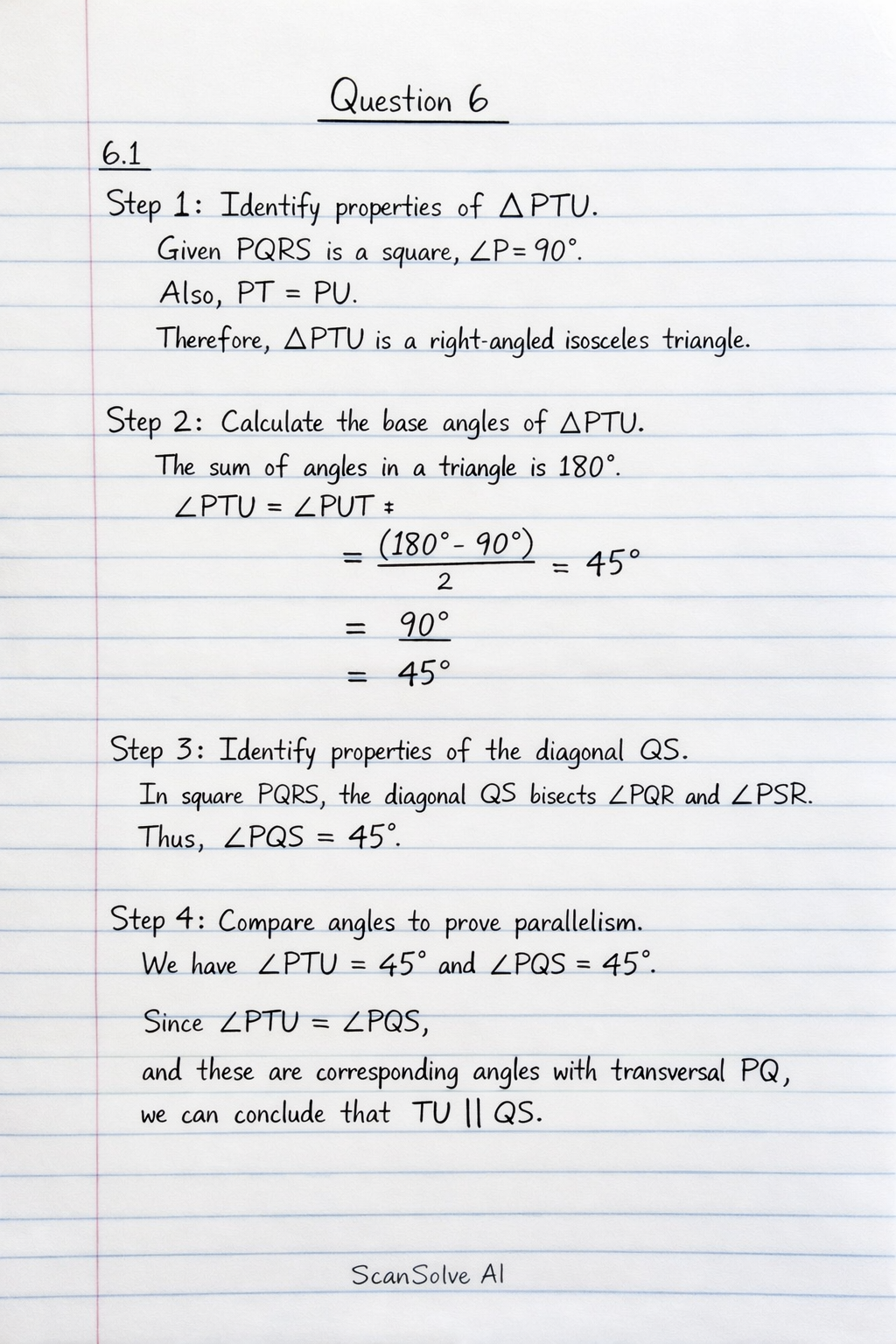
Given that PQRS is a square, P = 90^. It is also given that PT = PU.
ScanSolve AI Answer
Answers
2 partsStep-by-step solution
8 stepsPart 6
Part 6.1· 4 steps
Identify properties of .
Given that is a square, . It is also given that .
Therefore, is a right-angled isosceles triangle.Calculate the base angles of .
The sum of angles in a triangle is .
Identify properties of the diagonal .
In a square , the diagonal bisects and . Thus, .
Compare angles to prove parallelism.
We have and .
Since , and these are corresponding angles with transversal , we can conclude that .
Part 6.2
Identify the dimensions of .
Given units. Since is a square, units.
is a right-angled triangle at .Calculate the area of .
The area of a right-angled triangle is .
Part 6.3
Prove that is a right-angled isosceles triangle.
Since is a square, all its sides are equal in length () and all its interior angles are ().
Therefore, has two equal sides ( and ) and one right angle (), which means it is a right-angled isosceles triangle.Determine the length of .
Using the Pythagorean theorem in :
Since units (from the properties of a square and the given information in 6.2):
Try one yourself
A new problem that tests the same skill.
Still stuck on this one?
Ask a follow-up, and the answer starts from this question.
More Mathematics Questions
Handwritten Step-by-Step Solution
Get this as a handwritten image on WhatsApp — like a tutor wrote it for you.
Try on WhatsApp