
We read your photo as:
Given that Sn = 2n2 − 3n, find S6.
ScanSolve AI Answer
Answer
Step-by-step solution
9 stepsOkay Austino, let's tackle these.
17.
Substitute into the given formula for .
The formula is .
We need to find .Calculate the value.
The value of is 54.
The correct option is B.
18.
Define variables and set up the probability equation.
Let the number of green balls be .
Let the number of red balls be .
The total number of balls is .
The probability of selecting a red ball is .
Given that .
So, we have the equation:Solve the equation for .
Cross-multiply:
Subtract from both sides:
Divide by 2:
There are 30 red balls.
Calculate the total number of balls in the bag.
Total balls .
There are 50 balls in the bag.
The correct option is B.
19.
Write expressions for the terms of the Arithmetic Progression.
The first term is .
The -th term of an AP is given by , where is the common difference.
The third term is .
The fifth term is .Use the given condition to form an equation.
The fifth term is four-fifth of the third term:
Substitute the expressions for and into the equation.
Substitute and solve for .
Multiply both sides by 5 to eliminate the fraction:
Subtract from both sides:
Subtract 100 from both sides:
Divide by 12:
Simplify the fraction by dividing both numerator and denominator by their greatest common divisor, which is 4:
The common difference is .
The correct option is C.
Try one yourself
A new problem that tests the same skill.
Still stuck on this one?
Ask a follow-up, and the answer starts from this question.
More Mathematics Questions
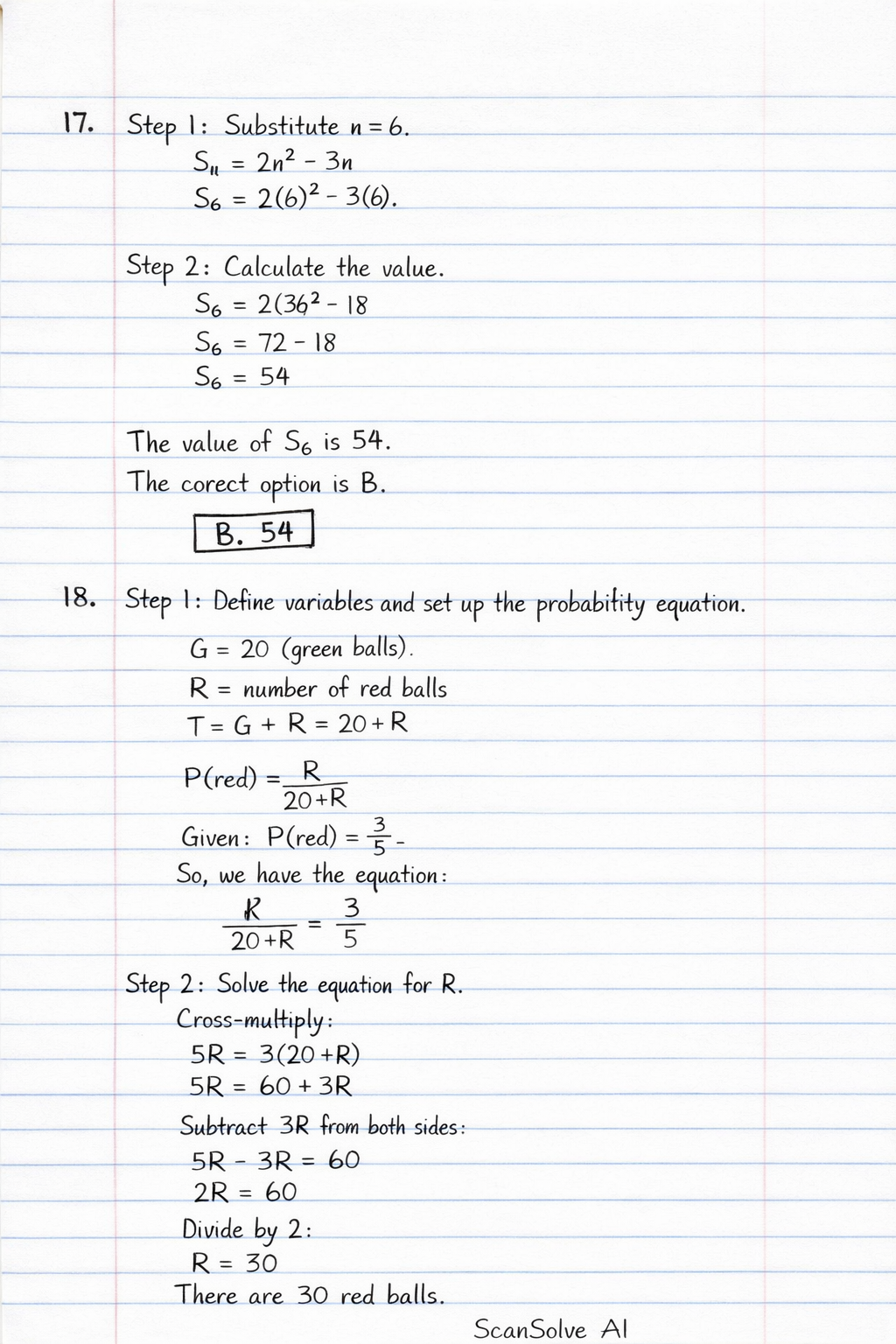
Handwritten Step-by-Step Solution
Get this as a handwritten image on WhatsApp — like a tutor wrote it for you.
Try on WhatsApp