
We read your photo as:
Given that the vectors (t, 4, 2t + 1) and (t + 2, 1 - t, -1) are perpendicular, find the possible values of the constant t.
Mathematics
ScanSolve AI Answer
Answer
Step-by-step solution
5 stepsFor two vectors to be perpendicular, their dot product must be zero.
Let the given vectors be and .
The dot product is calculated as:
Expand the terms in the equation.
Combine like terms to simplify the equation into a quadratic form.
Solve the quadratic equation for .
We can factor the quadratic equation. We need two numbers that multiply to 3 and add to -4. These numbers are -1 and -3.
Set each factor equal to zero to find the possible values of .
The possible values for are 1 and 3.
The possible values of the constant are .
Was this helpful?
Try one yourself
A new problem that tests the same skill.
Still stuck on this one?
Ask a follow-up, and the answer starts from this question.
Got a different question?Ask your own question
More Mathematics Questions
QFind the value t such that vectors a = 2i − 5j + k and b = −3i + tj - 7k are perpendicular (a.b = 0)QSolve the equation t4 + 4t3 - 6t2 - 4t + 1 = 0.QFind the equation of tangent and normal to the curve x=4t−1, y=2t2 at the point where t=1.QIf the vectors (6, 4) and (3, m) are perpendicular, what is the value of m?QSolve the equation (4t)/(9) − 5 = 3 for t and identify the correct option.
Browse by topic:Linear Algebra
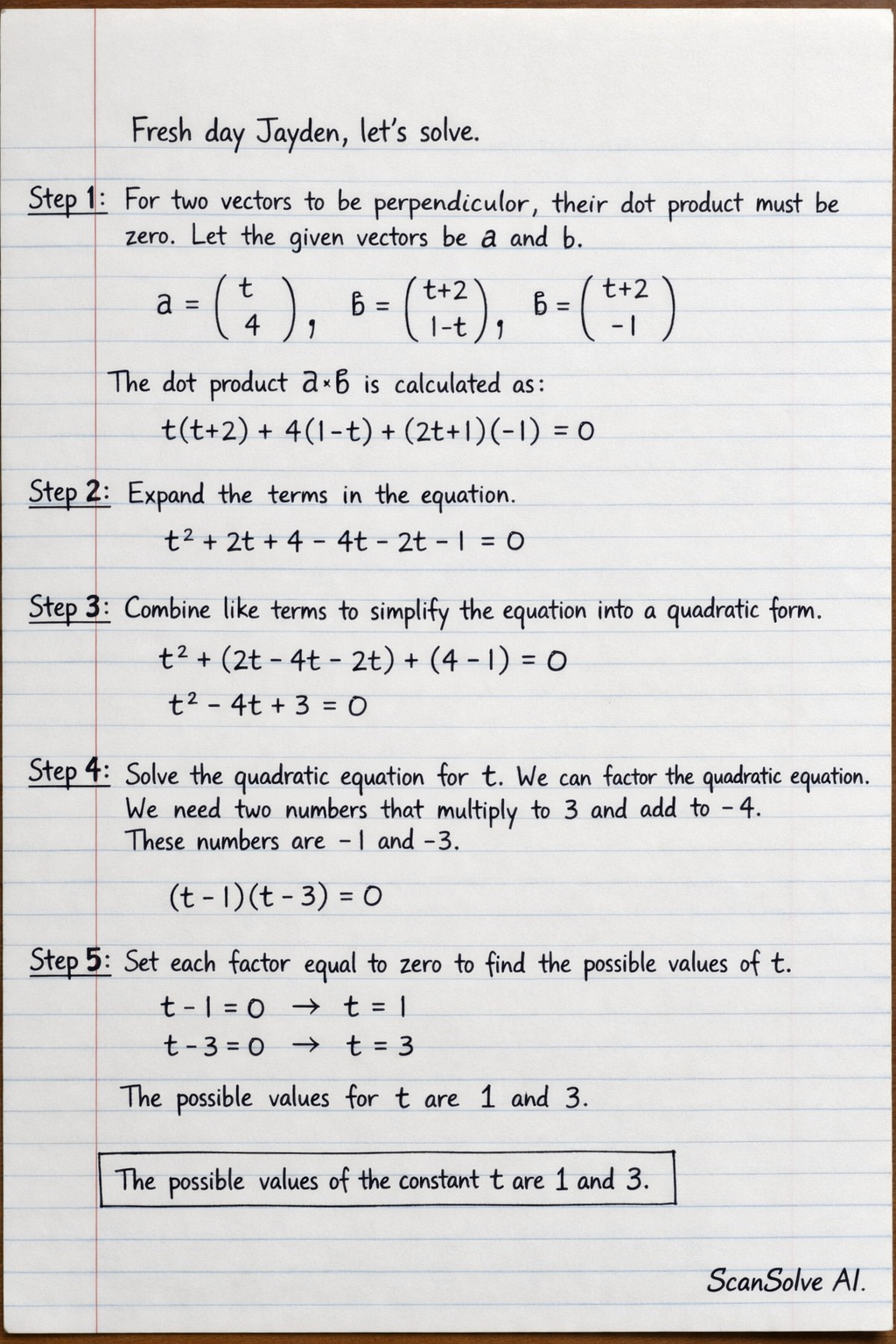
Handwritten Step-by-Step Solution
Get this as a handwritten image on WhatsApp — like a tutor wrote it for you.
Try on WhatsApp