ScanSolve logoScanSolve
Toggle sidebar
  • Homework
  • Tutor
  • Humanizer
  • AI Detector
  • Questions
  • Blog
  • History
  • Mobile App

  • Homework
  • Tutor
  • Humanizer
  • AI Detector

  • Questions
  • Math homework helpMath
    Physics homework helpPhysics
    Chemistry homework helpChemistry
    Biology homework helpBiology
    Computer Science homework helpComputer Science
    History homework helpHistory
    More homework helpMore
  • Blog
  • History

  • Mobile App
ScanSolvePLUS
  • Unlimited answers
  • ScanSolve AI Pro
Start Free Trial →
Try on WhatsApp
Home > Mathematics Homework Help > Solution

Given that (x-1) is a factor of f(x) = ax^4 + x^3 - 12x^2 - x + 2, by the Factor Theorem, f(1) = 0.

Asked on March 27, 2026|Mathematics

This mathematics problem involves applying core mathematical principles and formulas. Below you will find a complete step-by-step solution with detailed explanations for each step, helping you understand not just the answer but the method behind it.

ScanSolve AI AnswerAnswered on March 27, 2026
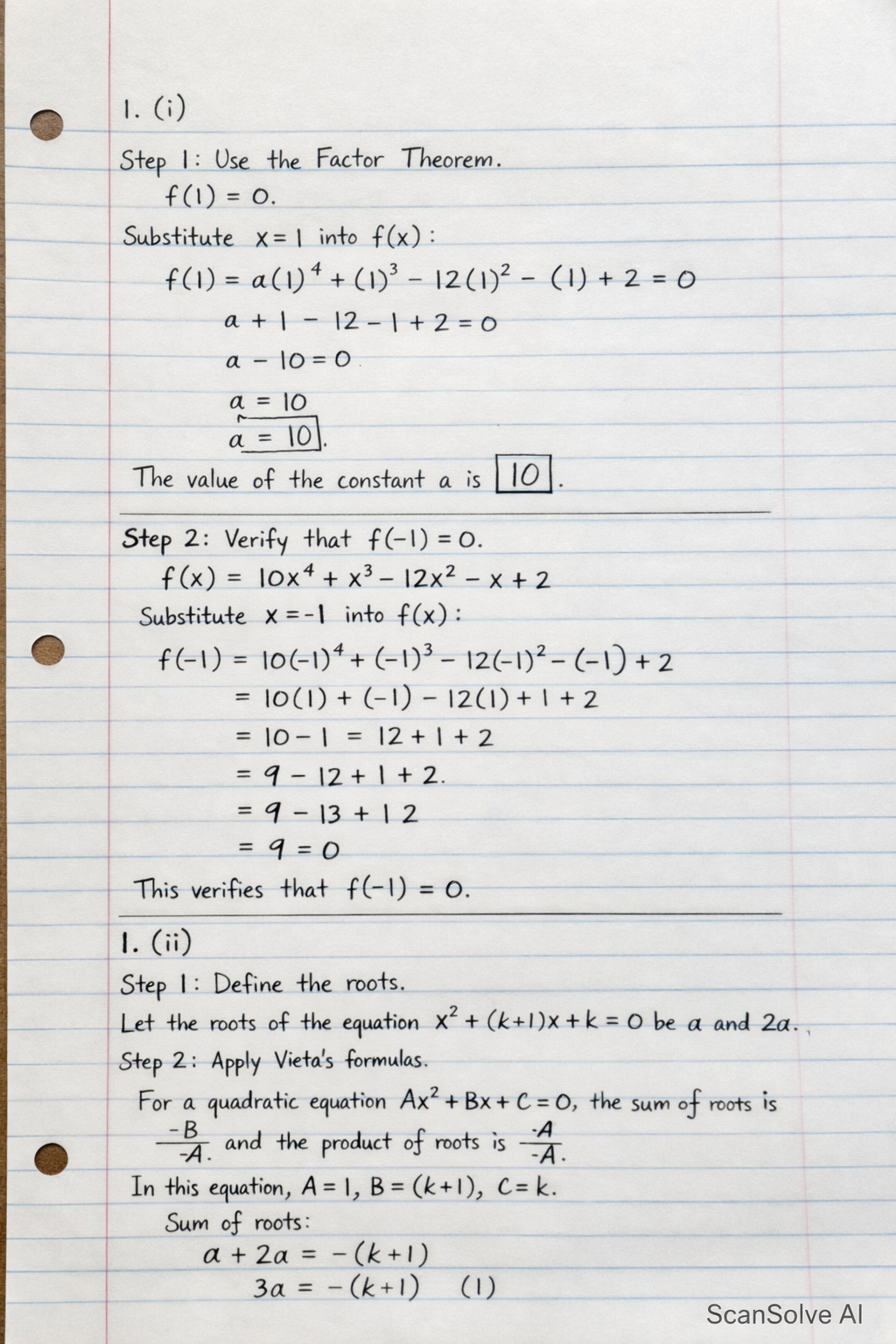
1. (i) Step 1: Use the Factor Theorem. Given that $(x-1)$ is a factor of $f(x) = ax^4 + x^3 - 12x^2 - x + 2$, by the Factor Theorem, $f(1) = 0$. Substitute $x=1$ into $f(x)$: $$f(1) = a(1)^4 + (1)^3 - 12(1)^2 - (1) + 2 = 0$$ $$a + 1 - 12 - 1 + 2 = 0$$ $$a - 10 = 0$$ $$a = 10$$ The value of the constant $a$ is $\boxed{10}$. Step 2: Verify that $f(-1) = 0$. Now, substitute $a=10$ into $f(x)$, so $f(x) = 10x^4 + x^3 - 12x^2 - x + 2$. Substitute $x=-1$ into $f(x)$: $$f(-1) = 10(-1)^4 + (-1)^3 - 12(-1)^2 - (-1) + 2$$ $$f(-1) = 10(1) + (-1) - 12(1) + 1 + 2$$ $$f(-1) = 10 - 1 - 12 + 1 + 2$$ $$f(-1) = 9 - 12 + 1 + 2$$ $$f(-1) = -3 + 1 + 2$$ $$f(-1) = 0$$ This verifies that $f(-1) = 0$. 1. (ii) Step 1: Define the roots. Let the roots of the equation $x^2 + (k+1)x + k = 0$ be $\alpha$ and $2\alpha$. Step 2: Apply Vieta's formulas. For a quadratic equation $Ax^2 + Bx + C = 0$, the sum of roots is $-\frac{B}{A}$ and the product of roots is $\frac{C}{A}$. In this equation, $A=1$, $B=(k+1)$, $C=k$. Sum of roots: $$\alpha + 2\alpha = -(k+1)$$ $$3\alpha = -(k+1) \quad (1)$$ Product of roots: $$\alpha \cdot 2\alpha = k$$ $$2\alpha^2 = k \quad (2)$$ Step 3: Solve the system of equations for $k$. From equation (1), express $\alpha$ in terms of $k$: $$\alpha = -\frac{k+1}{3}$$ Substitute this expression for $\alpha$ into equation (2): $$2\left(-\frac{k+1}{3}\right)^2 = k$$ $$2\frac{(k+1)^2}{9} = k$$ $$2(k^2 + 2k + 1) = 9k$$ $$2k^2 + 4k + 2 = 9k$$ $$2k^2 + 4k - 9k + 2 = 0$$ $$2k^2 - 5k + 2 = 0$$ Step 4: Solve the quadratic equation for $k$. Factor the quadratic equation: $$2k^2 - 4k - k + 2 = 0$$ $$2k(k - 2) - 1(k - 2) = 0$$ $$(2k - 1)(k - 2) = 0$$ This gives two possible values for $k$: $$2k - 1 = 0 \implies k = \frac{1}{2}$$ $$k - 2 = 0 \implies k = 2$$ The values of the constant $k$ are $\boxed{\frac{1}{2} \text{ and } 2}$.

Related Mathematics Questions

  • Simplify the numerator of the fraction.
  • Solve number 12-15
  • Solve number 9-11
  • Find the first three terms in ascending powers of y in the expansion of (1-y)^(1)/(2).
  • Find the binomial expansion of (x-2y)^3.
  • V_3 = 1.2\,A x 2
See all Mathematics questions

This step-by-step solution was generated by ScanSolve AI. Need help with more mathematics problems? Browse Mathematics solutions or ask your own question.

Home›Mathematics Homework Help›Given that (x-1) is a factor of f(x) = ax^4 + x^3 - 12x^2 -…
Q

Given that (x-1) is a factor of f(x) = ax^4 + x^3 - 12x^2 - x + 2, by the Factor Theorem, f(1) = 0.

March 27, 2026|Mathematics
Given that (x-1) is a factor of f(x) = ax^4 + x^3 - 12x^2 - x + 2, by the Factor Theorem, f(1) = 0.

Given that (x-1) is a factor of f(x) = ax^4 + x^3 - 12x^2 - x + 2, by the Factor Theorem, f(1) = 0.

ScanSolve AI

ScanSolve AI Answer

Answered on March 27, 2026

1. (i) Step 1: Use the Factor Theorem. Given that (x−1)(x-1)(x−1) is a factor of f(x)=ax4+x3−12x2−x+2f(x) = ax^4 + x^3 - 12x^2 - x + 2f(x)=ax4+x3−12x2−x+2, by the Factor Theorem, f(1)=0f(1) = 0f(1)=0. Substitute x=1x=1x=1 into f(x)f(x)f(x): f(1)=a(1)4+(1)3−12(1)2−(1)+2=0f(1) = a(1)^4 + (1)^3 - 12(1)^2 - (1) + 2 = 0f(1)=a(1)4+(1)3−12(1)2−(1)+2=0 a+1−12−1+2=0a + 1 - 12 - 1 + 2 = 0a+1−12−1+2=0 a−10=0a - 10 = 0a−10=0 a=10a = 10a=10 The value of the constant aaa is 10\boxed{10}10​.

Step 2: Verify that f(−1)=0f(-1) = 0f(−1)=0. Now, substitute a=10a=10a=10 into f(x)f(x)f(x), so f(x)=10x4+x3−12x2−x+2f(x) = 10x^4 + x^3 - 12x^2 - x + 2f(x)=10x4+x3−12x2−x+2. Substitute x=−1x=-1x=−1 into f(x)f(x)f(x): f(−1)=10(−1)4+(−1)3−12(−1)2−(−1)+2f(-1) = 10(-1)^4 + (-1)^3 - 12(-1)^2 - (-1) + 2f(−1)=10(−1)4+(−1)3−12(−1)2−(−1)+2 f(−1)=10(1)+(−1)−12(1)+1+2f(-1) = 10(1) + (-1) - 12(1) + 1 + 2f(−1)=10(1)+(−1)−12(1)+1+2 f(−1)=10−1−12+1+2f(-1) = 10 - 1 - 12 + 1 + 2f(−1)=10−1−12+1+2 f(−1)=9−12+1+2f(-1) = 9 - 12 + 1 + 2f(−1)=9−12+1+2 f(−1)=−3+1+2f(-1) = -3 + 1 + 2f(−1)=−3+1+2 f(−1)=0f(-1) = 0f(−1)=0 This verifies that f(−1)=0f(-1) = 0f(−1)=0.

1. (ii) Step 1: Define the roots. Let the roots of the equation x2+(k+1)x+k=0x^2 + (k+1)x + k = 0x2+(k+1)x+k=0 be α\alphaα and 2α2\alpha2α.

Step 2: Apply Vieta's formulas. For a quadratic equation Ax2+Bx+C=0Ax^2 + Bx + C = 0Ax2+Bx+C=0, the sum of roots is −BA-\frac{B}{A}−AB​ and the product of roots is CA\frac{C}{A}AC​. In this equation, A=1A=1A=1, B=(k+1)B=(k+1)B=(k+1), C=kC=kC=k.

Sum of roots: α+2α=−(k+1)\alpha + 2\alpha = -(k+1)α+2α=−(k+1) 3α=−(k+1)(1)3\alpha = -(k+1) \quad (1)3α=−(k+1)(1)

Product of roots: α⋅2α=k\alpha \cdot 2\alpha = kα⋅2α=k 2α2=k(2)2\alpha^2 = k \quad (2)2α2=k(2)

Step 3: Solve the system of equations for kkk. From equation (1), express α\alphaα in terms of kkk: α=−k+13\alpha = -\frac{k+1}{3}α=−3k+1​ Substitute this expression for α\alphaα into equation (2): 2(−k+13)2=k2\left(-\frac{k+1}{3}\right)^2 = k2(−3k+1​)2=k 2(k+1)29=k2\frac{(k+1)^2}{9} = k29(k+1)2​=k 2(k2+2k+1)=9k2(k^2 + 2k + 1) = 9k2(k2+2k+1)=9k 2k2+4k+2=9k2k^2 + 4k + 2 = 9k2k2+4k+2=9k 2k2+4k−9k+2=02k^2 + 4k - 9k + 2 = 02k2+4k−9k+2=0 2k2−5k+2=02k^2 - 5k + 2 = 02k2−5k+2=0

Step 4: Solve the quadratic equation for kkk. Factor the quadratic equation: 2k2−4k−k+2=02k^2 - 4k - k + 2 = 02k2−4k−k+2=0 2k(k−2)−1(k−2)=02k(k - 2) - 1(k - 2) = 02k(k−2)−1(k−2)=0 (2k−1)(k−2)=0(2k - 1)(k - 2) = 0(2k−1)(k−2)=0 This gives two possible values for kkk: 2k−1=0  ⟹  k=122k - 1 = 0 \implies k = \frac{1}{2}2k−1=0⟹k=21​ k−2=0  ⟹  k=2k - 2 = 0 \implies k = 2k−2=0⟹k=2 The values of the constant kkk are 12and2\boxed{\frac{1}{2} and 2}21​and2​.

Need help with your own homework?

Get instant step-by-step solutions to any question. Free to start.

Ask Your Question
Handwritten step-by-step solution

Handwritten Step-by-Step Solution

Get this solution as a handwritten image on WhatsApp — just like a tutor wrote it for you.

Try on WhatsApp

More Mathematics Questions

Simplify the numerator of the fraction.Solve number 12-15Solve number 9-11Find the first three terms in ascending powers of y in the expansion of (1-y)^(1)/(2).Find the binomial expansion of (x-2y)^3.V_3 = 1.2\,A x 2
See all Mathematicsquestions →