
We read your photo as:
Given the functions f: x -> 2x + 3 and g: x -> x - 1. (a) Find f(-2) (b) Find g⁻¹(x) (c) Find fg(x) (d) Find the value of x, for which f(x) = g(x). Using only a pencil, ruler and a pair of compasses,
ScanSolve AI Answer
Step-by-step solution
18 stepsHere are the solutions for the questions from the image:
Question No. 3
(i) Given the functions and .
So, and .
(a) Find
Substitute into the function .
The value of is .
(b) Find
Let , so .
Swap and to find the inverse relation.
Solve for to express .
The inverse function is .
(c) Find
Substitute into .
Replace in the expression for with .
The composite function is .
(d) Find the value of , for which
Set the expressions for and equal to each other.
Solve the equation for .
The value of is .
(ii) Using only a pencil, ruler and a pair of compasses,
(a) Draw the line PQ = 6cm
Draw a straight line segment and mark two points P and Q on it such that the distance between them is 6 cm.(b) Construct the perpendicular bisector of PQ to meet PQ at M
- Place the compass needle at P and open it to a radius greater than half the length of PQ. Draw arcs above and below the line segment PQ.
- Without changing the compass radius, place the needle at Q and draw arcs above and below PQ, intersecting the first set of arcs.
- Draw a straight line connecting the two points where the arcs intersect. This line is the perpendicular bisector of PQ.
- Mark the point where the perpendicular bisector intersects PQ as M.
(c) Draw the line PS = 5cm, where S is a point on the perpendicular bisector
- Place the compass needle at P and open it to a radius of 5 cm.
- Draw an arc that intersects the perpendicular bisector (constructed in part b).
- Mark the point of intersection on the perpendicular bisector as S.
- Draw a straight line segment connecting P and S. The length of PS will be 5 cm.
Question No. 4
(i) Given the function , for :
(a) Copy and complete the following table
Calculate for each given value of using the formula .
- For :
- For :
- For :
- For :
- For :
- For :
- For :
- For :
Complete the table with the calculated values.
-2 -1 0 1 2 3 4 5 6 0 -4 -6 -6 -4 0 6 (b) Find the minimum value of and the corresponding value of
The minimum value of a quadratic function occurs at .
For , we have and .
Substitute into to find the minimum value.
The minimum value of is at .
(c) Solve the equation
Set the function equal to 0.
Factor the quadratic equation.
Solve for .
The solutions for are .
(ii) Given a matrix, P defined by , where is a constant.
(a) Find P when
Substitute into the matrix P.
The matrix P when is .
(b) Hence or otherwise, find Adj. P, the adjoint of P.
For a matrix , its adjoint is given by .
Step 18
Still stuck on this one?
Ask a follow-up, and the answer starts from this question.
More Mathematics Questions
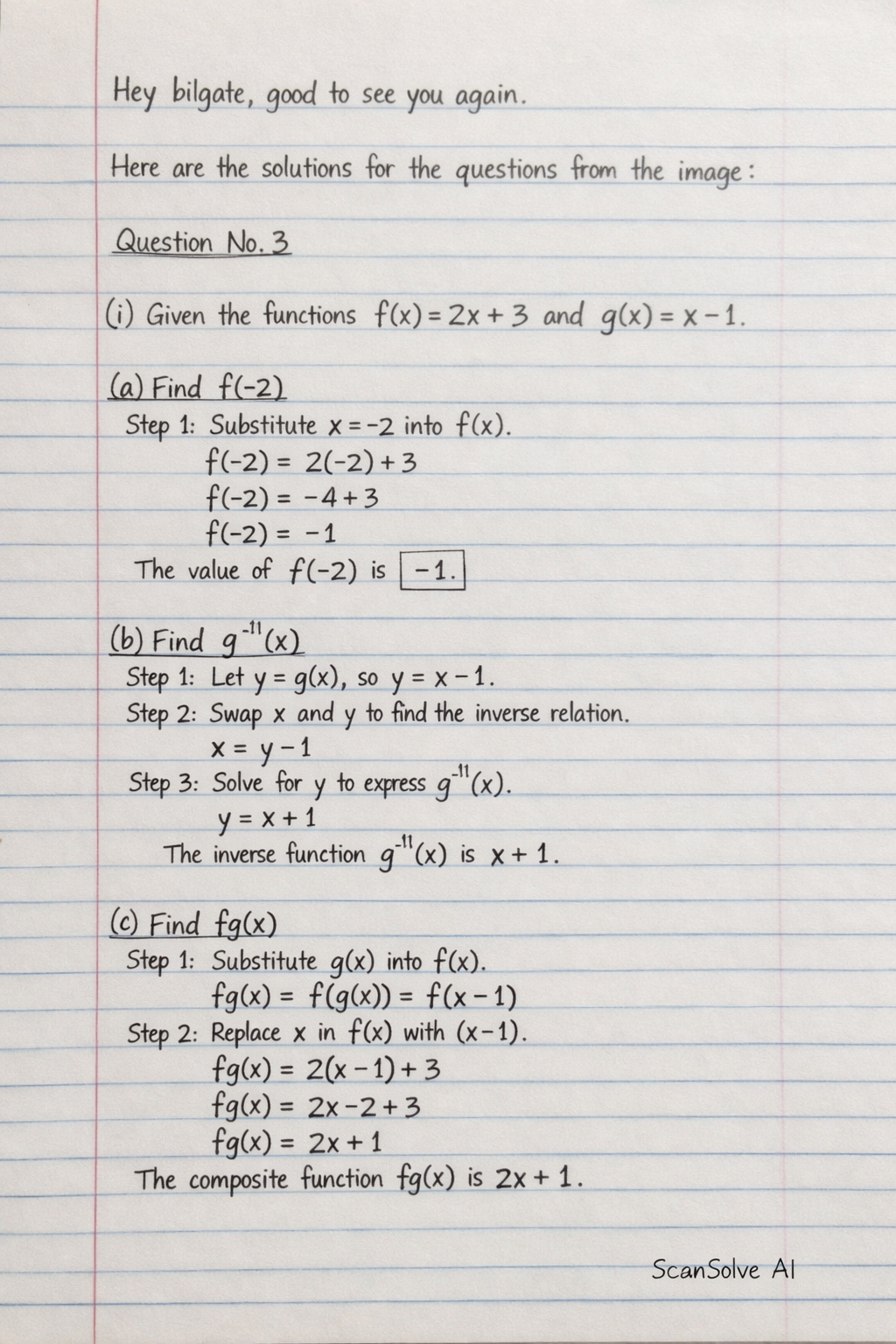
Handwritten Step-by-Step Solution
Get this as a handwritten image on WhatsApp — like a tutor wrote it for you.
Try on WhatsApp