
We read your photo as:
Given the functions f(x)=x2−2x−3 and g(x)=x−3, where x ∈ R. Determine the value(s) of x, for which: (a) f(x) > g(x) (b) f(x).g(x) 0
ScanSolve AI Answer
Answers
2 partsStep-by-step solution
10 steps1.2:
Given functions: and .
Part a· 5 steps
Determine the value(s) of for which .
Substitute the expressions for and into the inequality.
Rearrange the inequality to have 0 on one side.
Factor the quadratic expression.
Find the critical points by setting each factor to zero.
The critical points are and .
Determine the intervals where the inequality holds true.
We test values in the intervals , , and .
- For (e.g., ): . This interval is a solution.
- For (e.g., ): . This interval is not a solution.
- For (e.g., ): . This interval is a solution.
The solution is or .
Part b
Determine the value(s) of for which .
Substitute the expressions for and into the inequality.
Factor the quadratic expression .
Substitute the factored form of back into the inequality.
Find the critical points by setting each factor to zero.
The critical points are and .
Determine the intervals where the inequality holds true.
We consider the expression .
Since is always non-negative (i.e., ), the sign of depends on the sign of , unless .- If , then . So is a solution.
- If , then . For , we must have .
Combining these, the solution is or .
The solution is or .
Try one yourself
A new problem that tests the same skill.
Still stuck on this one?
Ask a follow-up, and the answer starts from this question.
More Mathematics Questions
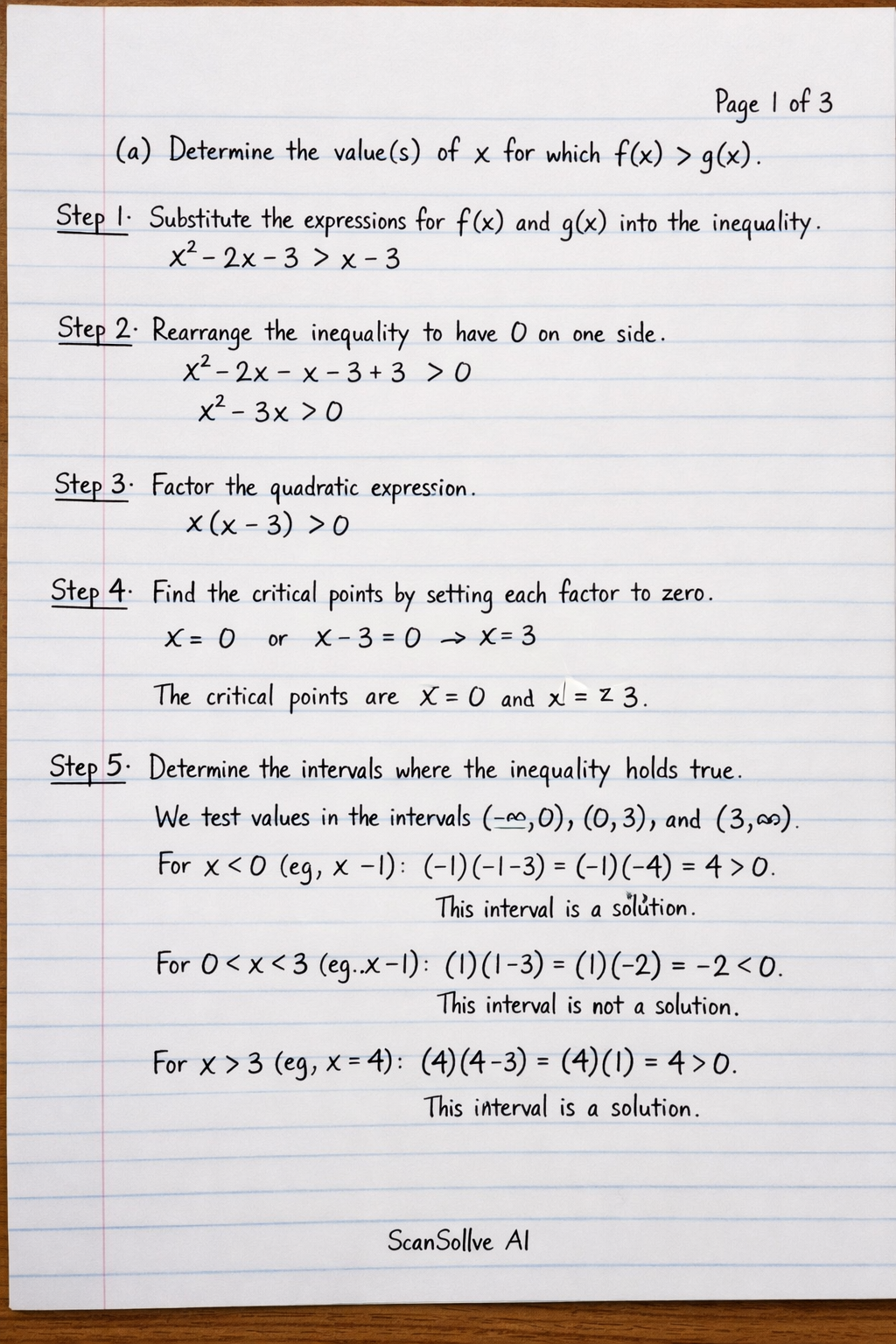
Handwritten Step-by-Step Solution
Get this as a handwritten image on WhatsApp — like a tutor wrote it for you.
Try on WhatsApp