We read your photo as:

Given the matrices A= -6 & 2 \ 0 & -4 , B= 5 & -3 \ -2 & 1 . Find i) A + B ii) A - B iii) 2A + 3B iv) 3A - B v) 1/2 A + B

Mathematics

ScanSolve AI Answer

Answers

5 parts
i

(−1−1−2−3)\begin{pmatrix} -1 & -1 \\ -2 & -3 \end{pmatrix}

ii

(−1152−5)\begin{pmatrix} -11 & 5 \\ 2 & -5 \end{pmatrix}

iii

(3−5−6−5)\begin{pmatrix} 3 & -5 \\ -6 & -5 \end{pmatrix}

iv

(−2392−13)\begin{pmatrix} -23 & 9 \\ 2 & -13 \end{pmatrix}

v

(2−2−2−1)\begin{pmatrix} 2 & -2 \\ -2 & -1 \end{pmatrix}

Step-by-step solution

10 steps

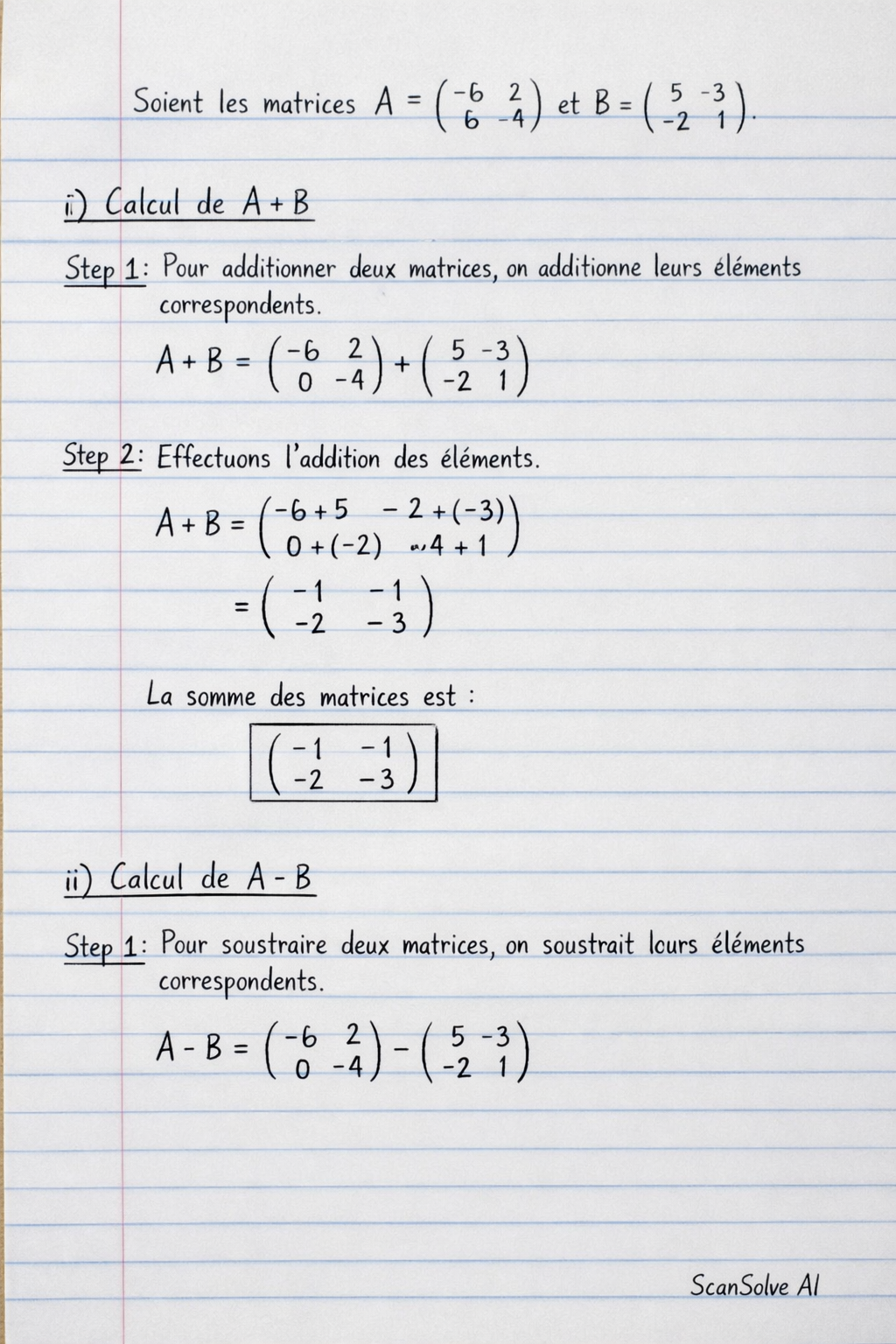
Soient les matrices A=(−620−4)A = \begin{pmatrix} -6 & 2 \\ 0 & -4 \end{pmatrix} et B=(5−3−21)B = \begin{pmatrix} 5 & -3 \\ -2 & 1 \end{pmatrix}.

Part i· 2 steps

Calcul de A+BA + B

  1. Pour additionner deux matrices, on additionne leurs éléments correspondants.

    A+B=(−620−4)+(5−3−21)A + B = \begin{pmatrix} -6 & 2 \\ 0 & -4 \end{pmatrix} + \begin{pmatrix} 5 & -3 \\ -2 & 1 \end{pmatrix}
  2. Effectuons l'addition des éléments.

    A+B=(−6+52+(−3)0+(−2)−4+1)=(−1−1−2−3)A + B = \begin{pmatrix} -6 + 5 & 2 + (-3) \\ 0 + (-2) & -4 + 1 \end{pmatrix} = \begin{pmatrix} -1 & -1 \\ -2 & -3 \end{pmatrix}

    La somme des matrices est :

    (−1−1−2−3)\boxed{\begin{pmatrix} -1 & -1 \\ -2 & -3 \end{pmatrix}}

Part ii

(−1152−5)\begin{pmatrix} -11 & 5 \\ 2 & -5 \end{pmatrix}

Calcul de A−BA - B

  1. Pour soustraire deux matrices, on soustrait leurs éléments correspondants.

    A−B=(−620−4)−(5−3−21)A - B = \begin{pmatrix} -6 & 2 \\ 0 & -4 \end{pmatrix} - \begin{pmatrix} 5 & -3 \\ -2 & 1 \end{pmatrix}
  2. Effectuons la soustraction des éléments.

    A−B=(−6−52−(−3)0−(−2)−4−1)=(−112+30+2−5)=(−1152−5)A - B = \begin{pmatrix} -6 - 5 & 2 - (-3) \\ 0 - (-2) & -4 - 1 \end{pmatrix} = \begin{pmatrix} -11 & 2 + 3 \\ 0 + 2 & -5 \end{pmatrix} = \begin{pmatrix} -11 & 5 \\ 2 & -5 \end{pmatrix}

    La différence des matrices est :

    (−1152−5)\boxed{\begin{pmatrix} -11 & 5 \\ 2 & -5 \end{pmatrix}}

Part iii

(3−5−6−5)\begin{pmatrix} 3 & -5 \\ -6 & -5 \end{pmatrix}

Calcul de 2A+3B2A + 3B

  1. Multiplions chaque matrice par son scalaire respectif.

    2A=2(−620−4)=(2×(−6)2×22×02×(−4))=(−1240−8)2A = 2 \begin{pmatrix} -6 & 2 \\ 0 & -4 \end{pmatrix} = \begin{pmatrix} 2 \times (-6) & 2 \times 2 \\ 2 \times 0 & 2 \times (-4) \end{pmatrix} = \begin{pmatrix} -12 & 4 \\ 0 & -8 \end{pmatrix} 3B=3(5−3−21)=(3×53×(−3)3×(−2)3×1)=(15−9−63)3B = 3 \begin{pmatrix} 5 & -3 \\ -2 & 1 \end{pmatrix} = \begin{pmatrix} 3 \times 5 & 3 \times (-3) \\ 3 \times (-2) & 3 \times 1 \end{pmatrix} = \begin{pmatrix} 15 & -9 \\ -6 & 3 \end{pmatrix}
  2. Additionnons les matrices résultantes.

    2A+3B=(−1240−8)+(15−9−63)=(−12+154+(−9)0+(−6)−8+3)=(3−5−6−5)2A + 3B = \begin{pmatrix} -12 & 4 \\ 0 & -8 \end{pmatrix} + \begin{pmatrix} 15 & -9 \\ -6 & 3 \end{pmatrix} = \begin{pmatrix} -12 + 15 & 4 + (-9) \\ 0 + (-6) & -8 + 3 \end{pmatrix} = \begin{pmatrix} 3 & -5 \\ -6 & -5 \end{pmatrix}

    Le résultat de l'opération est :

    (3−5−6−5)\boxed{\begin{pmatrix} 3 & -5 \\ -6 & -5 \end{pmatrix}}

Part iv

(−2392−13)\begin{pmatrix} -23 & 9 \\ 2 & -13 \end{pmatrix}

Calcul de 3A−B3A - B

  1. Multiplions la matrice A par le scalaire 3.

    3A=3(−620−4)=(3×(−6)3×23×03×(−4))=(−1860−12)3A = 3 \begin{pmatrix} -6 & 2 \\ 0 & -4 \end{pmatrix} = \begin{pmatrix} 3 \times (-6) & 3 \times 2 \\ 3 \times 0 & 3 \times (-4) \end{pmatrix} = \begin{pmatrix} -18 & 6 \\ 0 & -12 \end{pmatrix}
  2. Soustrayons la matrice B de la matrice $3A$.

    3A−B=(−1860−12)−(5−3−21)=(−18−56−(−3)0−(−2)−12−1)=(−236+30+2−13)=(−2392−13)3A - B = \begin{pmatrix} -18 & 6 \\ 0 & -12 \end{pmatrix} - \begin{pmatrix} 5 & -3 \\ -2 & 1 \end{pmatrix} = \begin{pmatrix} -18 - 5 & 6 - (-3) \\ 0 - (-2) & -12 - 1 \end{pmatrix} = \begin{pmatrix} -23 & 6 + 3 \\ 0 + 2 & -13 \end{pmatrix} = \begin{pmatrix} -23 & 9 \\ 2 & -13 \end{pmatrix}

    Le résultat de l'opération est :

    (−2392−13)\boxed{\begin{pmatrix} -23 & 9 \\ 2 & -13 \end{pmatrix}}

Part v

(2−2−2−1)\begin{pmatrix} 2 & -2 \\ -2 & -1 \end{pmatrix}

Calcul de 12A+B\frac{1}{2}A + B

  1. Multiplions la matrice A par le scalaire 12\frac{1}{2}.

    12A=12(−620−4)=(12×(−6)12×212×012×(−4))=(−310−2)\frac{1}{2}A = \frac{1}{2} \begin{pmatrix} -6 & 2 \\ 0 & -4 \end{pmatrix} = \begin{pmatrix} \frac{1}{2} \times (-6) & \frac{1}{2} \times 2 \\ \frac{1}{2} \times 0 & \frac{1}{2} \times (-4) \end{pmatrix} = \begin{pmatrix} -3 & 1 \\ 0 & -2 \end{pmatrix}
  2. Additionnons la matrice B à la matrice 12A\frac{1}{2}A.

    12A+B=(−310−2)+(5−3−21)=(−3+51+(−3)0+(−2)−2+1)=(2−2−2−1)\frac{1}{2}A + B = \begin{pmatrix} -3 & 1 \\ 0 & -2 \end{pmatrix} + \begin{pmatrix} 5 & -3 \\ -2 & 1 \end{pmatrix} = \begin{pmatrix} -3 + 5 & 1 + (-3) \\ 0 + (-2) & -2 + 1 \end{pmatrix} = \begin{pmatrix} 2 & -2 \\ -2 & -1 \end{pmatrix}

    Le résultat de l'opération est :

    (2−2−2−1)\boxed{\begin{pmatrix} 2 & -2 \\ -2 & -1 \end{pmatrix}}
Was this helpful?

Try one yourself

A new problem that tests the same skill.

Still stuck on this one?

Ask a follow-up, and the answer starts from this question.

Got a different question?Ask your own question
Handwritten step-by-step solution preview

Handwritten Step-by-Step Solution

Get this as a handwritten image on WhatsApp — like a tutor wrote it for you.

Try on WhatsApp