
We read your photo as:
Given the polynomial P(x) = 2x3 − 5x2 − 19x + 42, find the quotient and remainder when P(x) is divided by 2x-7.
ScanSolve AI Answer
Answers
4 parts(2x-7)(x+3)(x-2)
Use the left and right arrow keys to trace the curve, up and down to jump between key points, and plus and minus to zoom.
| Point | x | y |
|---|---|---|
| x-intercept | −3 | 0 |
| Maximum | −1.13 | 54.2 |
| y-intercept | 0 | 42 |
| x-intercept | 2 | 0 |
| Minimum | 2.8 | −6.5 |
| x-intercept | 3.5 | 0 |
Here's how to solve these polynomial problems.
Given the polynomial .
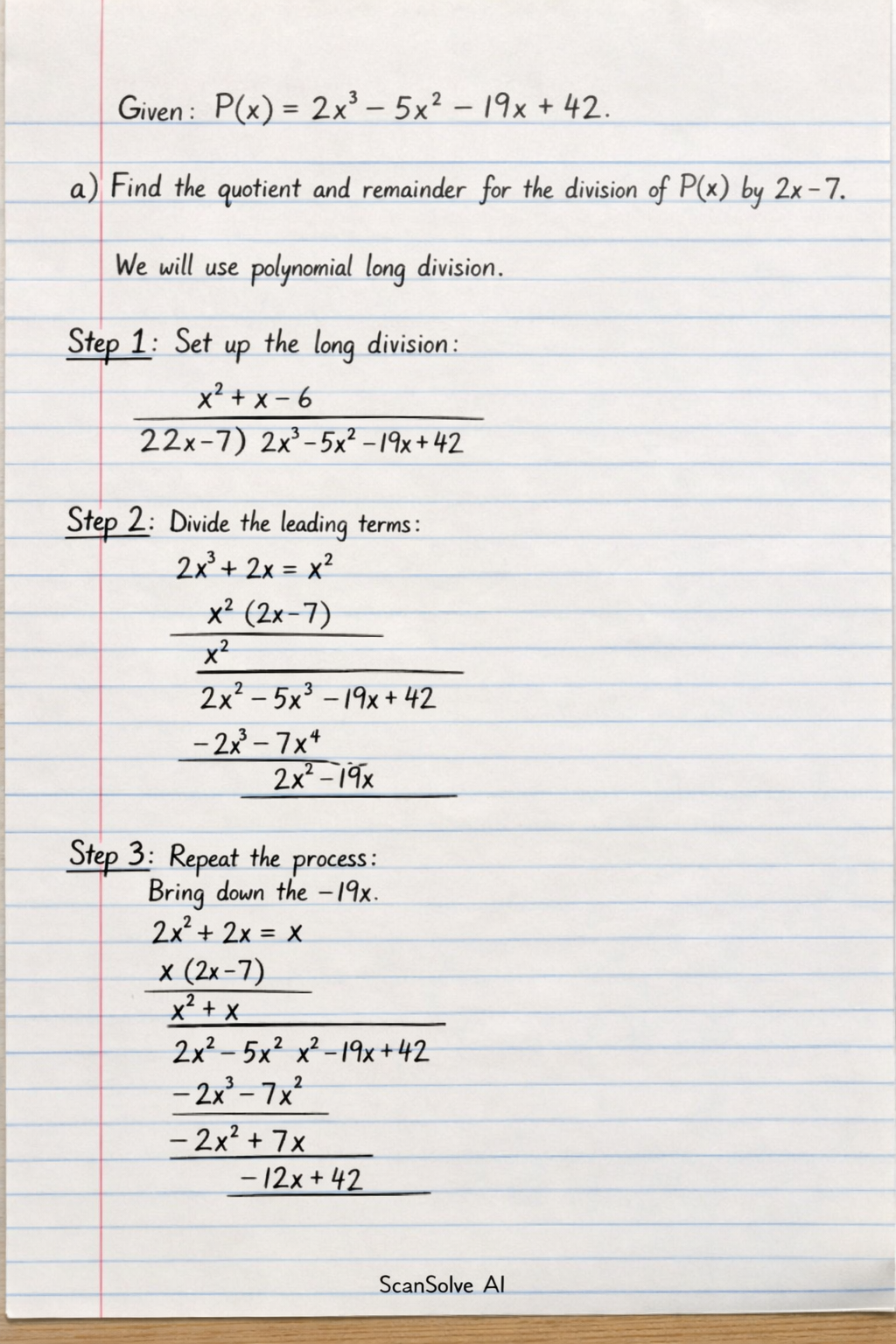
a) Find the quotient and the remainder for the division of by .
We will use polynomial long division.
Step 1: Set up the long division.
Step 2: Divide the leading terms.
Divide by to get . Multiply by and subtract.
Step 3: Repeat the process.
Bring down the next term (). Divide by to get . Multiply by and subtract.
Step 4: Repeat again.
Bring down the next term (). Divide by to get . Multiply by and subtract.
The quotient is and the remainder is 0.
The quotient is and the remainder is .
b) Factorise completely.
Since the remainder from part (a) is 0, is a factor of .
So, .
Step 1: Factor the quadratic term.
We need to factor the quadratic expression . We look for two numbers that multiply to and add to 1. These numbers are 3 and .
So, .
Step 2: Write the completely factored form.
Substitute the factored quadratic back into the expression for .
The completely factored form is .
c) Solve if .
To solve , we set the factored form of equal to zero.
Step 1: Set each factor to zero and solve for .
- For the first factor:
- For the second factor:
- For the third factor:
The solutions are .
d) Solve: .
Let . We need to find the roots of this cubic equation.
Step 1: Find a rational root using the Rational Root Theorem or by testing values.
We test integer factors of the constant term divided by integer factors of the leading coefficient .
Let's try :
Since , is a root, and is a factor of .
Step 2: Use synthetic division to divide by .
The coefficients of are .
The quotient is .
So, .
Step 3: Factor the quadratic quotient.
We need to solve . We can factor this quadratic.
We look for two numbers that multiply to and add to 5. These numbers are 8 and .
Step 4: Set each factor to zero and solve for .
- From the first factor we found:
- From the quadratic factors:
The solutions are .
Try one yourself
A new problem that tests the same skill.
Still stuck on this one?
Ask a follow-up, and the answer starts from this question.
More Mathematics Questions
Handwritten Step-by-Step Solution
Get this as a handwritten image on WhatsApp — like a tutor wrote it for you.
Try on WhatsApp