This mathematics problem involves applying core mathematical principles and formulas. Below you will find a complete step-by-step solution with detailed explanations for each step, helping you understand not just the answer but the method behind it.
ScanSolve AI Answer
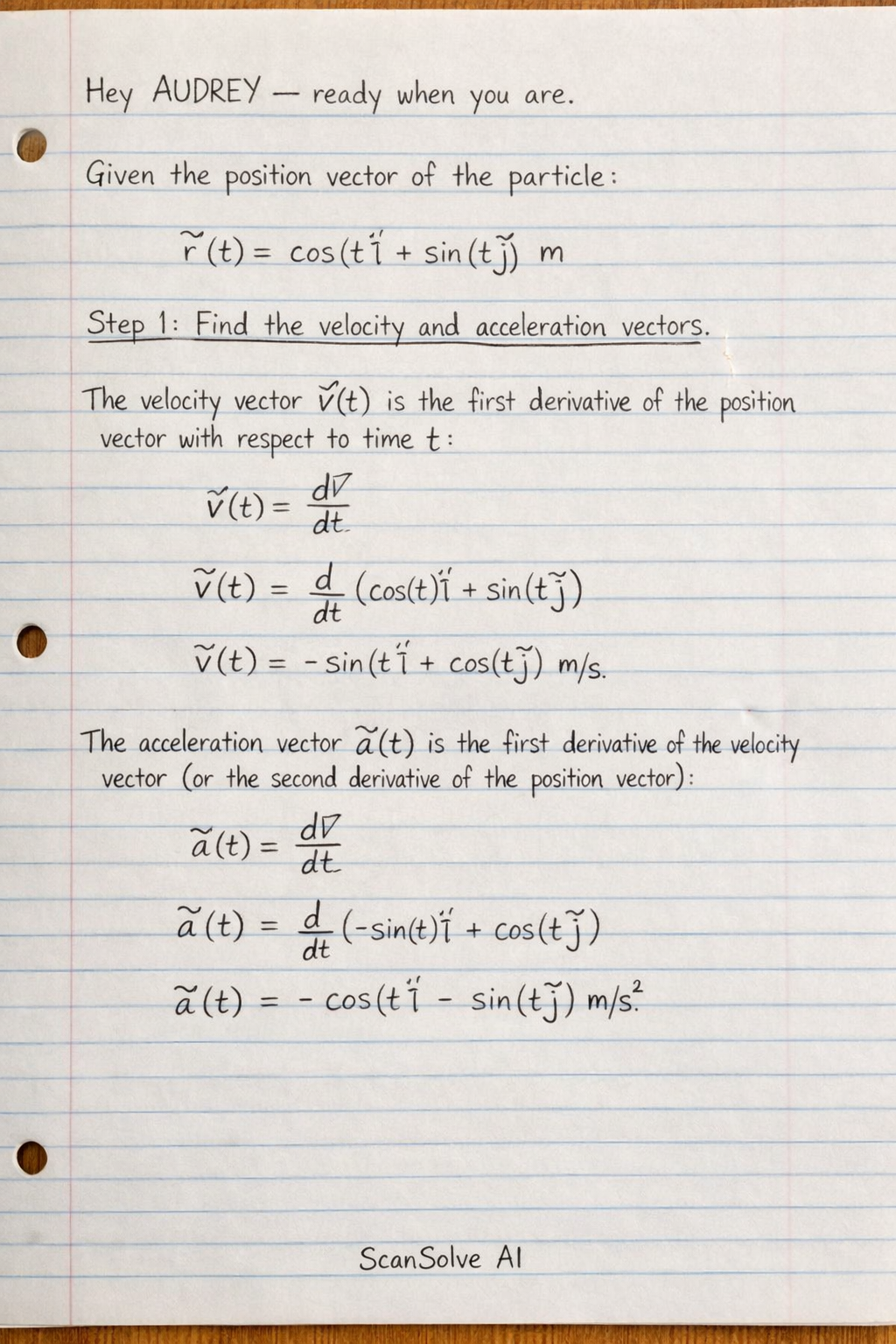
Hey AUDREY — ready when you are.
Given the position vector of the particle:
$$\vec{r}(t) = (\cos(t)\hat{i} + \sin(t)\hat{j}) \, \text{m}$$
Step 1: Find the velocity and acceleration vectors.
The velocity vector $\vec{v}(t)$ is the first derivative of the position vector with respect to time $t$:
$$\vec{v}(t) = \frac{d\vec{r}}{dt} = \frac{d}{dt}(\cos(t)\hat{i} + \sin(t)\hat{j})$$
$$\vec{v}(t) = (-\sin(t)\hat{i} + \cos(t)\hat{j}) \, \text{m/s}$$
The acceleration vector $\vec{a}(t)$ is the first derivative of the velocity vector with respect to time $t$ (or the second derivative of the position vector):
$$\vec{a}(t) = \frac{d\vec{v}}{dt} = \frac{d}{dt}(-\sin(t)\hat{i} + \cos(t)\hat{j})$$
$$\vec{a}(t) = (-\cos(t)\hat{i} - \sin(t)\hat{j}) \, \text{m/s}^2$$
a) Show that the position and acceleration vectors of the particle are in opposite directions.
To show that two vectors are in opposite directions, one must be a negative scalar multiple of the other.
We have $\vec{r}(t) = \cos(t)\hat{i} + \sin(t)\hat{j}$ and $\vec{a}(t) = -\cos(t)\hat{i} - \sin(t)\hat{j}$.
We can factor out $-1$ from $\vec{a}(t)$:
$$\vec{a}(t) = -(\cos(t)\hat{i} + \sin(t)\hat{j})$$
Comparing this with $\vec{r}(t)$, we see that:
$$\vec{a}(t) = -\vec{r}(t)$$
Since the acceleration vector is equal to the negative of the position vector, they are always in opposite directions.
b) Show that the velocity and acceleration vectors are always at right angles to each other.
Two vectors are at right angles (perpendicular) if their dot product is zero.
We have $\vec{v}(t) = -\sin(t)\hat{i} + \cos(t)\hat{j}$ and $\vec{a}(t) = -\cos(t)\hat{i} - \sin(t)\hat{j}$.
Calculate their dot product:
$$\vec{v}(t) \cdot \vec{a}(t) = (-\sin(t))(-\cos(t)) + (\cos(t))(-\sin(t))$$
$$\vec{v}(t) \cdot \vec{a}(t) = \sin(t)\cos(t) - \cos(t)\sin(t)$$
$$\vec{v}(t) \cdot \vec{a}(t) = 0$$
Since the dot product of the velocity and acceleration vectors is always zero, they are always at right angles to each other.
c) Given $t = \pi$, find the position vector.
Substitute $t = \pi$ into the position vector equation:
$$\vec{r}(\pi) = \cos(\pi)\hat{i} + \sin(\pi)\hat{j}$$
We know that $\cos(\pi) = -1$ and $\sin(\pi) = 0$.
$$\vec{r}(\pi) = (-1)\hat{i} + (0)\hat{j}$$
$$\boxed{\vec{r}(\pi) = -\hat{i} \, \text{m}}$$
d) This part of the question is incomplete. However, the given information for two particles P and Q is:
• Initial position vector of particle P: $\vec{r}_P = (3\hat{i} + 2\hat{j}) \, \text{m}$
• Initial position vector of particle Q: $\vec{r}_Q = (-2\hat{i} + 5\hat{j}) \, \text{m}$
• Constant velocity of particle P: $\vec{v}_P = (-2\hat{i} - 5\hat{j}) \, \text{m/s}$
• Constant velocity of particle Q: $\vec{v}_Q = (3\hat{i} + 5\hat{j}) \, \text{m/s}$
What's next? 📸
Given the position vector of the particle:
|Mathematics
Given the position vector of the particle:
ScanSolve AI Answer
Hey AUDREY — ready when you are.
Given the position vector of the particle:
r(t)=(cos(t)i^+sin(t)j^)m
Step 1: Find the velocity and acceleration vectors.
The velocity vector v(t) is the first derivative of the position vector with respect to time t:
v(t)=dtdr=dtd(cos(t)i^+sin(t)j^)v(t)=(−sin(t)i^+cos(t)j^)m/s
The acceleration vector a(t) is the first derivative of the velocity vector with respect to time t (or the second derivative of the position vector):
a(t)=dtdv=dtd(−sin(t)i^+cos(t)j^)a(t)=(−cos(t)i^−sin(t)j^)m/s2
a) Show that the position and acceleration vectors of the particle are in opposite directions.
To show that two vectors are in opposite directions, one must be a negative scalar multiple of the other.
We have r(t)=cos(t)i^+sin(t)j^ and a(t)=−cos(t)i^−sin(t)j^.
We can factor out −1 from a(t):
a(t)=−(cos(t)i^+sin(t)j^)
Comparing this with r(t), we see that:
a(t)=−r(t)
Since the acceleration vector is equal to the negative of the position vector, they are always in opposite directions.
b) Show that the velocity and acceleration vectors are always at right angles to each other.
Two vectors are at right angles (perpendicular) if their dot product is zero.
We have v(t)=−sin(t)i^+cos(t)j^ and a(t)=−cos(t)i^−sin(t)j^.
Calculate their dot product:
v(t)⋅a(t)=(−sin(t))(−cos(t))+(cos(t))(−sin(t))v(t)⋅a(t)=sin(t)cos(t)−cos(t)sin(t)v(t)⋅a(t)=0
Since the dot product of the velocity and acceleration vectors is always zero, they are always at right angles to each other.
c) Given t=π, find the position vector.
Substitute t=π into the position vector equation:
r(π)=cos(π)i^+sin(π)j^
We know that cos(π)=−1 and sin(π)=0.
r(π)=(−1)i^+(0)j^r(π)=−i^m
d) This part of the question is incomplete. However, the given information for two particles P and Q is:
• Initial position vector of particle P: rP=(3i^+2j^)m
• Initial position vector of particle Q: rQ=(−2i^+5j^)m
• Constant velocity of particle P: vP=(−2i^−5j^)m/s
• Constant velocity of particle Q: vQ=(3i^+5j^)m/s
What's next? 📸
Need help with your own homework?
Get instant step-by-step solutions to any question. Free to start.