This mathematics problem involves applying core mathematical principles and formulas. Below you will find a complete step-by-step solution with detailed explanations for each step, helping you understand not just the answer but the method behind it.
ScanSolve AI Answer
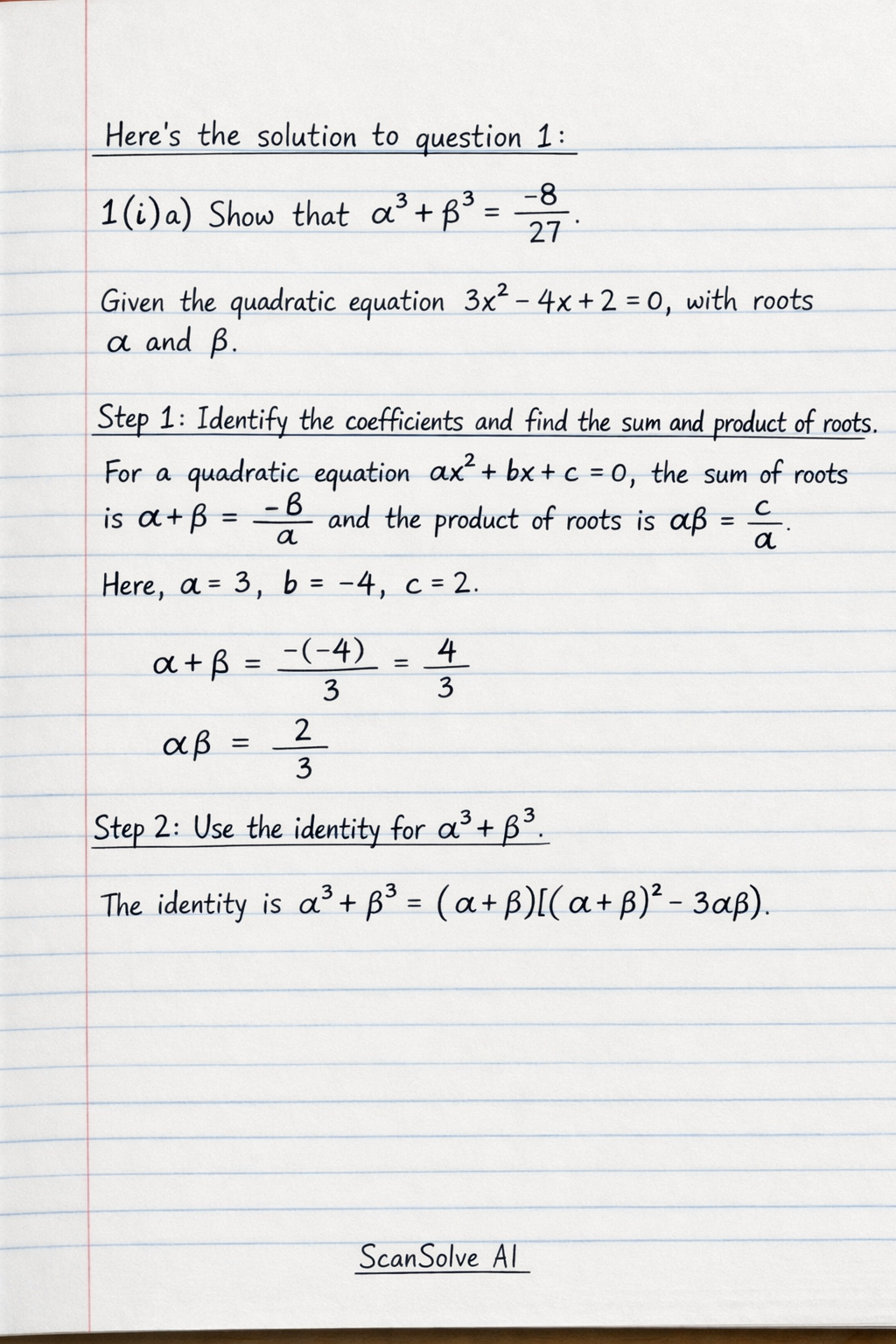
Here's the solution to question 1:
1(i)a) Show that $\alpha^3 + \beta^3 = -\frac{8}{27}$
Given the quadratic equation $3x^2 - 4x + 2 = 0$, with roots $\alpha$ and $\beta$.
Step 1: Identify the coefficients and find the sum and product of roots.
For a quadratic equation $ax^2 + bx + c = 0$, the sum of roots is $\alpha + \beta = -\frac{b}{a}$ and the product of roots is $\alpha \beta = \frac{c}{a}$.
Here, $a=3$, $b=-4$, $c=2$.
$$ \alpha + \beta = -\frac{-4}{3} = \frac{4}{3} $$
$$ \alpha \beta = \frac{2}{3} $$
Step 2: Use the identity for $\alpha^3 + \beta^3$.
The identity is $\alpha^3 + \beta^3 = (\alpha + \beta)((\alpha + \beta)^2 - 3\alpha \beta)$.
Step 3: Substitute the values of $\alpha + \beta$ and $\alpha \beta$.
$$ \alpha^3 + \beta^3 = \left(\frac{4}{3}\right)\left(\left(\frac{4}{3}\right)^2 - 3\left(\frac{2}{3}\right)\right) $$
$$ \alpha^3 + \beta^3 = \left(\frac{4}{3}\right)\left(\frac{16}{9} - 2\right) $$
$$ \alpha^3 + \beta^3 = \left(\frac{4}{3}\right)\left(\frac{16}{9} - \frac{18}{9}\right) $$
$$ \alpha^3 + \beta^3 = \left(\frac{4}{3}\right)\left(-\frac{2}{9}\right) $$
$$ \alpha^3 + \beta^3 = -\frac{8}{27} $$
This shows the required result.
1(i)b) Find the equation with integral coefficients whose roots are $\frac{1}{\alpha^2}$ and $\frac{1}{\beta^2}$
Let the new roots be $r_1 = \frac{1}{\alpha^2}$ and $r_2 = \frac{1}{\beta^2}$.
The general quadratic equation is $x^2 - (\text{sum of roots})x + (\text{product of roots}) = 0$.
Step 1: Calculate the sum of the new roots.
$$ S' = \frac{1}{\alpha^2} + \frac{1}{\beta^2} = \frac{\beta^2 + \alpha^2}{(\alpha \beta)^2} $$
First, find $\alpha^2 + \beta^2$:
$$ \alpha^2 + \beta^2 = (\alpha + \beta)^2 - 2\alpha \beta $$
Substitute the values from part (a):
$$ \alpha^2 + \beta^2 = \left(\frac{4}{3}\right)^2 - 2\left(\frac{2}{3}\right) = \frac{16}{9} - \frac{4}{3} = \frac{16}{9} - \frac{12}{9} = \frac{4}{9} $$
Now, calculate $S'$:
$$ S' = \frac{\frac{4}{9}}{\left(\frac{2}{3}\right)^2} = \frac{\frac{4}{9}}{\frac{4}{9}} = 1 $$
Step 2: Calculate the product of the new roots.
$$ P' = \left(\frac{1}{\alpha^2}\right)\left(\frac{1}{\beta^2}\right) = \frac{1}{(\alpha \beta)^2} $$
Substitute the value of $\alpha \beta$:
$$ P' = \frac{1}{\left(\frac{2}{3}\right)^2} = \frac{1}{\frac{4}{9}} = \frac{9}{4} $$
Step 3: Form the new quadratic equation.
The equation is $x^2 - S'x + P' = 0$.
$$ x^2 - 1x + \frac{9}{4} = 0 $$
To obtain integral coefficients, multiply the entire equation by 4:
$$ 4x^2 - 4x + 9 = 0 $$
The equation with integral coefficients is $\boxed{\text{4x^2 - 4x + 9 = 0}}$.
1(ii) Find the set of real values of $x$ for which $\left|\frac{x+3}{x-1}\right| = \frac{x+3}{x-1}$
The property $|A| = A$ holds true if and only if $A \ge 0$.
Therefore, we need to find the values of $x$ for which $\frac{x+3}{x-1} \ge 0$.
Also, the denominator cannot be zero, so $x-1 \ne 0 \implies x \ne 1$.
Step 1: Analyze the signs of the numerator and denominator.
For the fraction to be non-negative, both numerator and denominator must have the same sign (or the numerator is zero).
Case 1: Numerator is non-negative and denominator is positive.
$x+3 \ge 0 \implies x \ge -3$
$x-1 > 0 \implies x > 1$
The intersection of these conditions is $x > 1$.
Case 2: Numerator is non-positive and denominator is negative.
$x+3 \le 0 \implies x \le -3$
$x-1 < 0 \implies x < 1$
The intersection of these conditions is $x \le -3$.
Step 2: Combine the solutions from both cases.
The set of real values of $x$ is $x \le -3$ or $x > 1$.
In interval notation, this is $(-\infty, -3] \cup (1, \infty)$.
The set of real values of $x$ is $\boxed{x \le -3 \text{ or } x > 1}$.
Given the quadratic equation 3x^2 - 4x + 2 = 0, with roots alpha and beta.
|Mathematics
Given the quadratic equation 3x^2 - 4x + 2 = 0, with roots alpha and beta.
ScanSolve AI Answer
Here's the solution to question 1:
1(i)a) Show that α3+β3=−278
Given the quadratic equation 3x2−4x+2=0, with roots α and β.
Step 1: Identify the coefficients and find the sum and product of roots.
For a quadratic equation ax2+bx+c=0, the sum of roots is α+β=−ab and the product of roots is αβ=ac.
Here, a=3, b=−4, c=2.
α+β=−3−4=34αβ=32
Step 2: Use the identity for α3+β3.
The identity is α3+β3=(α+β)((α+β)2−3αβ).
Step 3: Substitute the values of α+β and αβ.
α3+β3=(34)((34)2−3(32))α3+β3=(34)(916−2)α3+β3=(34)(916−918)α3+β3=(34)(−92)α3+β3=−278
This shows the required result.
1(i)b) Find the equation with integral coefficients whose roots are α21 and β21
Let the new roots be r1=α21 and r2=β21.
The general quadratic equation is x2−(sumofroots)x+(productofroots)=0.
Step 1: Calculate the sum of the new roots.
S′=α21+β21=(αβ)2β2+α2
First, find α2+β2:
α2+β2=(α+β)2−2αβ
Substitute the values from part (a):
α2+β2=(34)2−2(32)=916−34=916−912=94
Now, calculate S′:
S′=(32)294=9494=1
Step 2: Calculate the product of the new roots.
P′=(α21)(β21)=(αβ)21
Substitute the value of αβ:
P′=(32)21=941=49
Step 3: Form the new quadratic equation.
The equation is x2−S′x+P′=0.
x2−1x+49=0
To obtain integral coefficients, multiply the entire equation by 4:
4x2−4x+9=0
The equation with integral coefficients is 4x2−4x+9=0.
1(ii) Find the set of real values of x for which x−1x+3=x−1x+3
The property ∣A∣=A holds true if and only if A≥0.
Therefore, we need to find the values of x for which x−1x+3≥0.
Also, the denominator cannot be zero, so x−1=0⟹x=1.
Step 1: Analyze the signs of the numerator and denominator.
For the fraction to be non-negative, both numerator and denominator must have the same sign (or the numerator is zero).
Case 1: Numerator is non-negative and denominator is positive.
x+3≥0⟹x≥−3x−1>0⟹x>1
The intersection of these conditions is x>1.
Case 2: Numerator is non-positive and denominator is negative.
x+3≤0⟹x≤−3x−1<0⟹x<1
The intersection of these conditions is x≤−3.
Step 2: Combine the solutions from both cases.
The set of real values of x is x≤−3 or x>1.
In interval notation, this is (−∞,−3]∪(1,∞).
The set of real values of x is x≤−3orx>1.
Need help with your own homework?
Get instant step-by-step solutions to any question. Free to start.