
We read your photo as:
Given the system of linear equations ax + by = c and ax + by = 0, determine the number of solutions based on the value of c.
ScanSolve AI Answer
Answer
Step-by-step solution
3 stepsHere are the given equations:
Compare the equations.
Both equations have the same coefficients for () and (). This means they represent lines with the same slope.
Analyze the constant terms.
The constant term in equation (1) is , and in equation (2) it is 0. The relationship between the two lines (and thus the number of solutions) depends on the value of .
Determine the number of solutions.
-
Case 1: If If is any non-zero number, then cannot simultaneously equal and 0. This means the two equations represent two distinct parallel lines. Parallel lines never intersect, so there is no solution to the system.
-
Case 2: If If is equal to 0, then both equations become . This means the two equations are identical. They represent the same line. In this case, there are infinitely many solutions, as any point that satisfies is a solution to the system.
The number of solutions depends on the value of :
-
Try one yourself
A new problem that tests the same skill.
Still stuck on this one?
Ask a follow-up, and the answer starts from this question.
More Mathematics Questions
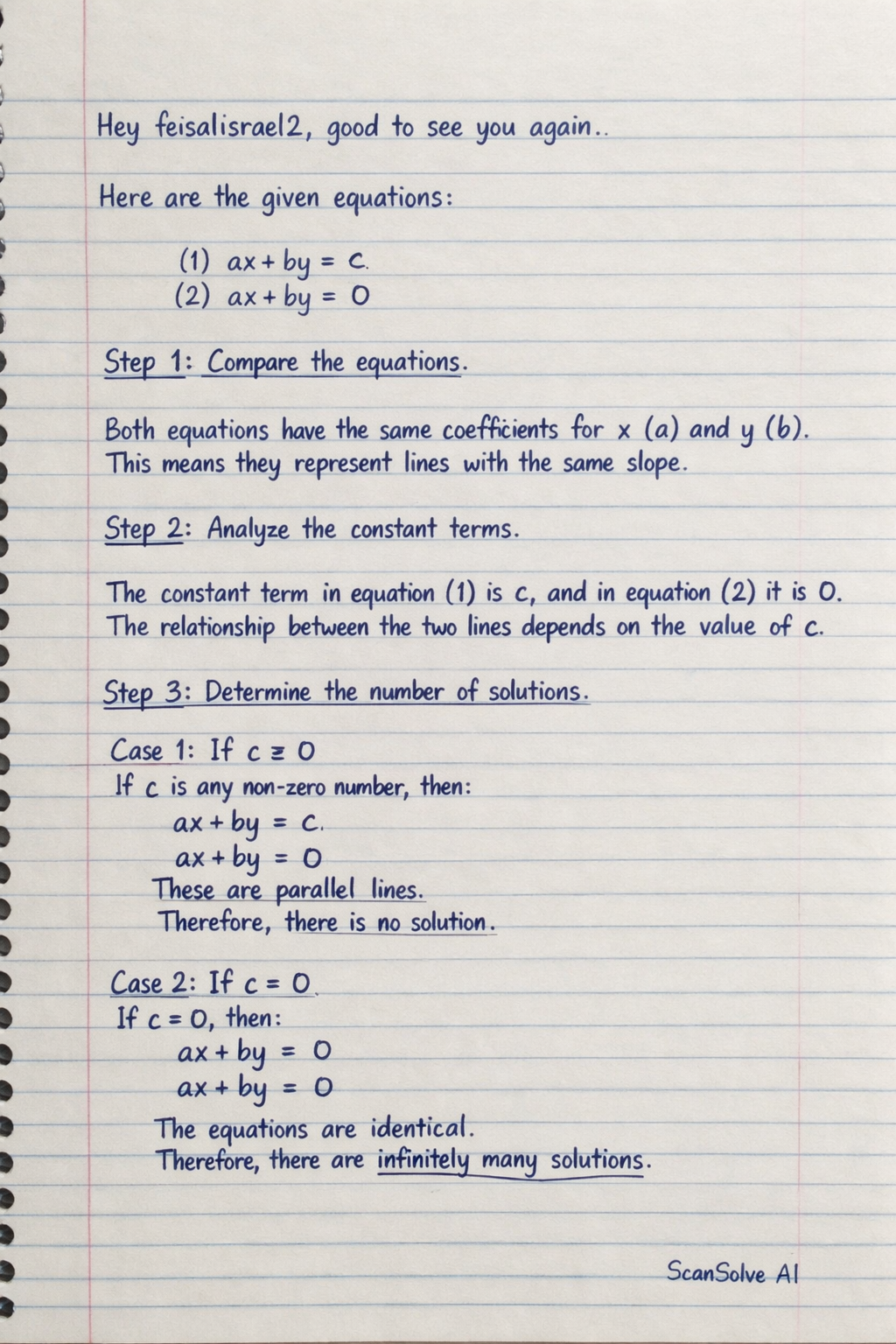
Handwritten Step-by-Step Solution
Get this as a handwritten image on WhatsApp — like a tutor wrote it for you.
Try on WhatsApp