We read your photo as:

Given vectors a = [1, -3], b = [2, 3], and c = [8, 3], find m and n such that c = ma + nb. Then find |d| if d = c − 2a.

Mathematics

ScanSolve AI Answer

Step-by-step solution

9 steps

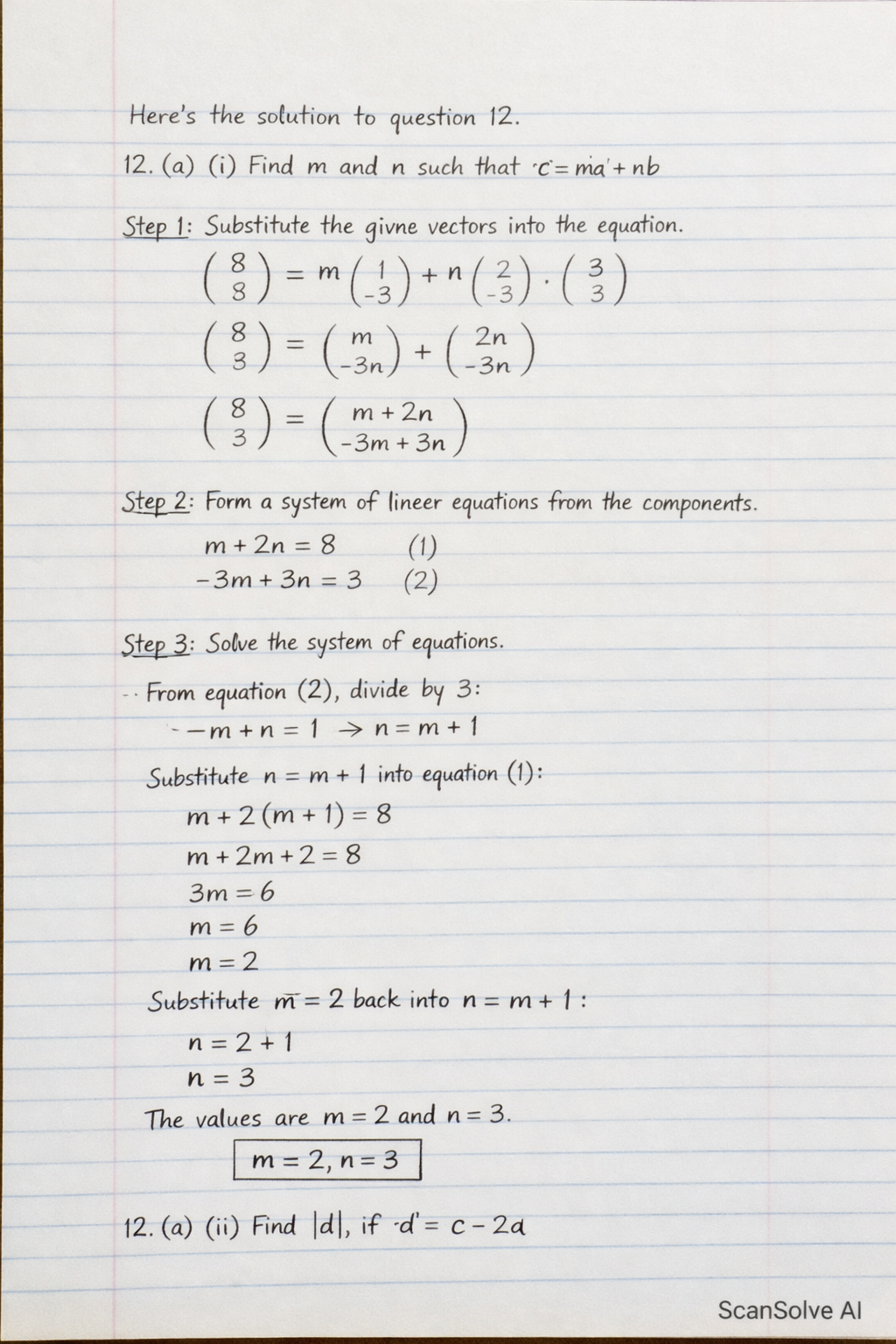
Here's the solution to question 12.

12. (a) (i) Find mm and nn such that c=ma+nb\mathbf{c} = m\mathbf{a} + n\mathbf{b}

  1. Substitute the given vectors into the equation.

    (83)=m(1−3)+n(23)\begin{pmatrix} 8 \\ 3 \end{pmatrix} = m \begin{pmatrix} 1 \\ -3 \end{pmatrix} + n \begin{pmatrix} 2 \\ 3 \end{pmatrix} (83)=(m−3m)+(2n3n)\begin{pmatrix} 8 \\ 3 \end{pmatrix} = \begin{pmatrix} m \\ -3m \end{pmatrix} + \begin{pmatrix} 2n \\ 3n \end{pmatrix} (83)=(m+2n−3m+3n)\begin{pmatrix} 8 \\ 3 \end{pmatrix} = \begin{pmatrix} m + 2n \\ -3m + 3n \end{pmatrix}
  2. Form a system of linear equations from the components.

    m+2n=8(1)m + 2n = 8 \quad (1) −3m+3n=3(2)-3m + 3n = 3 \quad (2)
  3. Solve the system of equations.

    From equation (2), divide by 3:

    −m+n=1  ⟹  n=m+1-m + n = 1 \implies n = m + 1

    Substitute n=m+1n = m + 1 into equation (1):

    m+2(m+1)=8m + 2(m + 1) = 8 m+2m+2=8m + 2m + 2 = 8 3m=63m = 6 m=2m = 2

    Substitute m=2m = 2 back into n=m+1n = m + 1:

    n=2+1n = 2 + 1 n=3n = 3

    The values are m=2m=2 and n=3n=3.

    m=2,n=3\boxed{m=2, n=3}

    12. (a) (ii) Find ∣d∣|\mathbf{d}|, if d=c−2a\mathbf{d} = \mathbf{c} - 2\mathbf{a}

  4. Calculate vector d\mathbf{d}.

    d=(83)−2(1−3)\mathbf{d} = \begin{pmatrix} 8 \\ 3 \end{pmatrix} - 2 \begin{pmatrix} 1 \\ -3 \end{pmatrix} d=(83)−(2−6)\mathbf{d} = \begin{pmatrix} 8 \\ 3 \end{pmatrix} - \begin{pmatrix} 2 \\ -6 \end{pmatrix} d=(8−23−(−6))\mathbf{d} = \begin{pmatrix} 8 - 2 \\ 3 - (-6) \end{pmatrix} d=(69)\mathbf{d} = \begin{pmatrix} 6 \\ 9 \end{pmatrix}
  5. Calculate the magnitude of d\mathbf{d}.

    ∣d∣=62+92|\mathbf{d}| = \sqrt{6^2 + 9^2} ∣d∣=36+81|\mathbf{d}| = \sqrt{36 + 81} ∣d∣=117|\mathbf{d}| = \sqrt{117}
  6. Simplify the radical.

    ∣d∣=9×13|\mathbf{d}| = \sqrt{9 \times 13} ∣d∣=313|\mathbf{d}| = 3\sqrt{13}

    The magnitude of d\mathbf{d} is 3133\sqrt{13}.

    ∣d∣=313\boxed{|\mathbf{d}| = 3\sqrt{13}}

    12. (b) If (x+32)−(yx+y)=(21)\begin{pmatrix} x+3 \\ 2 \end{pmatrix} - \begin{pmatrix} y \\ x+y \end{pmatrix} = \begin{pmatrix} 2 \\ 1 \end{pmatrix}, find the values for xx and yy.

  7. Perform the vector subtraction on the left side.

    ((x+3)−y2−(x+y))=(21)\begin{pmatrix} (x+3) - y \\ 2 - (x+y) \end{pmatrix} = \begin{pmatrix} 2 \\ 1 \end{pmatrix} (x+3−y2−x−y)=(21)\begin{pmatrix} x+3-y \\ 2-x-y \end{pmatrix} = \begin{pmatrix} 2 \\ 1 \end{pmatrix}
  8. Form a system of linear equations from the components.

    x+3−y=2  ⟹  x−y=−1(1)x + 3 - y = 2 \implies x - y = -1 \quad (1) 2−x−y=1  ⟹  −x−y=−1(2)2 - x - y = 1 \implies -x - y = -1 \quad (2)
  9. Solve the system of equations.

    Add equation (1) and equation (2):

    (x−y)+(−x−y)=−1+(−1)(x - y) + (-x - y) = -1 + (-1) −2y=−2-2y = -2 y=1y = 1

    Substitute y=1y = 1 into equation (1):

    x−1=−1x - 1 = -1 x=0x = 0

    The values are x=0x=0 and y=1y=1.

    x=0,y=1\boxed{x=0, y=1}
Was this helpful?

Still stuck on this one?

Ask a follow-up, and the answer starts from this question.

Got a different question?Ask your own question
Handwritten step-by-step solution preview

Handwritten Step-by-Step Solution

Get this as a handwritten image on WhatsApp — like a tutor wrote it for you.

Try on WhatsApp