Given vectors OA = a and OB = b, with Q being the midpoint of OA and P on AB such that AP = 3PB. Express AB, BQ, OP in terms of a and b.
|Mathematics
Given vectors OA = a and OB = b, with Q being the midpoint of OA and P on AB such that AP = 3PB. Express AB, BQ, OP in terms of a and b.
ScanSolve AI Answer
2 steps
Answer
b - a
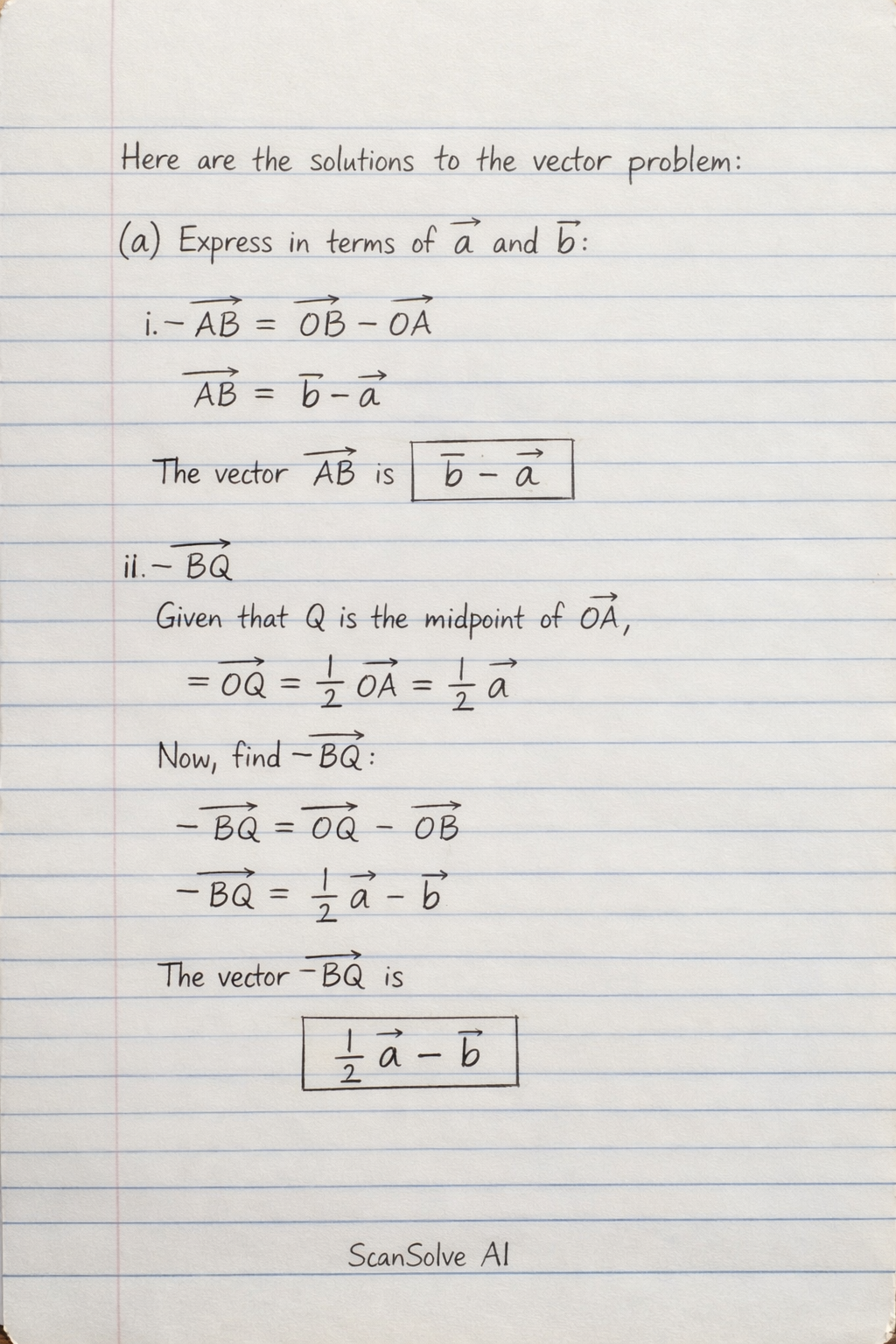
Here are the solutions to the vector problem:
a) Express in terms of a and b:
i. ABAB=OB−OAAB=b−a
The vector AB is b−a.
ii. BQ
Given that Q is the midpoint of OA,
OQ=21OA=21a
Now, find BQ:
BQ=OQ−OBBQ=21a−b
The vector BQ is 21a−b.
iii. OP
Given that P is a point on AB such that AP=3PB. This means P divides AB in the ratio 3:1.
So, AP=43AB.
OP=OA+APOP=OA+43AB
Substitute AB=b−a from part (a)i:
OP=a+43(b−a)OP=a+43b−43aOP=(1−43)a+43bOP=41a+43b
The vector OP is 41a+43b.
b) Given further that OX=kOP and BX=hBQ, give two expressions of OX in terms of a, b, k and h.
First expression for OX (using OX=kOP):
Substitute the expression for OP from part (a)iii:
OX=k(41a+43b)OX=4ka+43kb
Second expression for OX (using BX=hBQ):
We know that OX=OB+BX.
Substitute BX=hBQ and the expression for BQ from part (a)ii:
OX=OB+hBQOX=b+h(21a−b)OX=b+2ha−hbOX=2ha+(1−h)b
The two expressions for OX are:
OX=4ka+43kb
OX=2ha+(1−h)b
c) Find the values of h and k.
Equate the two expressions for OX from part (b):
4ka+43kb=2ha+(1−h)b
Since a and b are non-parallel vectors, the coefficients of a and b on both sides must be equal.
Equating coefficients of a:
4k=2hk=24hk=2h(Equation 1)
Equating coefficients of b:
43k=1−h(Equation 2)
Substitute Equation 1 into Equation 2:
43(2h)=1−h46h=1−h23h=1−h
Multiply both sides by 2:
3h=2(1−h)3h=2−2h3h+2h=25h=2h=52
Now substitute the value of h back into Equation 1 to find k:
k=2hk=2(52)k=54
The values are h=52,k=54.
Was this helpful?
Need help with your own homework?
Get instant step-by-step solutions to any question. Free to start.
This mathematics problem involves applying core mathematical principles and formulas. Below you will find a complete step-by-step solution with detailed explanations for each step, helping you understand not just the answer but the method behind it.
ScanSolve AI Answer
Here are the solutions to the vector problem: a) Express in terms of a and b: i. AB AB = OB - OA AB = b - a The vector AB is b - a. ii. BQ Given that Q is the midpoint of OA, OQ = (1)/(2)OA = (1)/(2)a Now, find BQ: BQ = OQ - OB BQ = (1)/(2)a - b The vector BQ is (1)/(2)a - b. iii. OP Given that P is a point on AB such that AP = 3PB. This means P divides AB in the ratio 3:1. So, AP = (3)/(4)AB. OP = OA + AP OP = OA + (3)/(4)AB Substitute AB = b - a from part (a)i: OP = a + (3)/(4)(b - a) OP = a + (3)/(4)b - (3)/(4)a OP = (1 - (3)/(4))a + (3)/(4)b OP = (1)/(4)a + (3)/(4)b The vector OP is (1)/(4)a + (3)/(4)b. b) Given further that OX = kOP and BX = hBQ, give two expressions of OX in terms of a, b, k and h. First expression for OX (using OX = kOP): Substitute the expression for OP from part (a)iii: OX = k((1)/(4)a + (3)/(4)b) OX = (k)/(4)a + (3k)/(4)b Second expression for OX (using BX = hBQ): We know that OX = OB + BX. Substitute BX = hBQ and the expression for BQ from part (a)ii: OX = OB + hBQ OX = b + h((1)/(2)a - b) OX = b + (h)/(2)a - hb OX = (h)/(2)a + (1 - h)b The two expressions for OX are: 1. OX = (k)/(4)a + (3k)/(4)b 2. OX = (h)/(2)a + (1 - h)b c) Find the values of h and k. Equate the two expressions for OX from part (b): (k)/(4)a + (3k)/(4)b = (h)/(2)a + (1 - h)b Since a and b are non-parallel vectors, the coefficients of a and b on both sides must be equal. Equating coefficients of a: (k)/(4) = (h)/(2) k = (4h)/(2) k = 2h (Equation 1) Equating coefficients of b: (3k)/(4) = 1 - h (Equation 2) Substitute Equation 1 into Equation 2: (3(2h))/(4) = 1 - h (6h)/(4) = 1 - h (3h)/(2) = 1 - h Multiply both sides by 2: 3h = 2(1 - h) 3h = 2 - 2h 3h + 2h = 2 5h = 2 h = (2)/(5) Now substitute the value of h back into Equation 1 to find k: k = 2h k = 2((2)/(5)) k = (4)/(5) The values are h = (2)/(5), k = (4)/(5).