
We read your photo as:
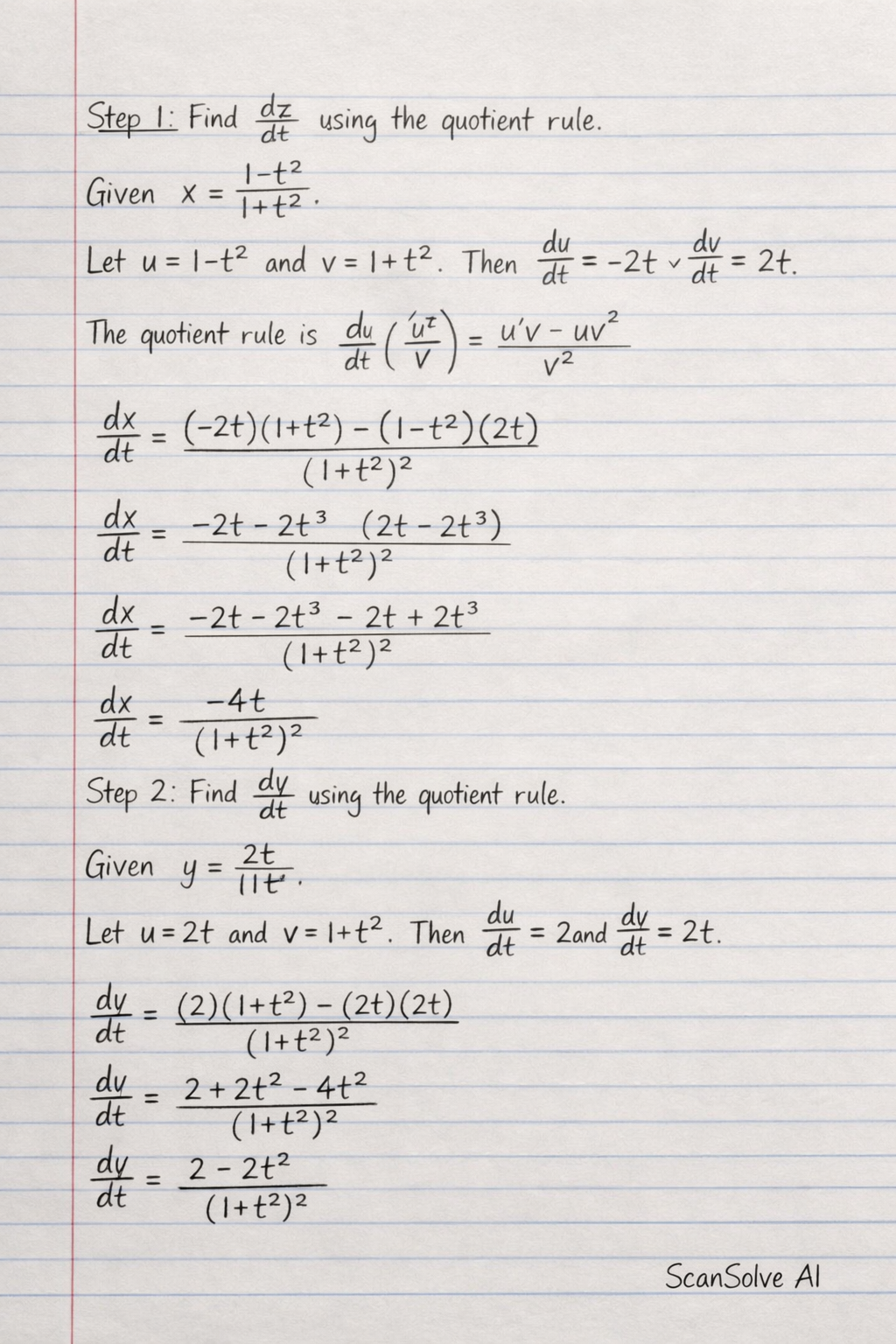
Given x = (1−t2)/(1+t2).
Mathematics
ScanSolve AI Answer
Answer
Step-by-step solution
5 stepsFind using the quotient rule.
Given .
Let and . Then and .
The quotient rule is .Find using the quotient rule.
Given .
Let and . Then and .Calculate using the chain rule .
Calculate .
Substitute and into the expression .
Was this helpful?
Try one yourself
A new problem that tests the same skill.
Still stuck on this one?
Ask a follow-up, and the answer starts from this question.
Got a different question?Ask your own question
More Mathematics Questions
QSimplify 60^ ecirc [(60^ ecirc + 2x) + (60^ ecirc - 2x)] given x = sqrt(t). Use the result from…QEvaluate the integral of 1/(1+tan⁻¹(x))² with respect to x, from 0 to 1.QMake x the subject of the formula a = sqrt((t+x)/p2)QSimplify the expression (1)/(((t2-1)−1)) + (2)/(((t2-1)+1))QUse the formula 2 ^-1 x = ^-1 ((2x)/(1-x2)).
Handwritten Step-by-Step Solution
Get this as a handwritten image on WhatsApp — like a tutor wrote it for you.
Try on WhatsApp