

This mathematics problem involves applying core mathematical principles and formulas. Below you will find a complete step-by-step solution with detailed explanations for each step, helping you understand not just the answer but the method behind it.
ScanSolve AI Answer
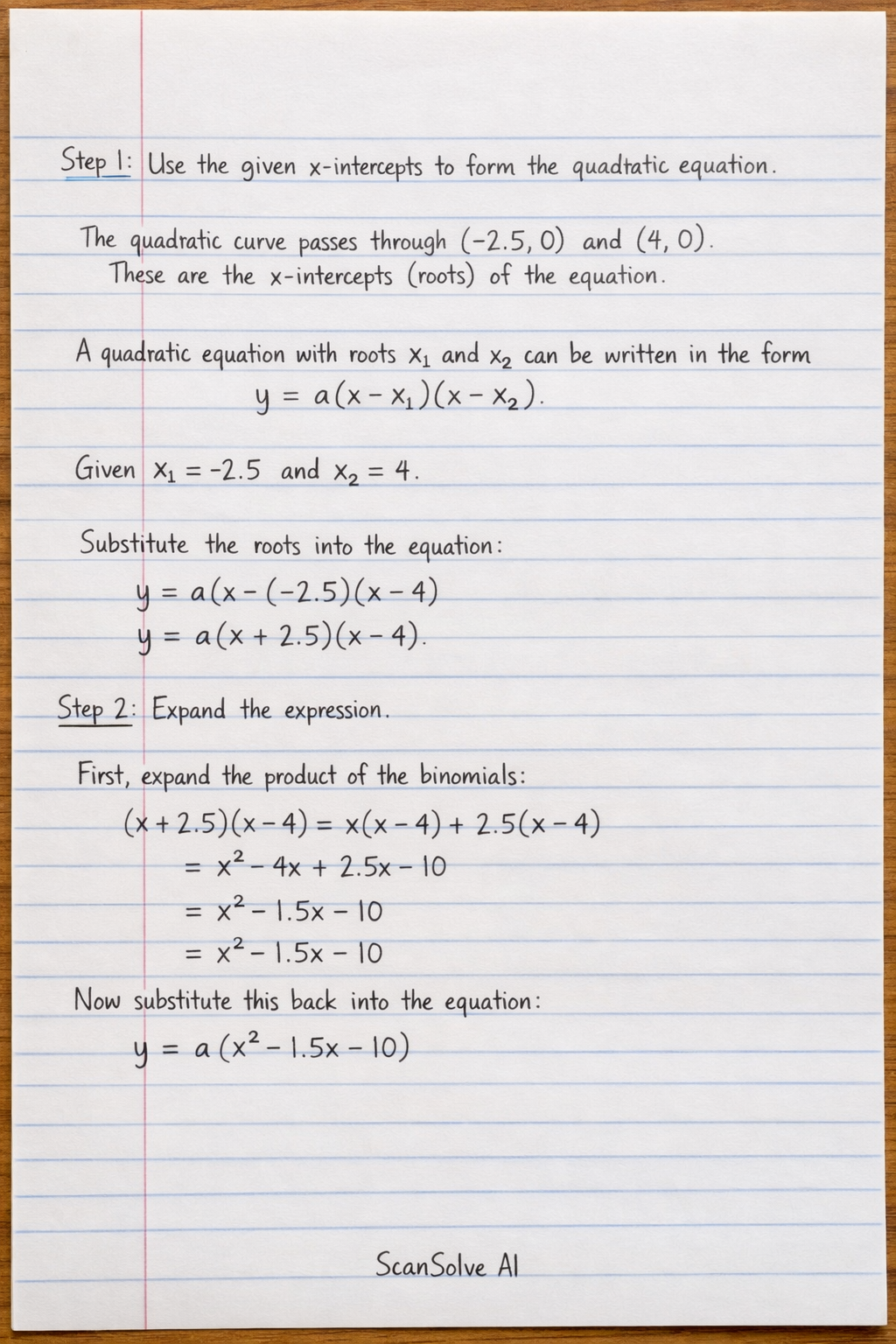
Step 1: Use the given x-intercepts to form the quadratic equation. The quadratic curve passes through (-2.5, 0) and (4, 0). These are the x-intercepts (roots) of the equation. A quadratic equation with roots x_1 and x_2 can be written in the form y = a(x - x_1)(x - x_2). Given x_1 = -2.5 and x_2 = 4. Substitute the roots into the equation: y = a(x - (-2.5))(x - 4) y = a(x + 2.5)(x - 4) Step 2: Expand the expression. First, expand the product of the binomials: (x + 2.5)(x - 4) = x(x - 4) + 2.5(x - 4) = x^2 - 4x + 2.5x - 10 = x^2 - 1.5x - 10 Now substitute this back into the equation: y = a(x^2 - 1.5x - 10) Step 3: Determine the value of a such that a, b, and c are integers. The equation is in the form y = ax^2 + bx + c. From our expanded form, y = ax^2 - 1.5ax - 10a. For b = -1.5a and c = -10a to be integers, a must be chosen carefully. The coefficient -1.5 can be written as -(3)/(2). So, y = a(x^2 - (3)/(2)x - 10). To make all coefficients integers, a must be a multiple of the denominator of the fraction, which is 2. The smallest positive integer value for a is 2. Let a = 2: y = 2(x^2 - (3)/(2)x - 10) y = 2x^2 - 2((3)/(2)x) - 2(10) y = 2x^2 - 3x - 20 In this equation, a=2, b=-3, and c=-20, which are all integers. The equation of the curve is y = 2x^2 - 3x - 20. Send me the next one 📸