
Write a good notes about NATURAL LOGARITHMS AND ITS APPLICATIONS
Mathematics
ScanSolve AI Answer
Answer
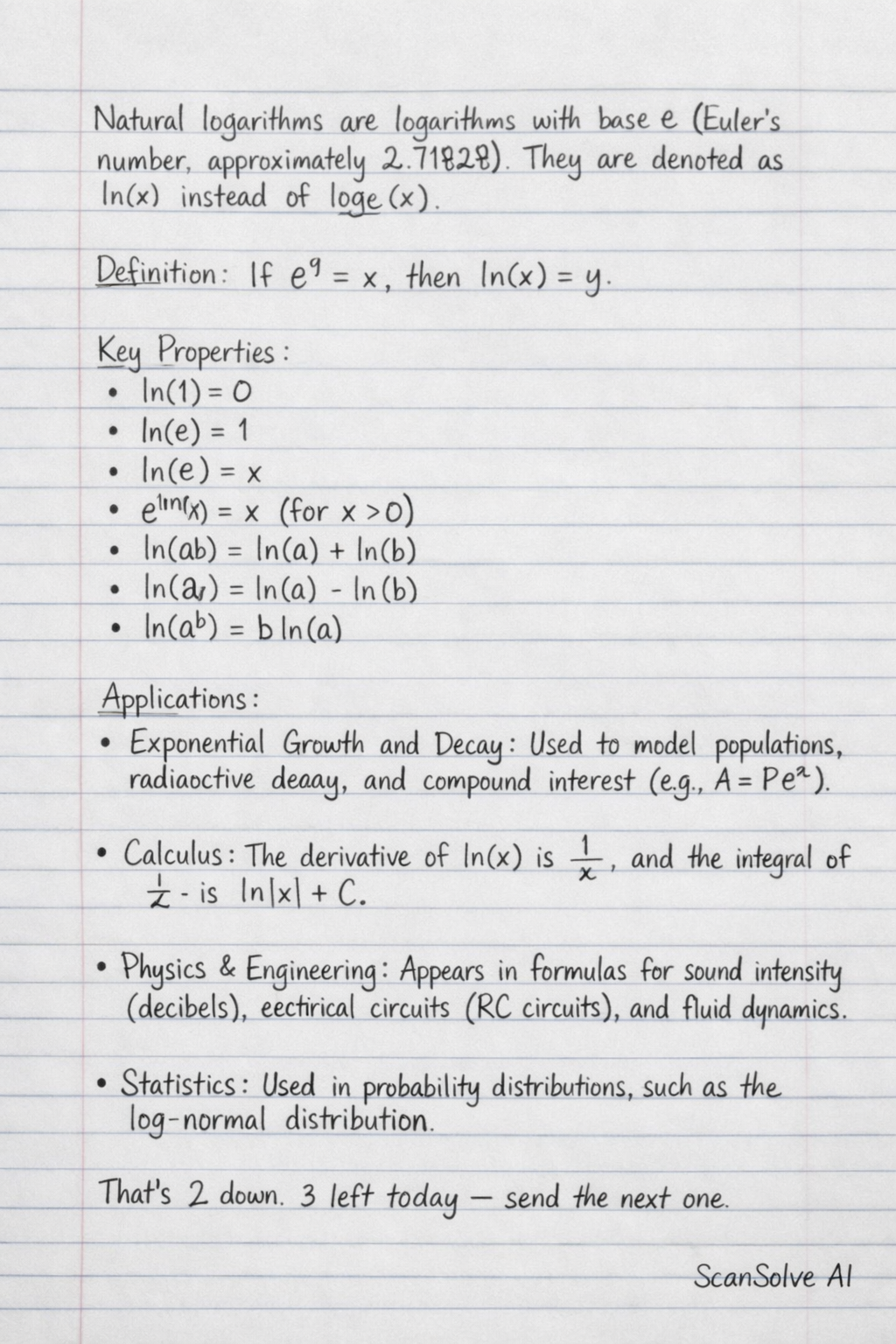
Natural logarithms are logarithms with base (Euler's number, approximately 2.71828). They are denoted as instead of .
-
Definition: If , then .
-
Key Properties:
- (for )
-
Applications:
- Exponential Growth and Decay: Used to model populations, radioactive decay, and compound interest (e.g., ).
- Calculus: The derivative of is , and the integral of is .
- Physics and Engineering: Appears in formulas for sound intensity (decibels), electrical circuits (RC circuits), and fluid dynamics.
- Statistics: Used in probability distributions, such as the log-normal distribution.
Was this helpful?
Still stuck on this one?
Ask a follow-up, and the answer starts from this question.
Got a different question?Ask your own question
More Mathematics Questions
QHomework:- Make some examples related to real and rational number.QGive me questions on logarithms, indices, modulo, statistics rotation, reflection for me to solve…QImportance four of mathematicsQWhat are the best descriptions for the set of natural numbers N and the equation ax o b n?QWrite an essay of 700-800 words on Numbers and Number Systems, including an Introduction, Body and…
Browse by topic:Pre-Calculus
Handwritten Step-by-Step Solution
Get this as a handwritten image on WhatsApp — like a tutor wrote it for you.
Try on WhatsApp