
We read your photo as:
Graph â riangle ABCâ ext with vertices â extA(-4, 4), B(-1, 7), and C(-1, 4)â ext and its image after a 270° clockwise rotation about the origin. Then, reflect a rectangle with vertices at â extA(-3,
ScanSolve AI Answer
Answer
A'(4, 4), B'(7, 1), C'(4, 1)
A'(-3, 3), B'(-1, 3), C'(-1, 0), D'(-3, 0)
Step-by-step solution
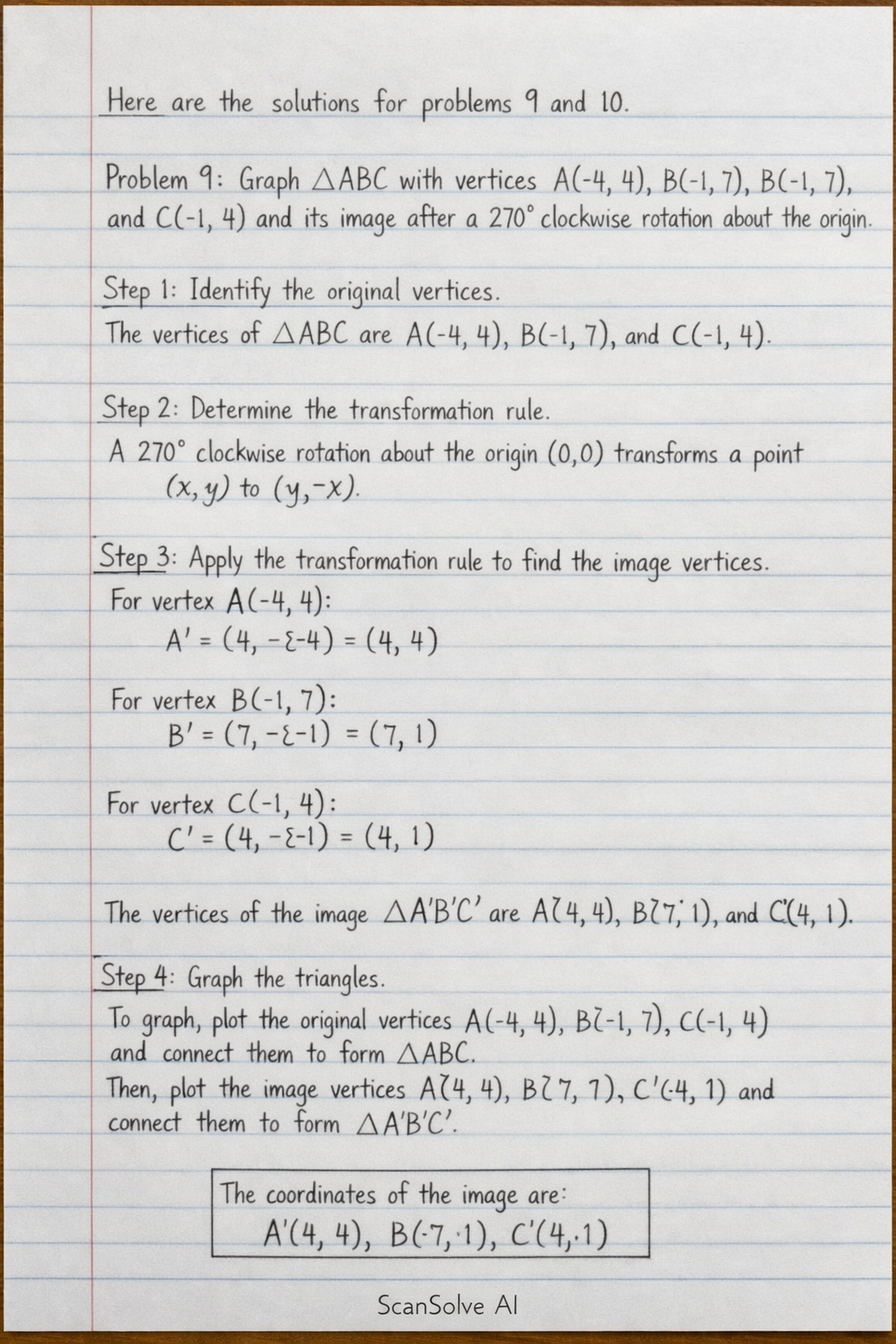
9 stepsHere are the solutions for problems 9 and 10.
: Graph with vertices , , and and its image after a 270° clockwise rotation about the origin.
Identify the original vertices.
The vertices of are , , and .
Determine the transformation rule.
A 270° clockwise rotation about the origin transforms a point to .
Apply the transformation rule to find the image vertices.
For vertex :
For vertex :
For vertex :
The vertices of the image are , , and .
Graph the triangles.
To graph, plot the original vertices , , and connect them to form .
Then, plot the image vertices , , and connect them to form .The coordinates of the image are:
: A rectangle has vertices at , , , and . Reflect the rectangle across the line and find the coordinates of the new vertices. Explain how the position of the shape changes after the reflection.
Identify the original vertices.
The vertices of the rectangle are , , , and .
Determine the transformation rule for reflection across .
A reflection across the horizontal line transforms a point to .
Here, , so the rule is .Apply the transformation rule to find the new vertices.
For vertex :
For vertex :
For vertex :
For vertex :
The coordinates of the new vertices are:
Explain how the position of the shape changes after the reflection.
The reflection across the line flips the rectangle vertically. Points that were below the line are now above it, and points that were above the line are now below it. The x-coordinates of the vertices remain unchanged, while the y-coordinates are transformed such that their distance from the line is preserved but on the opposite side.
Explain how the shape changes after the reflection.
Reflection is an isometry, which means it preserves the size and shape of the figure. The rectangle remains a rectangle of the same dimensions (length and width) and its angles remain 90 degrees. Only its position and orientation in the coordinate plane change.
Try one yourself
A new problem that tests the same skill.
Still stuck on this one?
Ask a follow-up, and the answer starts from this question.
More Mathematics Questions
Handwritten Step-by-Step Solution
Get this as a handwritten image on WhatsApp — like a tutor wrote it for you.
Try on WhatsApp