We read your photo as:

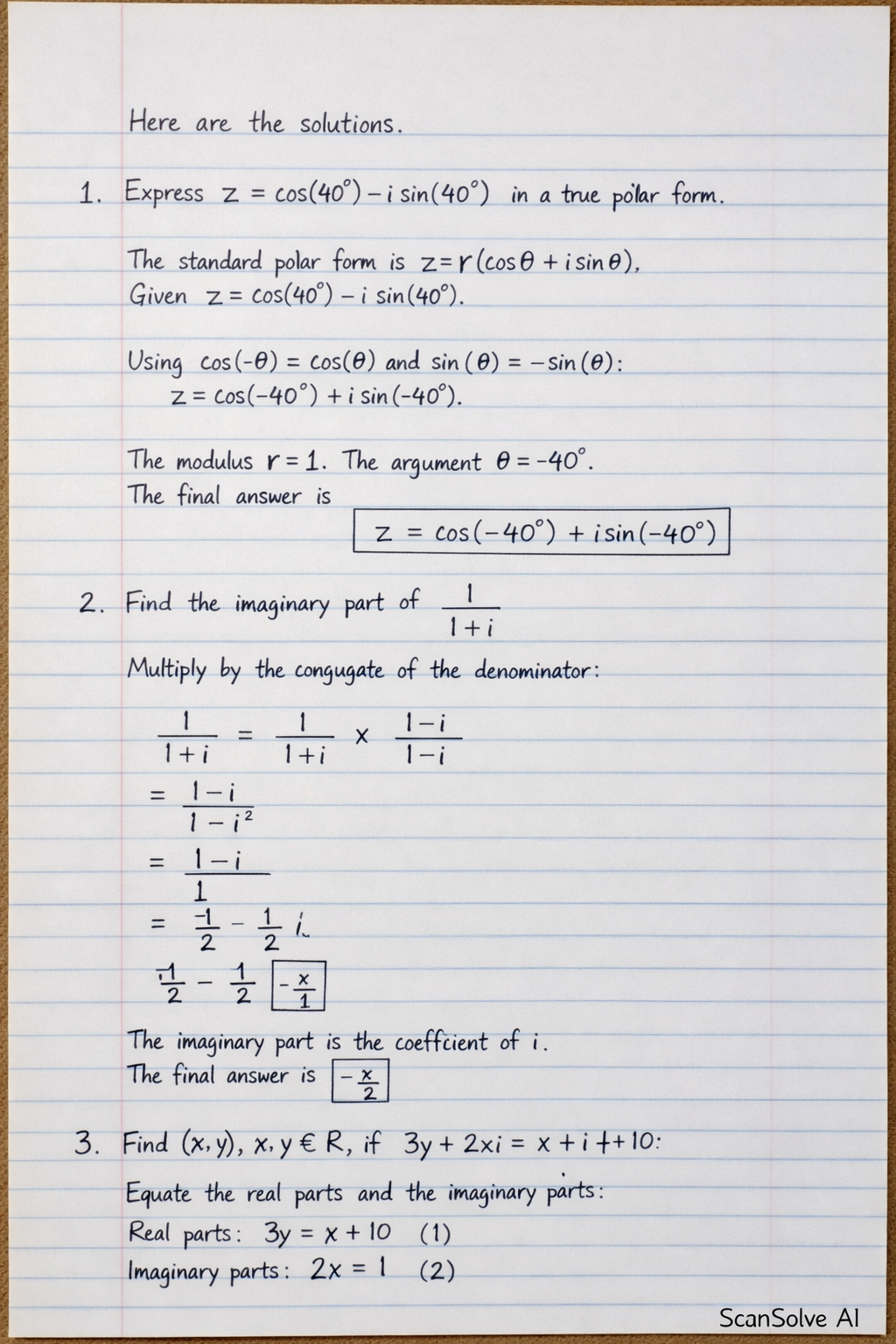
Here are the solutions. 1. Express z = (40^) - i(40^) in a true polar form. 2. Find the imaginary part of (1)/(1+i). 3. Find (x,y); x,y R, if 3y+2xi = x+i+10. 4. Evaluate the following powers of i: a)

Mathematics

ScanSolve AI Answer

Here are the solutions.

1. Express z=cos⁡(40∘)−isin⁡(40∘)z = \cos(40^\circ) - i\sin(40^\circ) in a true polar form.

The standard polar form is z=r(cos⁡θ+isin⁡θ)z = r(\cos\theta + i\sin\theta).
Given z=cos⁡(40∘)−isin⁡(40∘)z = \cos(40^\circ) - i\sin(40^\circ).
Using cos⁡(−θ)=cos⁡(θ)\cos(-\theta) = \cos(\theta) and sin⁡(−θ)=−sin⁡(θ)\sin(-\theta) = -\sin(\theta):

z=cos⁡(−40∘)+isin⁡(−40∘)z = \cos(-40^\circ) + i\sin(-40^\circ)

The modulus r=1r=1. The argument θ=−40∘\theta = -40^\circ.
The final answer is z=cos⁡(−40∘)+isin⁡(−40∘)\boxed{z = \cos(-40^\circ) + i\sin(-40^\circ)}.

2. Find the imaginary part of 11+i\frac{1}{1+i}.

Multiply by the conjugate of the denominator:

11+i=11+i×1−i1−i\frac{1}{1+i} = \frac{1}{1+i} \times \frac{1-i}{1-i} =1−i12−i2= \frac{1-i}{1^2 - i^2} =1−i1−(−1)= \frac{1-i}{1 - (-1)} =1−i2= \frac{1-i}{2} =12−12i= \frac{1}{2} - \frac{1}{2}i

The imaginary part is the coefficient of ii.
The final answer is −12\boxed{-\frac{1}{2}}.

3. Find (x,y)(x,y); x,y∈Rx,y \in \mathbb{R}, if 3y+2xi=x+i+103y+2xi = x+i+10.

Equate the real parts and the imaginary parts:
Real parts: 3y=x+10(1)3y = x+10 \quad (1)
Imaginary parts: 2x=1(2)2x = 1 \quad (2)

From (2):

x=12x = \frac{1}{2}

Substitute xx into (1):

3y=12+103y = \frac{1}{2} + 10 3y=12+2023y = \frac{1}{2} + \frac{20}{2} 3y=2123y = \frac{21}{2} y=212×3y = \frac{21}{2 \times 3} y=72y = \frac{7}{2}

The final answer is (12,72)\boxed{\left(\frac{1}{2}, \frac{7}{2}\right)}.

4. Evaluate the following powers of ii:

Recall that i1=ii^1=i, i2=−1i^2=-1, i3=−ii^3=-i, i4=1i^4=1. The powers repeat every 4.

*a) i8i^8:

i8=(i4)2=12=1i^8 = (i^4)^2 = 1^2 = 1

*b) i11i^{11}:

i11=i4×2+3=(i4)2⋅i3=12⋅(−i)=−ii^{11} = i^{4 \times 2 + 3} = (i^4)^2 \cdot i^3 = 1^2 \cdot (-i) = -i

*c) i42i^{42}:

i42=i4×10+2=(i4)10⋅i2=110⋅(−1)=−1i^{42} = i^{4 \times 10 + 2} = (i^4)^{10} \cdot i^2 = 1^{10} \cdot (-1) = -1

*d) i105i^{105}:

i105=i4×26+1=(i4)26⋅i1=126⋅i=ii^{105} = i^{4 \times 26 + 1} = (i^4)^{26} \cdot i^1 = 1^{26} \cdot i = i

The final answers are: a) 1\boxed{1}, b) −i\boxed{-i}, c) −1\boxed{-1}, d) i\boxed{i}.

5. Find the reciprocal of the number z=iz=i.

The reciprocal is 1z\frac{1}{z}:

1i=1i×−i−i\frac{1}{i} = \frac{1}{i} \times \frac{-i}{-i} =−i−i2= \frac{-i}{-i^2} =−i−(−1)= \frac{-i}{-(-1)} =−i1= \frac{-i}{1} =−i= -i

The final answer is −i\boxed{-i}.

Was this helpful?

Still stuck on this one?

Ask a follow-up, and the answer starts from this question.

Got a different question?Ask your own question
Handwritten step-by-step solution preview

Handwritten Step-by-Step Solution

Get this as a handwritten image on WhatsApp — like a tutor wrote it for you.

Try on WhatsApp