
We read your photo as:
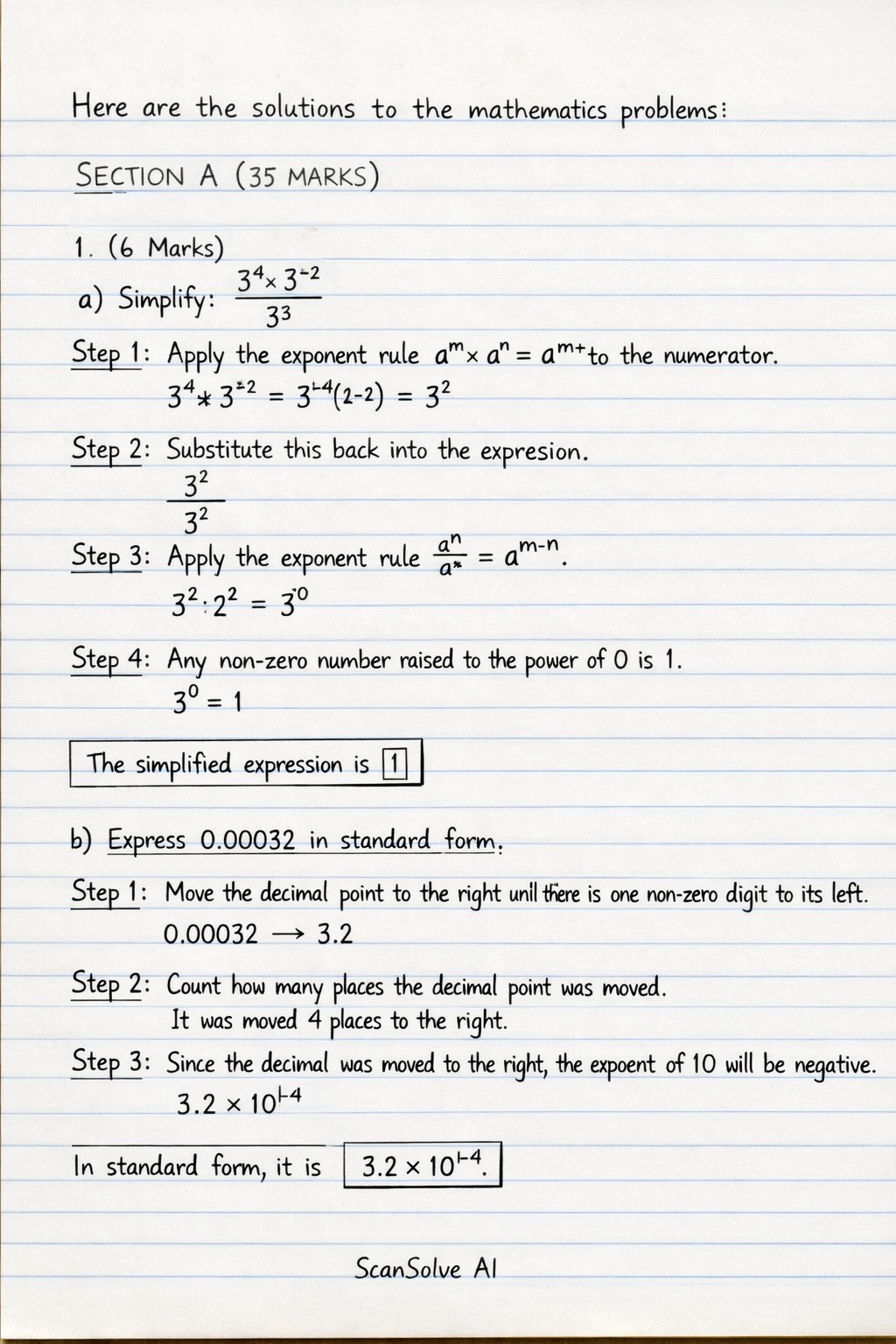
Here are the solutions to the mathematics problems: SECTION A (35 MARKS) 1. (6 Marks) a) Simplify: rac34 imes 3-232 b) Express 0.00032 in standard form. c) Rationalize and simplify: rac5sqrt(3)
ScanSolve AI Answer
Step-by-step solution
41 stepsHere are the solutions to the mathematics problems:
SECTION A (35 MARKS)
1. (6 Marks)
- a) Simplify:
Apply the exponent rule to the numerator.
$$ 3^4 \times 3^{-2} = 3^{4 + (-2)} = 3^{4-2} = 3^2 $$Substitute this back into the expression.
$$ \frac{3^2}{3^2} $$Apply the exponent rule .
$$ 3^{2-2} = 3^0 $$Any non-zero number raised to the power of 0 is 1.
$$ 3^0 = 1 $$ The simplified expression is $\boxed{1}$.- b) Express 0.00032 in standard form.
Move the decimal point to the right until there is one non-zero digit to its left.
$$ 0.00032 \to 3.2 $$Count how many places the decimal point was moved.
It was moved 4 places to the right.
Since the decimal was moved to the right, the exponent of 10 will be negative.
$$ 3.2 \times 10^{-4} $$ In standard form, it is $\boxed{3.2 \times 10^{-4}}$.- c) Rationalize and simplify:
To rationalize the denominator, multiply both the numerator and the denominator by .
$$ \frac{5}{\sqrt{3}} \times \frac{\sqrt{3}}{\sqrt{3}} $$Multiply the numerators and the denominators.
$$ \frac{5\sqrt{3}}{(\sqrt{3})^2} $$Simplify the denominator.
$$ \frac{5\sqrt{3}}{3} $$ The rationalized and simplified expression is $\boxed{\frac{5\sqrt{3}}{3}}$.- d) Evaluate:
Simplify by finding the largest perfect square factor.
$$ \sqrt{50} = \sqrt{25 \times 2} = \sqrt{25} \times \sqrt{2} = 5\sqrt{2} $$Simplify by finding the largest perfect square factor.
$$ \sqrt{8} = \sqrt{4 \times 2} = \sqrt{4} \times \sqrt{2} = 2\sqrt{2} $$Substitute the simplified radicals back into the expression.
$$ 5\sqrt{2} + 3(2\sqrt{2}) $$Multiply the terms.
$$ 5\sqrt{2} + 6\sqrt{2} $$Combine the like terms.
$$ (5+6)\sqrt{2} = 11\sqrt{2} $$ The evaluated expression is $\boxed{11\sqrt{2}}$.2. (7 Marks)
- a) Expand and simplify:
Expand the first product using FOIL.
$$ (2x)(x) + (2x)(5) + (-3)(x) + (-3)(5) $$ $$ 2x^2 + 10x - 3x - 15 $$ $$ 2x^2 + 7x - 15 $$Expand the second term using the formula .
$$ (x)^2 - 2(x)(4) + (4)^2 $$ $$ x^2 - 8x + 16 $$Substitute the expanded terms back into the original expression.
Remember to distribute the negative sign to all terms in the second expansion.
Combine like terms.
$$ (2x^2 - x^2) + (7x + 8x) + (-15 - 16) $$ $$ x^2 + 15x - 31 $$ The expanded and simplified expression is $\boxed{x^2 + 15x - 31}$.- b) Factorize completely:
Find two numbers that multiply to and add up to .
These numbers are and 1.
Rewrite the middle term using these two numbers.
$$ 3x^2 - 12x + x - 4 $$Factor by grouping.
$$ 3x(x - 4) + 1(x - 4) $$Factor out the common binomial factor .
$$ (x-4)(3x+1) $$ The completely factorized expression is $\boxed{(x-4)(3x+1)}$.- c) Solve:
Add 9 to both sides of the equation.
$$ 4x^2 = 9 $$Divide both sides by 4.
$$ x^2 = \frac{9}{4} $$Take the square root of both sides, remembering both positive and negative roots.
$$ x = \pm\sqrt{\frac{9}{4}} $$ $$ x = \pm\frac{\sqrt{9}}{\sqrt{4}} $$ $$ x = \pm\frac{3}{2} $$ The solutions are $\boxed{x = \frac{3}{2} \text{ or } x = -\frac{3}{2}}$.3. (6 Marks)
- Solve:
Use the elimination method.
Multiply Equation 2 by 2 to make the coefficients of opposites.
Add Equation 1 and Equation 3.
$$ (3x + 2y) + (4x - 2y) = 17 + 8 $$ $$ 7x = 25 $$Solve for .
$$ x = \frac{25}{7} $$Substitute the value of into Equation 2 to solve for .
$$ 2\left(\frac{25}{7}\right) - y = 4 $$ $$ \frac{50}{7} - y = 4 $$Isolate .
$$ -y = 4 - \frac{50}{7} $$ $$ -y = \frac{28}{7} - \frac{50}{7} $$ $$ -y = -\frac{22}{7} $$ $$ y = \frac{22}{7} $$ The solution is $\boxed{x = \frac{25}{7}, y = \frac{22}{7}}$.4. (8 Marks)
A projectile is modeled by .
- a) Find the maximum height. The maximum height occurs at the vertex of the parabola. For a quadratic equation , the t-coordinate of the vertex is given by .
Identify and from the equation .
$$ a = -2, \quad b = 12 $$Calculate the time at which the maximum height occurs.
$$ t = \frac{-12}{2(-2)} = \frac{-12}{-4} = 3 $$Substitute into the height equation to find the maximum height .
$$ h = -2(3)^2 + 12(3) + 5 $$ $$ h = -2(9) + 36 + 5 $$ $$ h = -18 + 36 + 5 $$ $$ h = 18 + 5 $$ $$ h = 23 $$ The maximum height is $\boxed{23 \text{ units}}$.- b) Determine the time when the projectile hits the ground. The projectile hits the ground when its height is 0.
Set the equation to 0.
$$ -2t^2 + 12t + 5 = 0 $$Use the quadratic formula .
Here , , .
Calculate the square root of 184.
.
Calculate the two possible values for .
$$ t_1 = \frac{-12 + 13.56}{-4} = \frac{1.56}{-4} = -0.39 $$ $$ t_2 = \frac{-12 - 13.56}{-4} = \frac{-25.56}{-4} = 6.39 $$ Since time cannot be negative, we take the positive value. The projectile hits the ground at approximately $\boxed{6.39 \text{ units of time}}$.- c) Find the average rate of change between and . The average rate of change is given by .
Calculate .
$$ h(1) = -2(1)^2 + 12(1) + 5 $$ $$ h(1) = -2 + 12 + 5 = 15 $$Calculate .
$$ h(3) = -2(3)^2 + 12(3) + 5 $$ $$ h(3) = -2(9) + 36 + 5 $$ $$ h(3) = -18 + 36 + 5 = 23 $$Calculate the average rate of change.
$$
\text{Average rate of change} = \frac{h(3) - h(1)}{3 - 1}
$$
$$
= \frac{23 - 15}{2}
$$
$$
= \frac{8}{2}
$$
$$
= 4
$$
The average rate of change between $t=1$ and $t=3$ is $\boxed{4 \text{ units of height per unit of time}}$.
Still stuck on this one?
Ask a follow-up, and the answer starts from this question.
More Mathematics Questions
Handwritten Step-by-Step Solution
Get this as a handwritten image on WhatsApp — like a tutor wrote it for you.
Try on WhatsApp