

This mathematics problem involves applying core mathematical principles and formulas. Below you will find a complete step-by-step solution with detailed explanations for each step, helping you understand not just the answer but the method behind it.
ScanSolve AI Answer
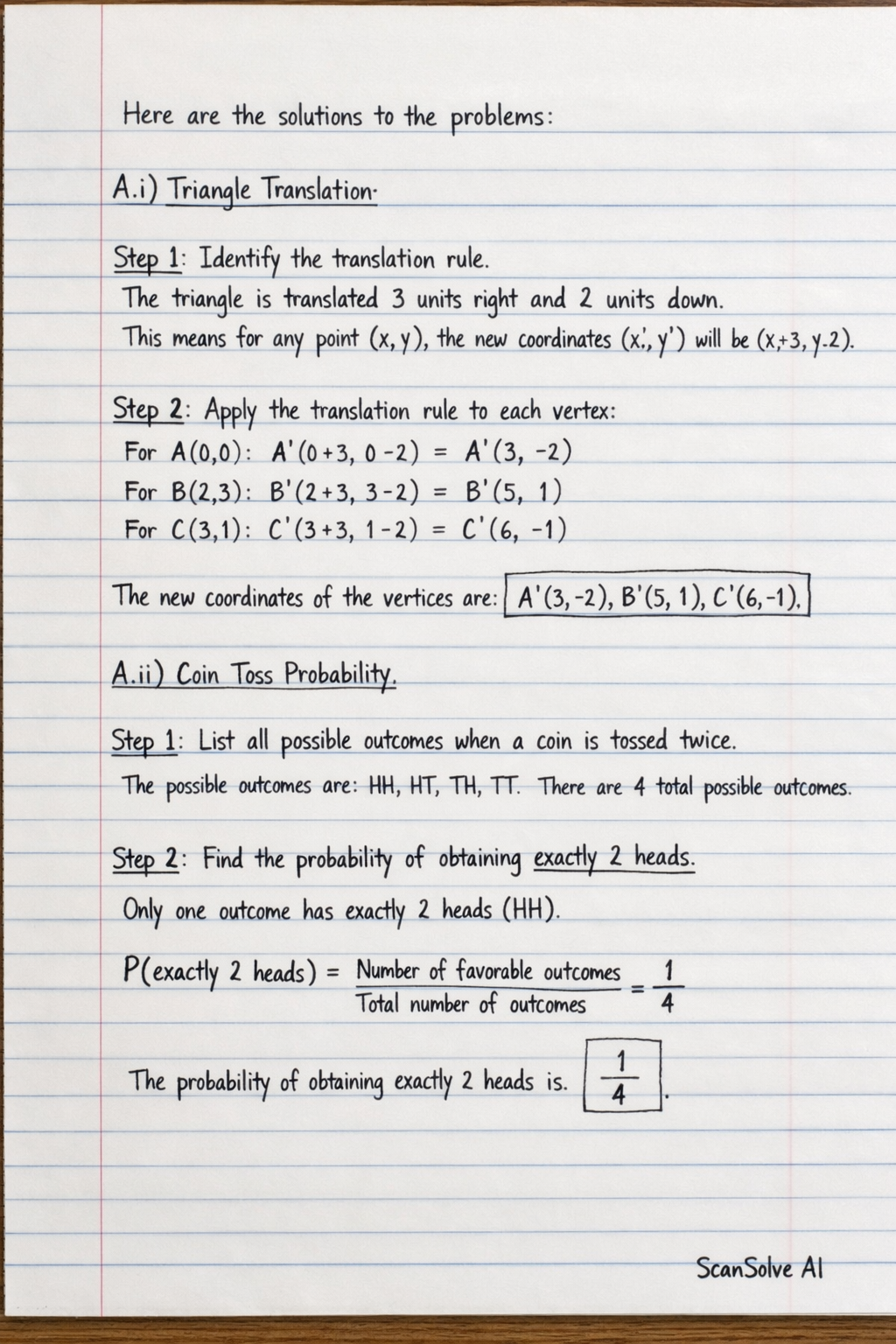
Here are the solutions to the problems: A.i) Triangle Translation Step 1: Identify the translation rule. The triangle is translated 3 units right and 2 units down. This means for any point (x, y), the new coordinates (x', y') will be (x+3, y-2). Step 2: Apply the translation rule to each vertex. For A(0,0): A'(0+3, 0-2) = A'(3, -2) For B(2,3): B'(2+3, 3-2) = B'(5, 1) For C(3,1): C'(3+3, 1-2) = C'(6, -1) The new coordinates of the vertices are A'(3, -2), B'(5, 1), C'(6, -1). A.ii) Coin Toss Probability Step 1: List all possible outcomes when a coin is tossed twice. The possible outcomes are: HH, HT, TH, TT. There are 4 total possible outcomes. Step 2: Find the probability of obtaining exactly 2 heads. Only one outcome has exactly 2 heads (HH). P(exactly 2 heads) = Number of favorable outcomesTotal number of outcomes = (1)/(4) The probability of obtaining exactly 2 heads is (1)/(4). Step 3: Find the probability of obtaining no head. Only one outcome has no head (TT). P(no head) = Number of favorable outcomesTotal number of outcomes = (1)/(4) The probability of obtaining no head is (1)/(4). A.iii) Addition Step 1: Identify the numbers to be added. The numbers are 4,367, 635,486 (assuming 6,35,486 is a typo for 635,486), and 8,039. Step 2: Perform the addition. 4367 + 635486 + 8039 = 647892 The sum of the numbers is 647,892. B) Data Analysis The table shows the marks scored by 7 learners: | Students | Dwo | Aloa | Sisimuden | Loaso | Abid | Animfoo | Wohohantan | |----------|-----|------|-----------|-------|------|---------|------------| | Mark | 60 | 65 | 70 | 66 | 75 | 80 | 85 | B.a) Draw a line graph for the data. Step 1: Set up the axes. Draw a horizontal axis (x-axis) for the Students and a vertical axis (y-axis) for the Mark scored. Label the x-axis with the names of the students and the y-axis with a suitable scale for marks (e.g., from 0 to 100). Step 2: Plot the points. For each student, plot a point corresponding to their mark. For example, plot a point at (Dwo, 60), (Aloa, 65), (Sisimuden, 70), (Loaso, 66), (Abid, 75), (Animfoo, 80), and (Wohohantan, 85). Step 3: Connect the points. Draw straight lines connecting the plotted points in the order the students appear in the table. B.b) Which of them scored the highest mark? Step 1: Examine the marks in the table. The marks are 60, 65, 70, 66, 75, 80, 85. Step 2: Identify the highest mark and the student who scored it. The highest mark is 85, which was scored by Wohohantan. The student who scored the highest mark is Wohohantan. B.c) Which of them scored the least mark? Step 1: Examine the marks in the table. The marks are 60, 65, 70, 66, 75, 80, 85. Step 2: Identify the least mark and the student who scored it. The least mark is 60, which was scored by Dwo. The student who scored the least mark is Dwo. B.d) Find the total mark scored by Atopa, Sisimuden, and Wohohantan. Step 1: Identify the marks for the specified students. Assuming "Atopa" is a typo for "Aloa" from the table: Aloa's mark: 65 Sisimuden's mark: 70 Wohohantan's mark: 85 Step 2: Calculate the sum of their marks. 65 + 70 + 85 = 220 The total mark scored by Aloa, Sisimuden, and Wohohantan is 220. B.e) What is the difference between the total mark scored by Aloa, Animfoo, Wohohantan, and Dwo, Atopa, Toaso? Step 1: Calculate the total mark for the first group (Aloa, Animfoo, Wohohantan). Aloa: 65 Animfoo: 80 Wohohantan: 85 65 + 80 + 85 = 230 Step 2: Calculate the total mark for the second group (Dwo, Aloa, Loaso). Assuming "Atopa" is a typo for "Aloa" and "Toaso" is a typo for "Loaso" from the table: Dwo: 60 Aloa: 65 Loaso: 66 60 + 65 + 66 = 191 Step 3: Find the difference between the two totals. 230 - 191 = 39 The difference between the total marks of the two groups is 39. 3 done, 2 left today. You're making progress.