
We read your photo as:
A coin tossed three times, find the probability of getting: (i) 3 heads (ii) Not 3 heads (iii) At least 2 heads (iv) At least two tails
ScanSolve AI Answer
Answers
4 partsStep-by-step solution
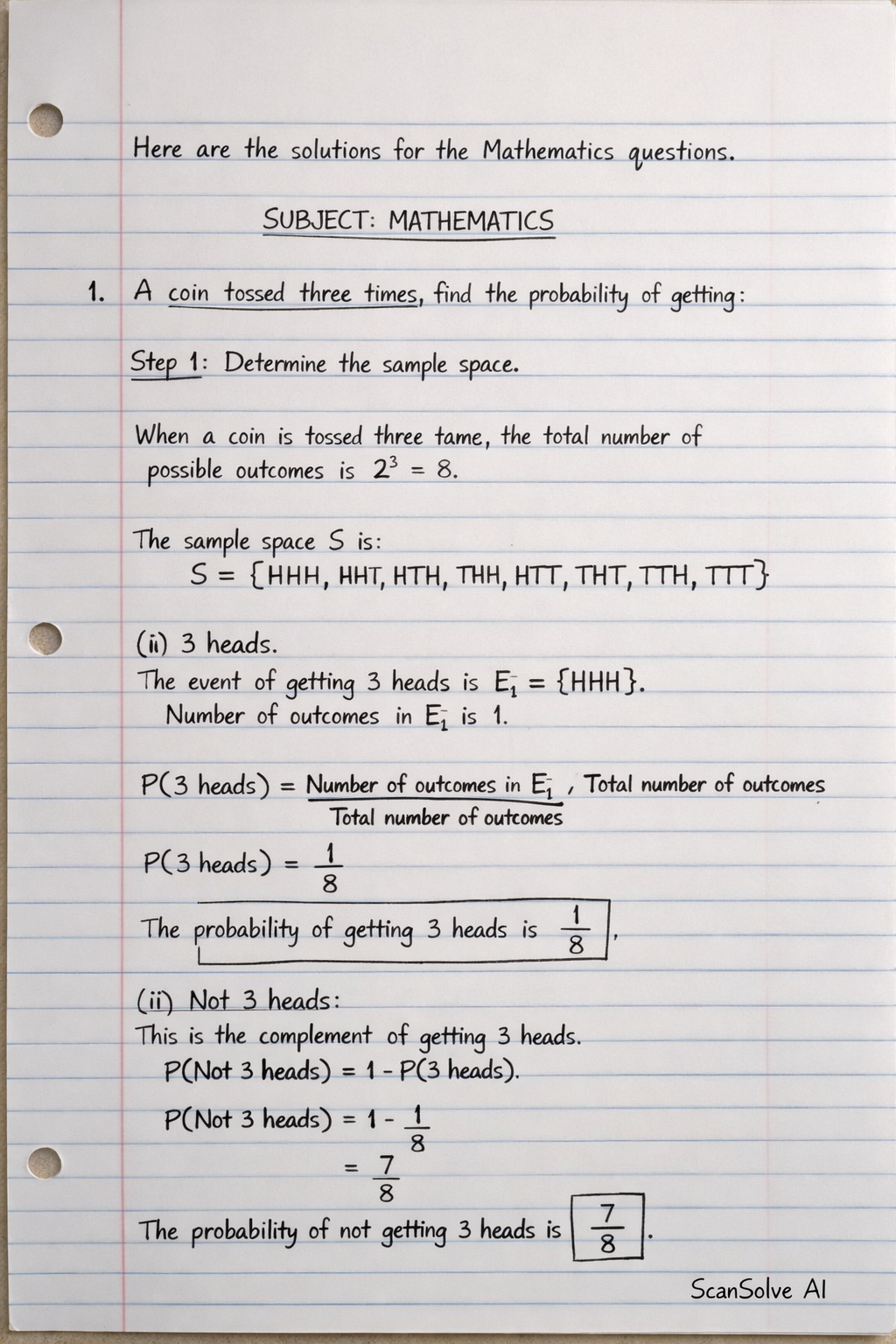
2 stepsHere are the solutions for the Mathematics questions.
SUBJECT: MATHEMATICS
1. A coin tossed three times, find the probability of getting:
Step 1: Determine the sample space.
When a coin is tossed three times, the total number of possible outcomes is .
The sample space is:
Part i
3 heads
The event of getting 3 heads is .
The number of outcomes in is 1.
The probability of getting 3 heads is .
Part ii
Not 3 heads
This is the complement of getting 3 heads.
The probability of not getting 3 heads is .
Part iii
At least 2 heads
The event of getting at least 2 heads means getting 2 heads or 3 heads.
Outcomes with 2 heads:
Outcomes with 3 heads:
The event .
The number of outcomes in is 4.
The probability of getting at least 2 heads is .
Part iv
At least two tails
The event of getting at least two tails means getting 2 tails or 3 tails.
Outcomes with 2 tails:
Outcomes with 3 tails:
The event .
The number of outcomes in is 4.
The probability of getting at least two tails is .
2. The favorite fruits of 40 students are in the table below:
| Fruit | Oranges | Apples | Mangoes | Grapes |
|---|---|---|---|---|
| Frequency | 15 | 7 | 8 | 10 |
Calculate the angles for the pie chart.
The total number of students is 40. The total angle in a circle is .
Angle for Oranges:Angle for Apples:
Angle for Mangoes:
Angle for Grapes:
Note: I cannot draw the pie chart in this format, but these are the calculations needed to construct it.
Calculate the fraction of mangoes.
The frequency of mangoes is 8.
The total number of students is 40.The fraction of mangoes is .
Try one yourself
A new problem that tests the same skill.
Still stuck on this one?
Ask a follow-up, and the answer starts from this question.
More Mathematics Questions
Handwritten Step-by-Step Solution
Get this as a handwritten image on WhatsApp — like a tutor wrote it for you.
Try on WhatsApp