We read your photo as:

I. (Cos x)/(1+Cos x) + (1+Sin x)/(Cos x) = 2Sec x ii. (Sin x+Tan x)/(1+Cos x) = Tan x

Mathematics

ScanSolve AI Answer

Answers

2 parts
i

cos⁡x1+sin⁡x+1+sin⁡xcos⁡x=2sec⁡x\frac{\cos x}{1+\sin x} + \frac{1+\sin x}{\cos x} = 2\sec x

ii

sin⁡x+tan⁡x1+cos⁡x=tan⁡x\frac{\sin x + \tan x}{1+\cos x} = \tan x

Step-by-step solution

12 steps

Here are the proofs for the trigonometric identities:

Part i· 6 steps

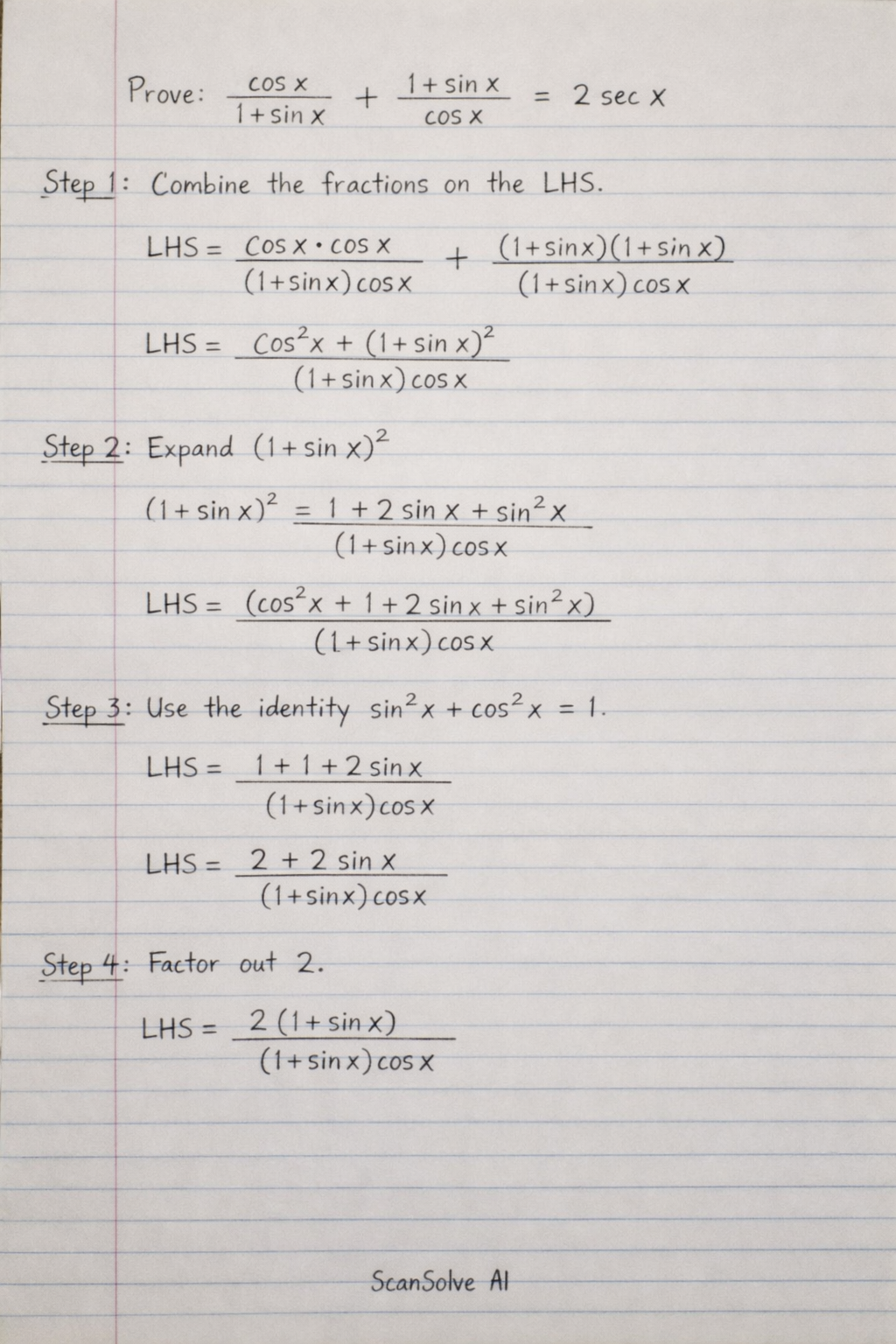
Prove cos⁡x1+sin⁡x+1+sin⁡xcos⁡x=2sec⁡x\frac{\cos x}{1+\sin x} + \frac{1+\sin x}{\cos x} = 2\sec x

  1. Combine the fractions on the left-hand side (LHS) using a common denominator, which is (1+sin⁡x)(cos⁡x)(1+\sin x)(\cos x).

    LHS=cos⁡x⋅cos⁡x(1+sin⁡x)cos⁡x+(1+sin⁡x)(1+sin⁡x)(1+sin⁡x)cos⁡x\text{LHS} = \frac{\cos x \cdot \cos x}{(1+\sin x)\cos x} + \frac{(1+\sin x)(1+\sin x)}{(1+\sin x)\cos x} LHS=cos⁡2x+(1+sin⁡x)2(1+sin⁡x)cos⁡x\text{LHS} = \frac{\cos^2 x + (1+\sin x)^2}{(1+\sin x)\cos x}
  2. Expand the term (1+sin⁡x)2(1+\sin x)^2 in the numerator.

    (1+sin⁡x)2=12+2(1)(sin⁡x)+(sin⁡x)2=1+2sin⁡x+sin⁡2x(1+\sin x)^2 = 1^2 + 2(1)(\sin x) + (\sin x)^2 = 1 + 2\sin x + \sin^2 x

    Substitute this back into the numerator:

    LHS=cos⁡2x+1+2sin⁡x+sin⁡2x(1+sin⁡x)cos⁡x\text{LHS} = \frac{\cos^2 x + 1 + 2\sin x + \sin^2 x}{(1+\sin x)\cos x}
  3. Apply the Pythagorean identity sin⁡2x+cos⁡2x=1\sin^2 x + \cos^2 x = 1 to simplify the numerator.

    LHS=(cos⁡2x+sin⁡2x)+1+2sin⁡x(1+sin⁡x)cos⁡x\text{LHS} = \frac{(\cos^2 x + \sin^2 x) + 1 + 2\sin x}{(1+\sin x)\cos x} LHS=1+1+2sin⁡x(1+sin⁡x)cos⁡x\text{LHS} = \frac{1 + 1 + 2\sin x}{(1+\sin x)\cos x} LHS=2+2sin⁡x(1+sin⁡x)cos⁡x\text{LHS} = \frac{2 + 2\sin x}{(1+\sin x)\cos x}
  4. Factor out 2 from the numerator.

    LHS=2(1+sin⁡x)(1+sin⁡x)cos⁡x\text{LHS} = \frac{2(1+\sin x)}{(1+\sin x)\cos x}
  5. Cancel the common term (1+sin⁡x)(1+\sin x) from the numerator and denominator.

    LHS=2cos⁡x\text{LHS} = \frac{2}{\cos x}
  6. Use the reciprocal identity sec⁡x=1cos⁡x\sec x = \frac{1}{\cos x}.

    LHS=2sec⁡x\text{LHS} = 2\sec x

    This matches the right-hand side (RHS).

    cos⁡x1+sin⁡x+1+sin⁡xcos⁡x=2sec⁡x\boxed{\frac{\cos x}{1+\sin x} + \frac{1+\sin x}{\cos x} = 2\sec x}

Part ii

sin⁡x+tan⁡x1+cos⁡x=tan⁡x\frac{\sin x + \tan x}{1+\cos x} = \tan x

Prove sin⁡x+tan⁡x1+cos⁡x=tan⁡x\frac{\sin x + \tan x}{1+\cos x} = \tan x

  1. Rewrite tan⁡x\tan x in terms of sin⁡x\sin x and cos⁡x\cos x on the left-hand side (LHS).

    LHS=sin⁡x+sin⁡xcos⁡x1+cos⁡x\text{LHS} = \frac{\sin x + \frac{\sin x}{\cos x}}{1+\cos x}
  2. Combine the terms in the numerator by finding a common denominator for the numerator.

    LHS=sin⁡xcos⁡xcos⁡x+sin⁡xcos⁡x1+cos⁡x\text{LHS} = \frac{\frac{\sin x \cos x}{\cos x} + \frac{\sin x}{\cos x}}{1+\cos x} LHS=sin⁡xcos⁡x+sin⁡xcos⁡x1+cos⁡x\text{LHS} = \frac{\frac{\sin x \cos x + \sin x}{\cos x}}{1+\cos x}
  3. Factor out sin⁡x\sin x from the numerator's numerator.

    LHS=sin⁡x(cos⁡x+1)cos⁡x1+cos⁡x\text{LHS} = \frac{\frac{\sin x (\cos x + 1)}{\cos x}}{1+\cos x}
  4. Rewrite the complex fraction as a multiplication.

    LHS=sin⁡x(cos⁡x+1)cos⁡x⋅11+cos⁡x\text{LHS} = \frac{\sin x (\cos x + 1)}{\cos x} \cdot \frac{1}{1+\cos x}
  5. Cancel the common term (cos⁡x+1)(\cos x + 1) from the numerator and denominator.

    LHS=sin⁡xcos⁡x\text{LHS} = \frac{\sin x}{\cos x}
  6. Use the identity tan⁡x=sin⁡xcos⁡x\tan x = \frac{\sin x}{\cos x}.

    LHS=tan⁡x\text{LHS} = \tan x

    This matches the right-hand side (RHS).

    sin⁡x+tan⁡x1+cos⁡x=tan⁡x\boxed{\frac{\sin x + \tan x}{1+\cos x} = \tan x}
Was this helpful?

Try one yourself

A new problem that tests the same skill.

Still stuck on this one?

Ask a follow-up, and the answer starts from this question.

Got a different question?Ask your own question
Handwritten step-by-step solution preview

Handwritten Step-by-Step Solution

Get this as a handwritten image on WhatsApp — like a tutor wrote it for you.

Try on WhatsApp