
This mathematics problem involves applying core mathematical principles and formulas. Below you will find a complete step-by-step solution with detailed explanations for each step, helping you understand not just the answer but the method behind it.
ScanSolve AI Answer
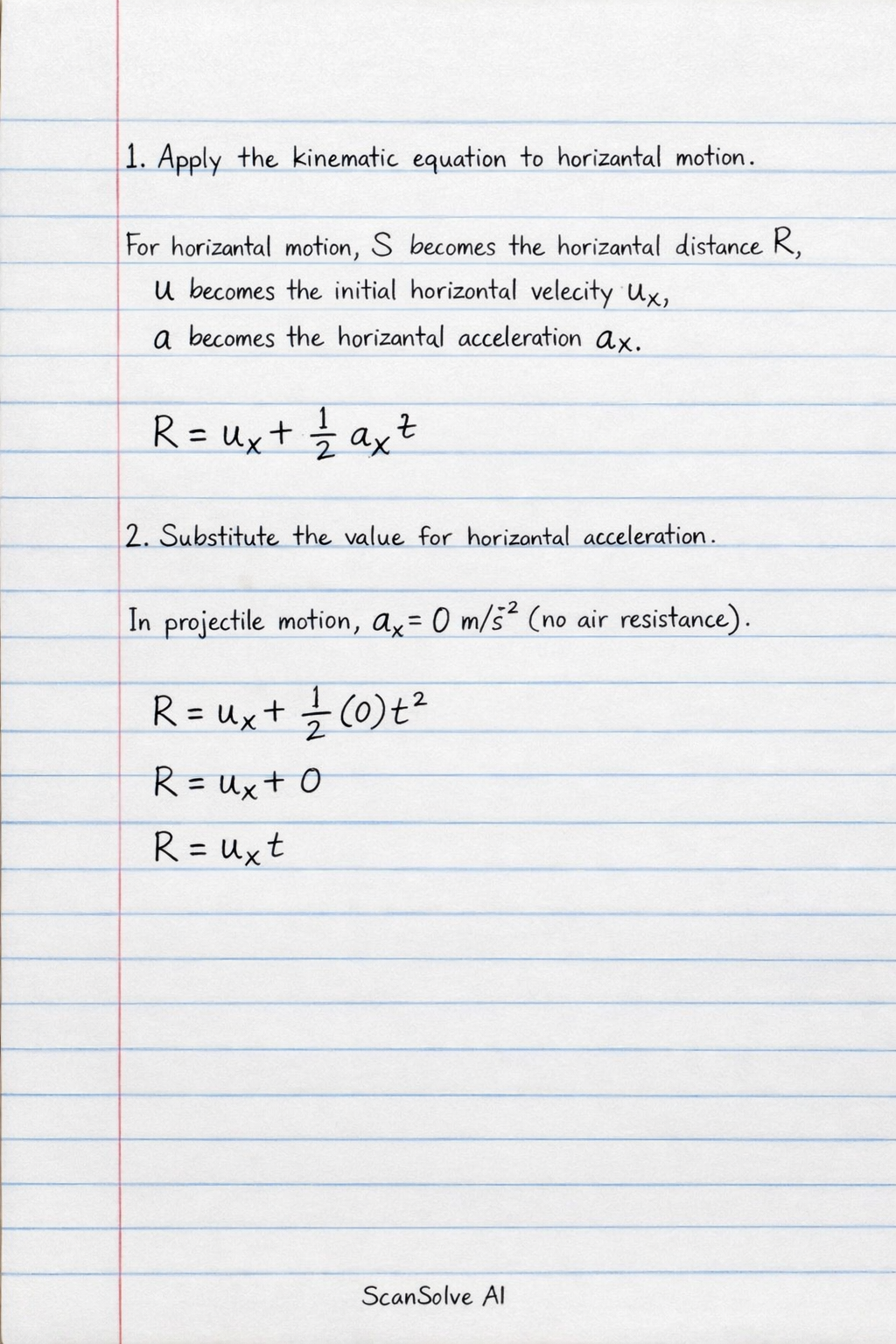
You are asking to use the general kinematic equation S = ut + (1)/(2)at^2 to solve for the horizontal distance, which was denoted as R in the previous problem (and you are referring to as 'c'). Step 1: Apply the kinematic equation to horizontal motion. For horizontal motion, the displacement S becomes the horizontal distance R, the initial velocity u becomes the initial horizontal velocity u_x, and the acceleration a becomes the horizontal acceleration a_x. R = u_x t + (1)/(2)a_x t^2 Step 2: Substitute the value for horizontal acceleration. In projectile motion, assuming no air resistance, the horizontal acceleration a_x is 0 \, m/s^2. R = u_x t + (1)/(2)(0)t^2 R = u_x t Step 3: Substitute the values from the previous problem. From the previous problem: Initial horizontal velocity u_x = 10 \, m/s Time taken to reach the ground t = sqrt(10) \, s (calculated in part a) R = (10 \, m/s)(sqrt(10) \, s) R = 10sqrt(10) \, m R ≈ 31.62 \, m The horizontal distance (c) is 31.6 m.