
We read your photo as:
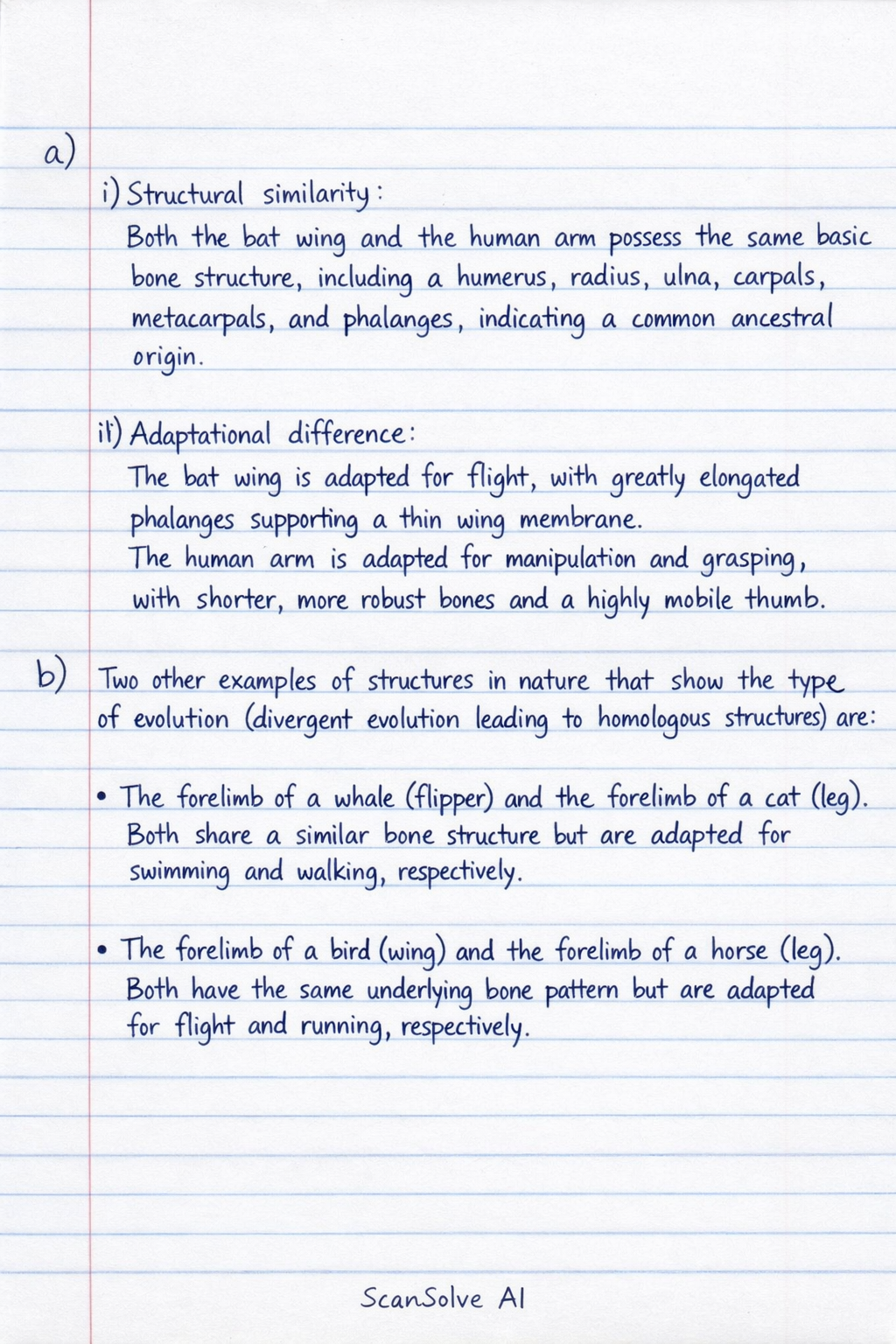
I) Structural similarity: Both the bat wing and the human arm possess the same basic bone structure, including a humerus, radius, ulna, carpals, metacarpals, and phalanges, indicating a common ances
ScanSolve AI Answer
a)
i) Structural similarity: Both the bat wing and the human arm possess the same basic bone structure, including a humerus, radius, ulna, carpals, metacarpals, and phalanges, indicating a common ancestral origin.
ii) Adaptational difference: The bat wing is adapted for flight, with greatly elongated phalanges supporting a thin wing membrane. The human arm is adapted for manipulation and grasping, with shorter, more robust bones and a highly mobile thumb.
b) Two other examples of structures in nature that show the type of evolution (divergent evolution leading to homologous structures) are:
- The forelimb of a whale (flipper) and the forelimb of a cat (leg). Both share a similar bone structure but are adapted for swimming and walking, respectively.
- The forelimb of a bird (wing) and the forelimb of a horse (leg). Both have the same underlying bone pattern but are adapted for flight and running, respectively.
c)
- Chemical evolution refers to the process by which simple inorganic molecules on early Earth gradually combined to form more complex organic molecules, eventually leading to the formation of the first living cells. It describes the origin of life from non-living matter.
- Organic evolution (or biological evolution) refers to the gradual change in the heritable characteristics of biological populations over successive generations. It describes the diversification and adaptation of living organisms after life originated.
d) The study of fossils is called Paleontology.
Still stuck on this one?
Ask a follow-up, and the answer starts from this question.
More Mathematics Questions
Handwritten Step-by-Step Solution
Get this as a handwritten image on WhatsApp — like a tutor wrote it for you.
Try on WhatsApp