
This mathematics problem involves applying core mathematical principles and formulas. Below you will find a complete step-by-step solution with detailed explanations for each step, helping you understand not just the answer but the method behind it.
ScanSolve AI Answer
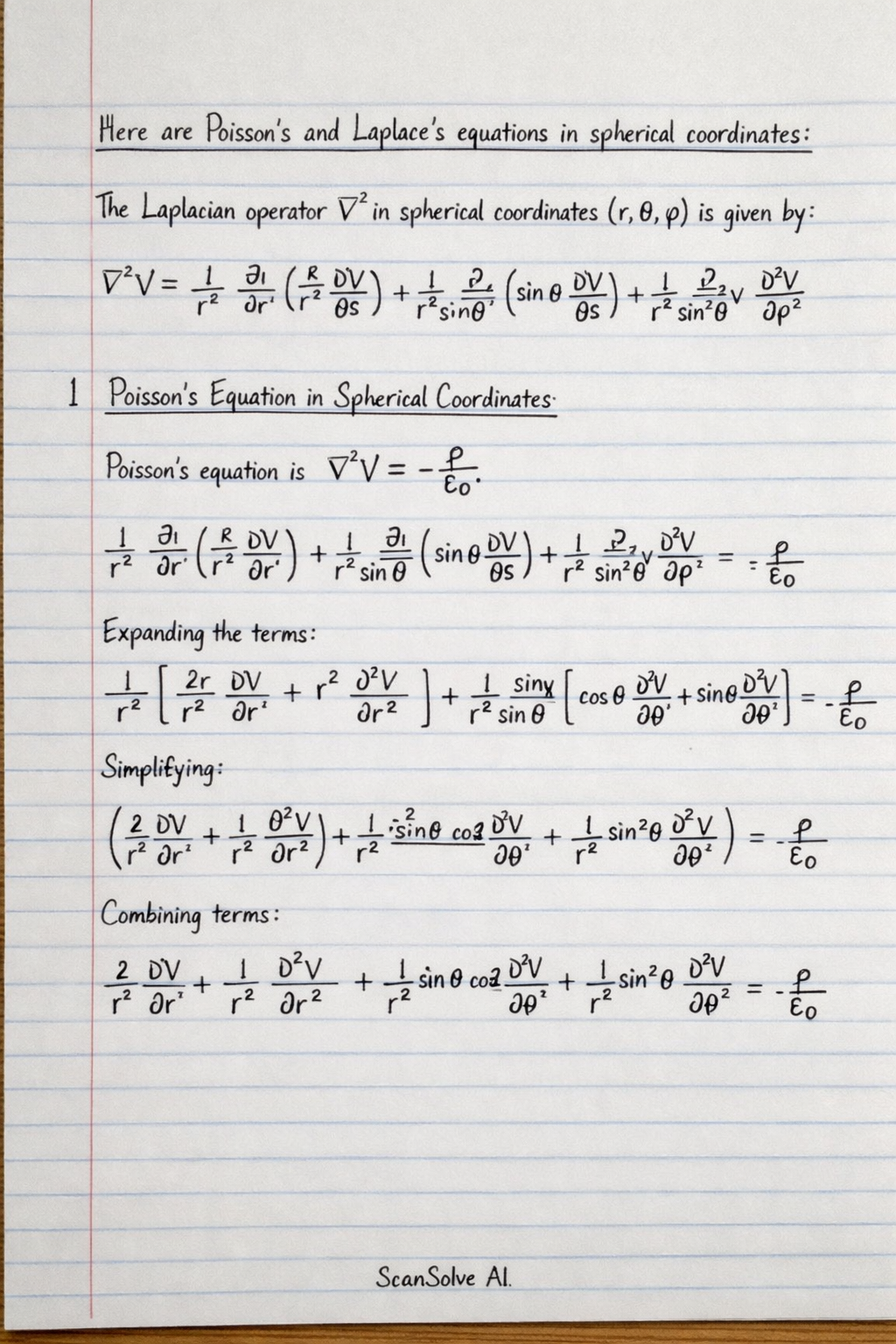
Here are Poisson's and Laplace's equations in spherical coordinates: The Laplacian operator ^2 in spherical coordinates (r, , ) is given by: ^2 V = (1)/(r^2) ()/( r) ( r^2 ( V)/( r) ) + (1)/(r^2 ) ()/( ) ( ( V)/( ) ) + (1)/(r^2 ^2 ) (^2 V)/( ^2) 1. Poisson's Equation in Spherical Coordinates Poisson's equation is ^2 V = -()/(_0), where V is the electric potential, is the volume charge density, and _0 is the permittivity of free space. (1)/(r^2) ()/( r) ( r^2 ( V)/( r) ) + (1)/(r^2 ) ()/( ) ( ( V)/( ) ) + (1)/(r^2 ^2 ) (^2 V)/( ^2) = -()/(_0) 2. Laplace's Equation in Spherical Coordinates Laplace's equation is ^2 V = 0, which is a special case of Poisson's equation where the charge density = 0. (1)/(r^2) ()/( r) ( r^2 ( V)/( r) ) + (1)/(r^2 ) ()/( ) ( ( V)/( ) ) + (1)/(r^2 ^2 ) (^2 V)/( ^2) = 0 What's next?