We read your photo as:

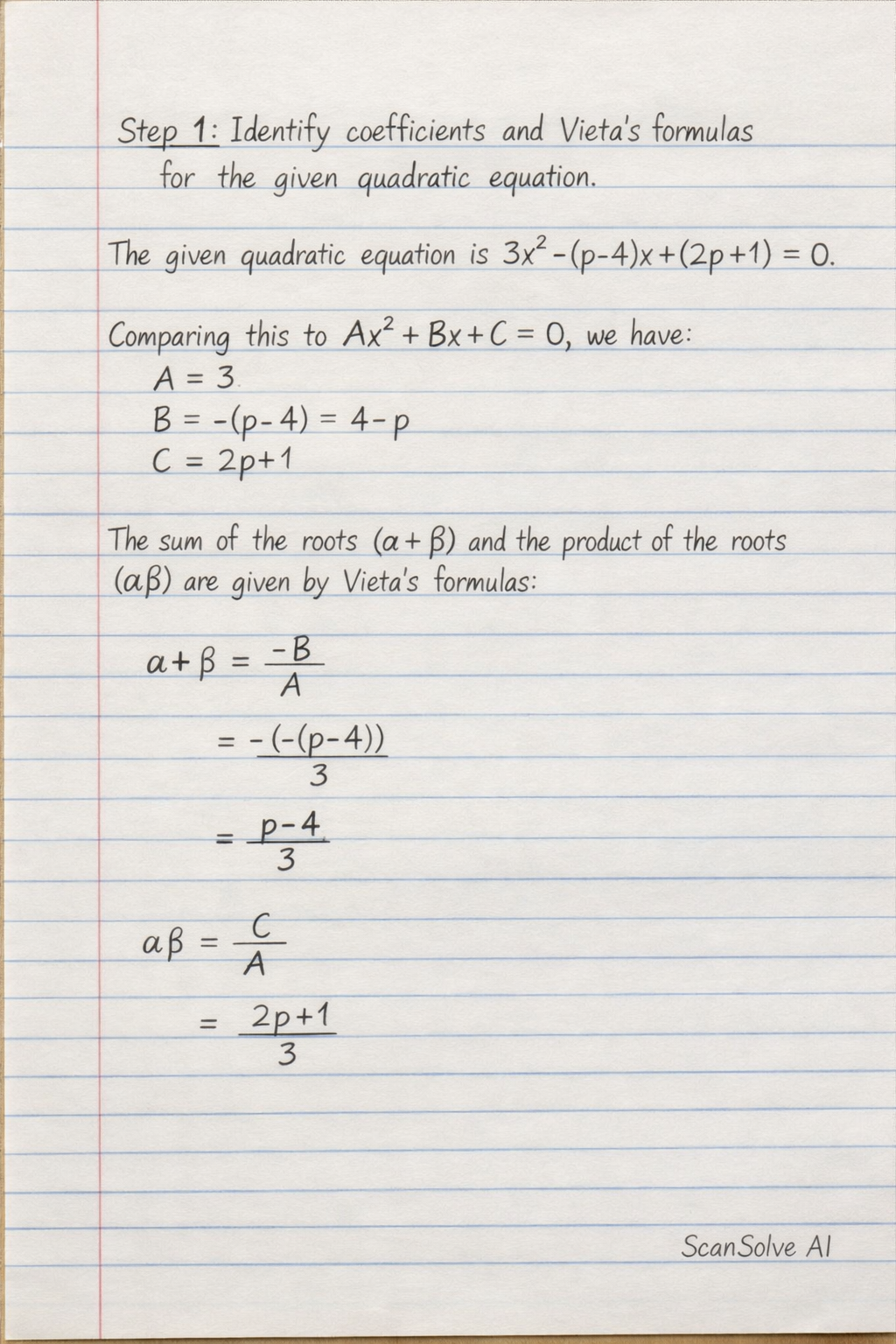
Identify coefficients and Vieta's formulas for the given quadratic equation.

Mathematics

ScanSolve AI Answer

Step-by-step solution

2 steps

Step 1: Identify coefficients and Vieta's formulas for the given quadratic equation.
The given quadratic equation is 3x2−(p−4)x+(2p+1)=03x^2 - (p-4)x + (2p+1) = 0.
Comparing this to Ax2+Bx+C=0Ax^2 + Bx + C = 0, we have:
A=3A = 3
B=−(p−4)=4−pB = -(p-4) = 4-p
C=2p+1C = 2p+1

The sum of the roots (α+β\alpha + \beta) and the product of the roots (αβ\alpha \beta) are given by Vieta's formulas:

α+β=−BA=−−(p−4)3=p−43\alpha + \beta = -\frac{B}{A} = -\frac{-(p-4)}{3} = \frac{p-4}{3} αβ=CA=2p+13\alpha \beta = \frac{C}{A} = \frac{2p+1}{3}

Step 2: Use the given condition to find the value of pp.
The problem states that (α+2)(β+2)=1(\alpha+2)(\beta+2) = 1.
Expand this expression:

αβ+2α+2β+4=1\alpha\beta + 2\alpha + 2\beta + 4 = 1 αβ+2(α+β)+4=1\alpha\beta + 2(\alpha + \beta) + 4 = 1

Substitute the expressions for α+β\alpha + \beta and αβ\alpha \beta from Step 1:

2p+13+2(p−43)+4=1\frac{2p+1}{3} + 2\left(\frac{p-4}{3}\right) + 4 = 1

Multiply the entire equation by 3 to eliminate the denominators:

3(2p+13)+3(2(p−4)3)+3(4)=3(1)3\left(\frac{2p+1}{3}\right) + 3\left(\frac{2(p-4)}{3}\right) + 3(4) = 3(1) (2p+1)+2(p−4)+12=3(2p+1) + 2(p-4) + 12 = 3 2p+1+2p−8+12=32p+1 + 2p-8 + 12 = 3

Combine like terms:

4p+5=34p + 5 = 3 4p=3−54p = 3 - 5 4p=−24p = -2 p=−24p = -\frac{2}{4} p=−12p = -\frac{1}{2}

Part a· 2 steps

The value of pp is* −12\boxed{-\frac{1}{2}}.

  1. Find the sum and product of the new roots.

    The new roots are (α+2)(\alpha+2) and (β+2)(\beta+2).
    Sum of new roots:

    S′=(α+2)+(β+2)=α+β+4S' = (\alpha+2) + (\beta+2) = \alpha + \beta + 4

    Substitute the value of p=−12p = -\frac{1}{2} into the expression for α+β\alpha + \beta:

    α+β=p−43=−12−43=−12−823=−923=−96=−32\alpha + \beta = \frac{p-4}{3} = \frac{-\frac{1}{2}-4}{3} = \frac{-\frac{1}{2}-\frac{8}{2}}{3} = \frac{-\frac{9}{2}}{3} = -\frac{9}{6} = -\frac{3}{2}

    Now calculate S′S':

    S′=−32+4=−32+82=52S' = -\frac{3}{2} + 4 = -\frac{3}{2} + \frac{8}{2} = \frac{5}{2}

    Product of new roots:

    P′=(α+2)(β+2)P' = (\alpha+2)(\beta+2)

    From the problem statement, we are given that (α+2)(β+2)=1(\alpha+2)(\beta+2) = 1.
    So, P′=1P' = 1.

  2. Form the new quadratic equation.

    A quadratic equation with roots r1r_1 and r2r_2 can be written as x2−(r1+r2)x+r1r2=0x^2 - (r_1+r_2)x + r_1r_2 = 0.
    Using S′=52S' = \frac{5}{2} and P′=1P' = 1:

    x2−(52)x+1=0x^2 - \left(\frac{5}{2}\right)x + 1 = 0

    To eliminate the fraction, multiply the entire equation by 2:

    2x2−5x+2=02x^2 - 5x + 2 = 0

Part b

The equation whose roots are (α+2)(\alpha+2) and (β+2)(\beta+2) is* 2x2−5x+2=0\boxed{2x^2 - 5x + 2 = 0}.

Was this helpful?

Still stuck on this one?

Ask a follow-up, and the answer starts from this question.

Got a different question?Ask your own question
Handwritten step-by-step solution preview

Handwritten Step-by-Step Solution

Get this as a handwritten image on WhatsApp — like a tutor wrote it for you.

Try on WhatsApp