If the minimum of x2+4x+K is -10, find the value of K. Express 4x2-3x-1 in the form a(x+b)2+c and 8+2x-x2 in the form a-(x+b)2. Find the maximum and the value of x where it occurs.

Mathematics
If the minimum of x2+4x+K is -10, find the value of K. Express 4x2-3x-1 in the form a(x+b)2+c and 8+2x-x2 in the form a-(x+b)2. Find the maximum and the value of x where it occurs.

ScanSolve AI Answer

Answer

-6

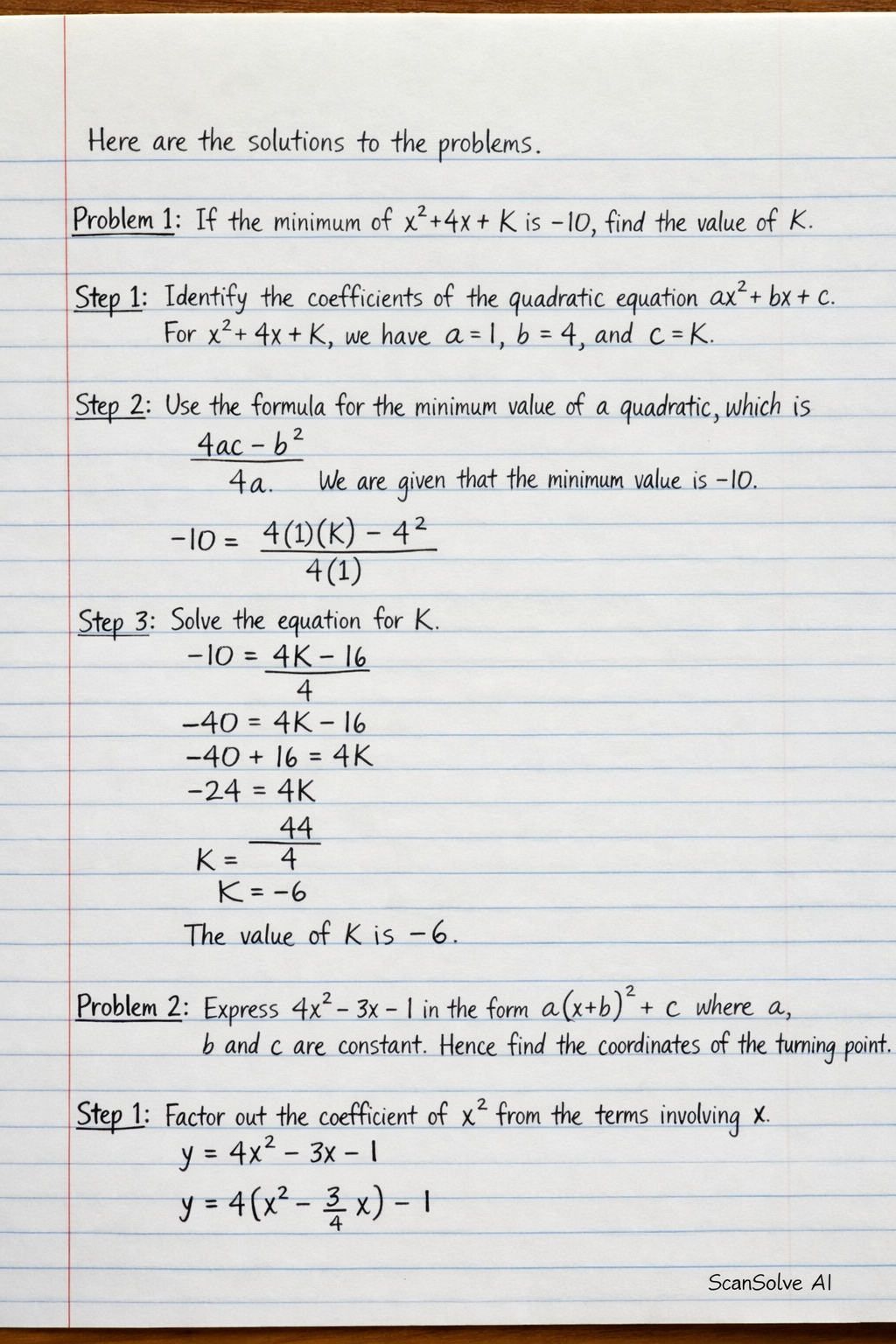
Here are the solutions to the problems.

: If the minimum of x2+4x+Kx^2 + 4x + K is 10-10, find the value of KK.

Step 1: Identify the coefficients of the quadratic equation ax2+bx+cax^2 + bx + c. For x2+4x+Kx^2 + 4x + K, we have a=1a=1, b=4b=4, and c=Kc=K.

Step 2: Use the formula for the minimum value of a quadratic, which is 4acb24a\frac{4ac - b^2}{4a}. We are given that the minimum value is 10-10. 10=4(1)(K)(4)24(1)-10 = \frac{4(1)(K) - (4)^2}{4(1)}

Step 3: Solve the equation for KK. 10=4K164-10 = \frac{4K - 16}{4} Multiply both sides by 4: 40=4K16-40 = 4K - 16 Add 16 to both sides: 40+16=4K-40 + 16 = 4K 24=4K-24 = 4K Divide by 4: K=244K = \frac{-24}{4} K=6K = -6 The value of KK is 6\boxed{-6}.

: Express 4x23x14x^2 - 3x - 1 in the form a(x+b)2+ca(x+b)^2 + c where aa, bb and cc are constant. Hence find the coordinate of the turning point.

Step 1: Factor out the coefficient of x2x^2 from the terms involving xx. y=4x23x1y = 4x^2 - 3x - 1 y=4(x234x)1y = 4\left(x^2 - \frac{3}{4}x\right) - 1

Step 2: Complete the square inside the parenthesis. Take half of the coefficient of xx (34\frac{-3}{4}), square it, and add and subtract it. Half of 34\frac{-3}{4} is 38\frac{-3}{8}. Squaring it gives (38)2=964\left(\frac{-3}{8}\right)^2 = \frac{9}{64}. y=4(x234x+964964)1y = 4\left(x^2 - \frac{3}{4}x + \frac{9}{64} - \frac{9}{64}\right) - 1

Step 3: Group the perfect square trinomial and distribute the 4. y=4((x38)2964)1y = 4\left(\left(x - \frac{3}{8}\right)^2 - \frac{9}{64}\right) - 1 y=4(x38)24(964)1y = 4\left(x - \frac{3}{8}\right)^2 - 4\left(\frac{9}{64}\right) - 1 y=4(x38)29161y = 4\left(x - \frac{3}{8}\right)^2 - \frac{9}{16} - 1

Step 4: Combine the constant terms. y=4(x38)29161616y = 4\left(x - \frac{3}{8}\right)^2 - \frac{9}{16} - \frac{16}{16} y=4(x38)22516y = 4\left(x - \frac{3}{8}\right)^2 - \frac{25}{16} The expression in the form a(x+b)2+ca(x+b)^2 + c is 4(x38)22516\boxed{4\left(x - \frac{3}{8}\right)^2 - \frac{25}{16}}.

Step 5: Find the coordinate of the turning point. For a quadratic in the form a(x+b)2+ca(x+b)^2 + c, the turning point is at (b,c)(-b, c). From our expression, b=38b = -\frac{3}{8} and c=2516c = -\frac{25}{16}. So, b=(38)=38-b = -(-\frac{3}{8}) = \frac{3}{8}. The coordinate of the turning point is (38,2516)\boxed{\left(\frac{3}{8}, -\frac{25}{16}\right)}.

: Express 8+2xx28 + 2x - x^2 in the form a(x+b)2a - (x+b)^2 where aa and bb are constant. Hence find the maximum and the exact value of xx where it occurs.

Step 1: Rearrange the quadratic into standard form and factor out 1-1. y=x2+2x+8y = -x^2 + 2x + 8 y=(x22x8)y = -(x^2 - 2x - 8)

Step 2: Complete the square inside the parenthesis. Take half of the coefficient of xx (which is 2-2), square it, and add and subtract it. Half of 2-2 is 1-1. Squaring it gives (1)2=1(-1)^2 = 1. y=(x22x+118)y = -(x^2 - 2x + 1 - 1 - 8)

Step 3: Group the perfect square trinomial. y=((x1)29)y = -((x - 1)^2 - 9)

Step 4: Distribute the negative sign. y=(x1)2+9y = -(x - 1)^2 + 9 Rearrange to the form a(x+b)2a - (x+b)^2: y=9(x1)2y = 9 - (x - 1)^2 The expression in the form a(x+b)2a - (x+b)^2 is 9(x1)2\boxed{9 - (x - 1)^2}.

Step 5: Find the maximum value and the value of xx where it occurs. The term (x1)2(x-1)^2 is always greater than or equal to 0. To maximize 9(x1)29 - (x-1)^2, we need to minimize (x1)2(x-1)^2. The minimum value of (x1)2(x-1)^2 is 0, which occurs when x1=0x-1=0, so x=1x=1. When (x1)2=0(x-1)^2 = 0, the expression becomes 90=99 - 0 = 9. The maximum value is 9\boxed{9}. The exact value of xx where it occurs is 1\boxed{1}.

Was this helpful?

Need help with your own homework?

Get instant step-by-step solutions to any question. Free to start.

Ask Your Question
Handwritten step-by-step solution preview

Handwritten Step-by-Step Solution

Get this as a handwritten image on WhatsApp — like a tutor wrote it for you.

Try on WhatsApp

Still have questions?

Quick Answer

If the minimum of x^2 + 4x + K is -10, find the value of K. Step 1: Identify the coefficients of the quadratic equation ax^2 + bx + c.

If the minimum of x2+4x+K is -10, find the value of K. Express 4x2-3x-1 in the form a(x+b)2+c and 8+2x-x2 in the form a-(x+b)2. Find the maximum and the value of x where it occurs.
Mathematics

This mathematics problem involves applying core mathematical principles and formulas. Below you will find a complete step-by-step solution with detailed explanations for each step, helping you understand not just the answer but the method behind it.

ScanSolve AI Answer
Here are the solutions to the problems. Problem 1: If the minimum of x^2 + 4x + K is -10, find the value of K. Step 1: Identify the coefficients of the quadratic equation ax^2 + bx + c. For x^2 + 4x + K, we have a=1, b=4, and c=K. Step 2: Use the formula for the minimum value of a quadratic, which is (4ac - b^2)/(4a). We are given that the minimum value is -10. -10 = (4(1)(K) - (4)^2)/(4(1)) Step 3: Solve the equation for K. -10 = (4K - 16)/(4) Multiply both sides by 4: -40 = 4K - 16 Add 16 to both sides: -40 + 16 = 4K -24 = 4K Divide by 4: K = (-24)/(4) K = -6 The value of K is -6. Problem 2: Express 4x^2 - 3x - 1 in the form a(x+b)^2 + c where a, b and c are constant. Hence find the coordinate of the turning point. Step 1: Factor out the coefficient of x^2 from the terms involving x. y = 4x^2 - 3x - 1 y = 4(x^2 - (3)/(4)x) - 1 Step 2: Complete the square inside the parenthesis. Take half of the coefficient of x ((-3)/(4)), square it, and add and subtract it. Half of (-3)/(4) is (-3)/(8). Squaring it gives ((-3)/(8))^2 = (9)/(64). y = 4(x^2 - (3)/(4)x + (9)/(64) - (9)/(64)) - 1 Step 3: Group the perfect square trinomial and distribute the 4. y = 4((x - (3)/(8))^2 - (9)/(64)) - 1 y = 4(x - (3)/(8))^2 - 4((9)/(64)) - 1 y = 4(x - (3)/(8))^2 - (9)/(16) - 1 Step 4: Combine the constant terms. y = 4(x - (3)/(8))^2 - (9)/(16) - (16)/(16) y = 4(x - (3)/(8))^2 - (25)/(16) The expression in the form a(x+b)^2 + c is 4(x - (3)/(8))^2 - (25)/(16). Step 5: Find the coordinate of the turning point. For a quadratic in the form a(x+b)^2 + c, the turning point is at (-b, c). From our expression, b = -(3)/(8) and c = -(25)/(16). So, -b = -(-(3)/(8)) = (3)/(8). The coordinate of the turning point is ((3)/(8), -(25)/(16)). Problem 3: Express 8 + 2x - x^2 in the form a - (x+b)^2 where a and b are constant. Hence find the maximum and the exact value of x where it occurs. Step 1: Rearrange the quadratic into standard form and factor out -1. y = -x^2 + 2x + 8 y = -(x^2 - 2x - 8) Step 2: Complete the square inside the parenthesis. Take half of the coefficient of x (which is -2), square it, and add and subtract it. Half of -2 is -1. Squaring it gives (-1)^2 = 1. y = -(x^2 - 2x + 1 - 1 - 8) Step 3: Group the perfect square trinomial. y = -((x - 1)^2 - 9) Step 4: Distribute the negative sign. y = -(x - 1)^2 + 9 Rearrange to the form a - (x+b)^2: y = 9 - (x - 1)^2 The expression in the form a - (x+b)^2 is 9 - (x - 1)^2. Step 5: Find the maximum value and the value of x where it occurs. The term (x-1)^2 is always greater than or equal to 0. To maximize 9 - (x-1)^2, we need to minimize (x-1)^2. The minimum value of (x-1)^2 is 0, which occurs when x-1=0, so x=1. When (x-1)^2 = 0, the expression becomes 9 - 0 = 9. The maximum value is 9. The exact value of x where it occurs is 1.