
We read your photo as:
Identify the given sides of the right-angled triangle ABC.
Mathematics
ScanSolve AI Answer
Answers
2 partsStep-by-step solution
8 stepsPart a· 5 steps
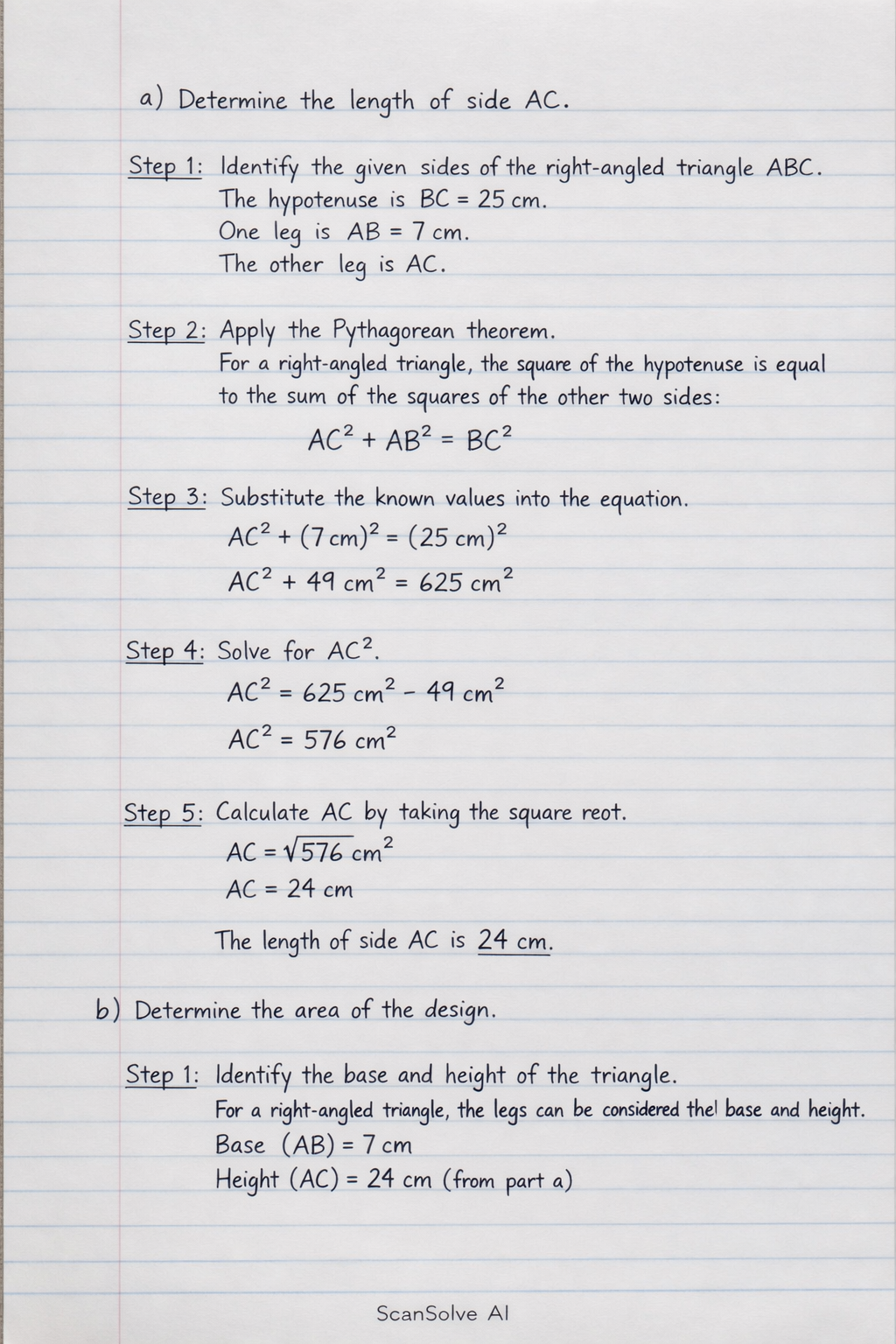
Determine the length of side AC.
Identify the given sides of the right-angled triangle ABC.
The hypotenuse is BC = 25 cm.
One leg is AB = 7 cm.
The other leg is AC.Apply the Pythagorean theorem.
For a right-angled triangle, the square of the hypotenuse is equal to the sum of the squares of the other two sides:
Substitute the known values into the equation.
Solve for .
Calculate AC by taking the square root.
The length of side AC is .
Part b
Determine the area of the design.
Identify the base and height of the triangle.
For a right-angled triangle, the legs can be considered the base and height.
Base (AB) = 7 cm
Height (AC) = 24 cm (from part a)Use the formula for the area of a triangle.
Substitute the values and calculate the area.
The area of the design is .
Was this helpful?
Try one yourself
A new problem that tests the same skill.
Still stuck on this one?
Ask a follow-up, and the answer starts from this question.
Got a different question?Ask your own question
More Mathematics Questions
QIdentify the angle and the sides of the right-angled triangle.QIdentify the lengths of the two given sides of the right-angled triangle.QThe image shows a right-angled triangle ABC, with the right angle at C. What is the formula relating…QIdentify the sides of the isosceles triangle.QGiven a right-angled triangle ABC, right-angled at B:
Browse by topic:Geometry
Handwritten Step-by-Step Solution
Get this as a handwritten image on WhatsApp — like a tutor wrote it for you.
Try on WhatsApp