

This mathematics problem involves applying core mathematical principles and formulas. Below you will find a complete step-by-step solution with detailed explanations for each step, helping you understand not just the answer but the method behind it.
ScanSolve AI Answer
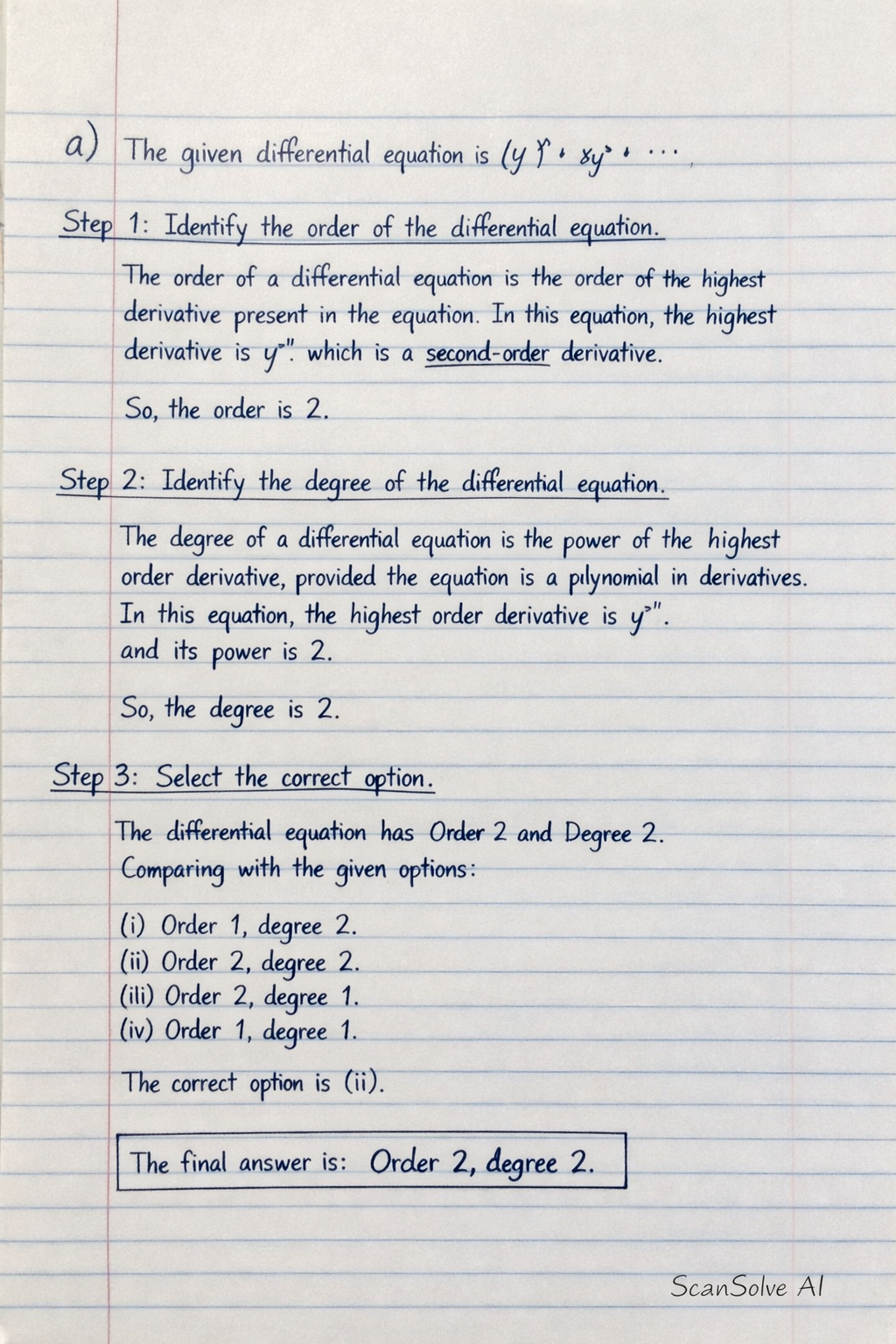
a) The given differential equation is (y'')^2 + xy' + . Step 1: Identify the order of the differential equation. The order of a differential equation is the order of the highest derivative present in the equation. In this equation, the highest derivative is y'', which is a second-order derivative. So, the order is 2. Step 2: Identify the degree of the differential equation. The degree of a differential equation is the power of the highest order derivative, provided the equation is a polynomial in derivatives. In this equation, the highest order derivative is y'', and its power is 2. So, the degree is 2. Step 3: Select the correct option. The differential equation has Order 2 and Degree 2. Comparing with the given options: (i) Order 1, degree 2 (ii) Order 2, degree 2 (iii) Order 2, degree 1 (iv) Order 1, degree 1 The correct option is (ii). The final answer is Order 2, degree 2 b) The given differential equation is y' = (x+y)/(x-y). Step 1: Check if the equation is homogeneous. A first-order differential equation (dy)/(dx) = f(x,y) is homogeneous if f(tx, ty) = f(x,y) for any non-zero constant t. Let f(x,y) = (x+y)/(x-y). Substitute tx for x and ty for y: f(tx, ty) = (tx+ty)/(tx-ty) = (t(x+y))/(t(x-y)) = (x+y)/(x-y) Since f(tx, ty) = f(x,y), the differential equation is homogeneous. Step 2: Select the correct option. Comparing with the given options: (i) Exact (ii) Homogeneous (iii) Linear (iv) Bernoulli The equation is homogeneous. The final answer is Homogeneous Send me the next one 📸