We read your photo as:

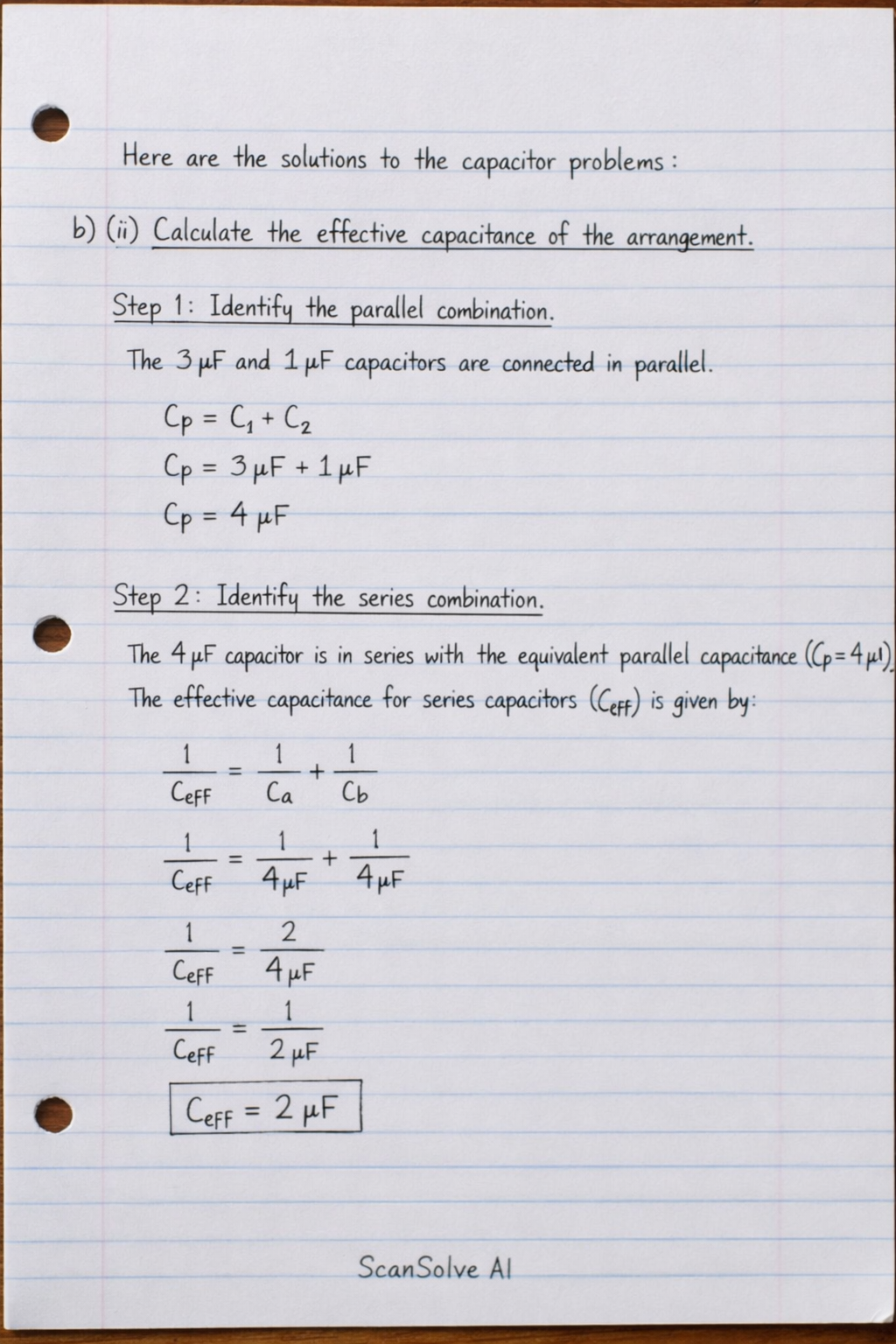
Identify the parallel combination.

Mathematics

ScanSolve AI Answer

Step-by-step solution

10 steps

Here are the solutions to the capacitor problems:

b) (i) Calculate the effective capacitance of the arrangement.

  1. Identify the parallel combination.

    The 3 µF3 \text{ µF} and 1 µF1 \text{ µF} capacitors are connected in parallel.
    The equivalent capacitance for parallel capacitors (CpC_p) is the sum of their individual capacitances.

    Cp=C1+C2C_p = C_1 + C_2 Cp=3 µF+1 µFC_p = 3 \text{ µF} + 1 \text{ µF} Cp=4 µFC_p = 4 \text{ µF}
  2. Identify the series combination.

    The 4 µF4 \text{ µF} capacitor is in series with the equivalent parallel capacitance (Cp=4 µFC_p = 4 \text{ µF}).
    The effective capacitance for series capacitors (CeffC_{eff}) is given by:

    1Ceff=1Ca+1Cb\frac{1}{C_{eff}} = \frac{1}{C_a} + \frac{1}{C_b} 1Ceff=14 µF+14 µF\frac{1}{C_{eff}} = \frac{1}{4 \text{ µF}} + \frac{1}{4 \text{ µF}} 1Ceff=24 µF\frac{1}{C_{eff}} = \frac{2}{4 \text{ µF}} 1Ceff=12 µF\frac{1}{C_{eff}} = \frac{1}{2 \text{ µF}} Ceff=2 µFC_{eff} = \boxed{\text{2 µF}}

    b) (ii) Calculate the charge on the 3 µF capacitor.

  3. Calculate the total charge stored in the circuit.

    The total charge (QtotalQ_{total}) is stored by the effective capacitance (CeffC_{eff}) at the total voltage (VtotalV_{total}).

    Qtotal=Ceff×VtotalQ_{total} = C_{eff} \times V_{total} Qtotal=2 µF×12 VQ_{total} = 2 \text{ µF} \times 12 \text{ V} Qtotal=24 µCQ_{total} = 24 \text{ µC}
  4. Determine the charge and voltage for the series components.

    In a series circuit, the charge on each component is the same as the total charge. So, the charge on the 4 µF4 \text{ µF} capacitor is 24 µC24 \text{ µC}, and the charge on the parallel combination (Cp=4 µFC_p = 4 \text{ µF}) is also 24 µC24 \text{ µC}.

  5. Calculate the voltage across the parallel combination.

    The voltage across the parallel combination (VpV_p) is:

    Vp=QpCpV_p = \frac{Q_p}{C_p} Vp=24 µC4 µFV_p = \frac{24 \text{ µC}}{4 \text{ µF}} Vp=6 VV_p = 6 \text{ V}
  6. Calculate the charge on the 3 µF capacitor.

    Since the 3 µF3 \text{ µF} capacitor is part of the parallel combination, the voltage across it is Vp=6 VV_p = 6 \text{ V}.

    Q3μF=C3μF×VpQ_{3\mu F} = C_{3\mu F} \times V_p Q3μF=3 µF×6 VQ_{3\mu F} = 3 \text{ µF} \times 6 \text{ V} Q3μF=18 µCQ_{3\mu F} = \boxed{\text{18 µC}}

    c) Find the separation distance between two plates if the capacitance between them is 8.0×10⁻¹² F8.0 \times 10^{-12} \text{ F} and the area enclosed is 2.0 cm22.0 \text{ cm}^2 (take ϵo=8.85×10⁻¹²\epsilon_o = 8.85 \times 10^{-12}).

  7. State the formula for capacitance of a parallel plate capacitor.

    C=ϵoAdC = \frac{\epsilon_o A}{d}

    Where CC is capacitance, ϵo\epsilon_o is the permittivity of free space, AA is the area of the plates, and dd is the separation distance.

  8. Convert the given area to square meters.

    A=2.0 cm2=2.0×(10−2 m)2=2.0×10⁻⁴ m2A = 2.0 \text{ cm}^2 = 2.0 \times (10^{-2} \text{ m})^2 = 2.0 \times 10^{-4} \text{ m}^2
  9. Rearrange the formula to solve for dd.

    d=ϵoACd = \frac{\epsilon_o A}{C}
  10. Substitute the given values and calculate dd.

    d=(8.85×10⁻¹² F/m)×(2.0×10−4 m2)8.0×10⁻¹² Fd = \frac{(8.85 \times 10^{-12} \text{ F/m}) \times (2.0 \times 10^{-4} \text{ m}^2)}{8.0 \times 10^{-12} \text{ F}} d=17.7×10−168.0×10⁻¹² md = \frac{17.7 \times 10^{-16}}{8.0 \times 10^{-12}} \text{ m} d=2.2125×10⁻⁴ md = 2.2125 \times 10^{-4} \text{ m}

    Rounding to three significant figures:

    d=2.21×10⁻⁴ md = \boxed{\text{2.21} \times 10^{-4} \text{ m}}
Was this helpful?

Still stuck on this one?

Ask a follow-up, and the answer starts from this question.

Got a different question?Ask your own question
Handwritten step-by-step solution preview

Handwritten Step-by-Step Solution

Get this as a handwritten image on WhatsApp — like a tutor wrote it for you.

Try on WhatsApp