
We read your photo as:
Identify two numbers that multiply to the constant term (-6) and add up to the coefficient of the x term (-1).
Mathematics
ScanSolve AI Answer
Answer
Step-by-step solution
5 stepsTo solve the quadratic equation by factoring:
Identify two numbers that multiply to the constant term () and add up to the coefficient of the term ().
The two numbers are 2 and , because and .
Rewrite the middle term using these two numbers.
Factor by grouping.
Group the first two terms and the last two terms.
Factor out the common term from each group.
Factor out the common binomial .
Set each factor equal to zero and solve for .
The solutions are and .
The final answers are .
Was this helpful?
Try one yourself
A new problem that tests the same skill.
Still stuck on this one?
Ask a follow-up, and the answer starts from this question.
Got a different question?Ask your own question
More Mathematics Questions
QFind two numbers that multiply to the constant term (2) and add up to the coefficient of the middle…QIdentify the constant term and the coefficient of the x term.QFactor the quadratic expression x²−4x+3. We need two numbers that multiply to 3 and add to −4. These…QSolve the following multiplication problems: a) (6) × (−2) × (9) b) (−4) × (−12) × (−7)QIdentify the coefficient of the x2 term.
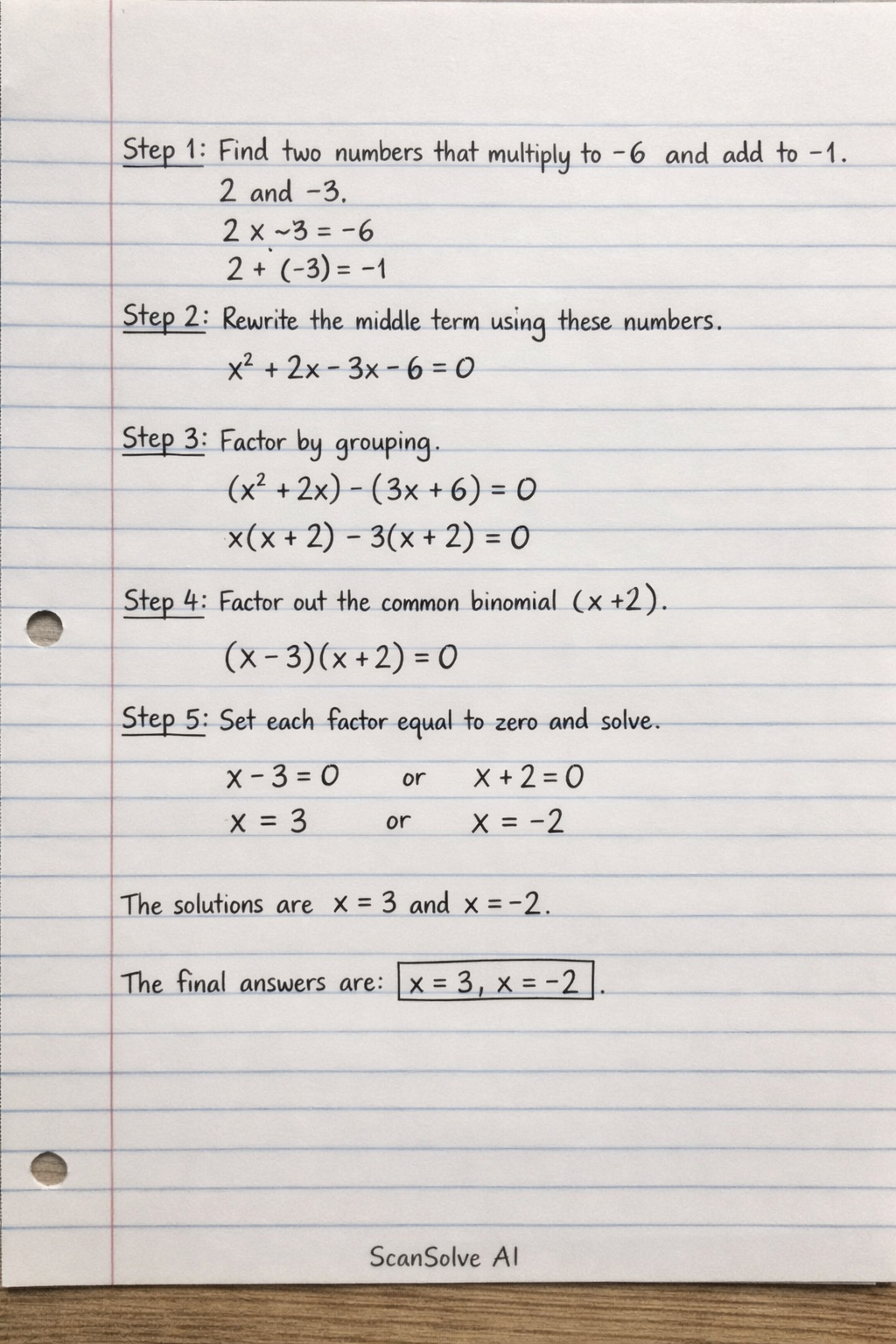
Handwritten Step-by-Step Solution
Get this as a handwritten image on WhatsApp — like a tutor wrote it for you.
Try on WhatsApp