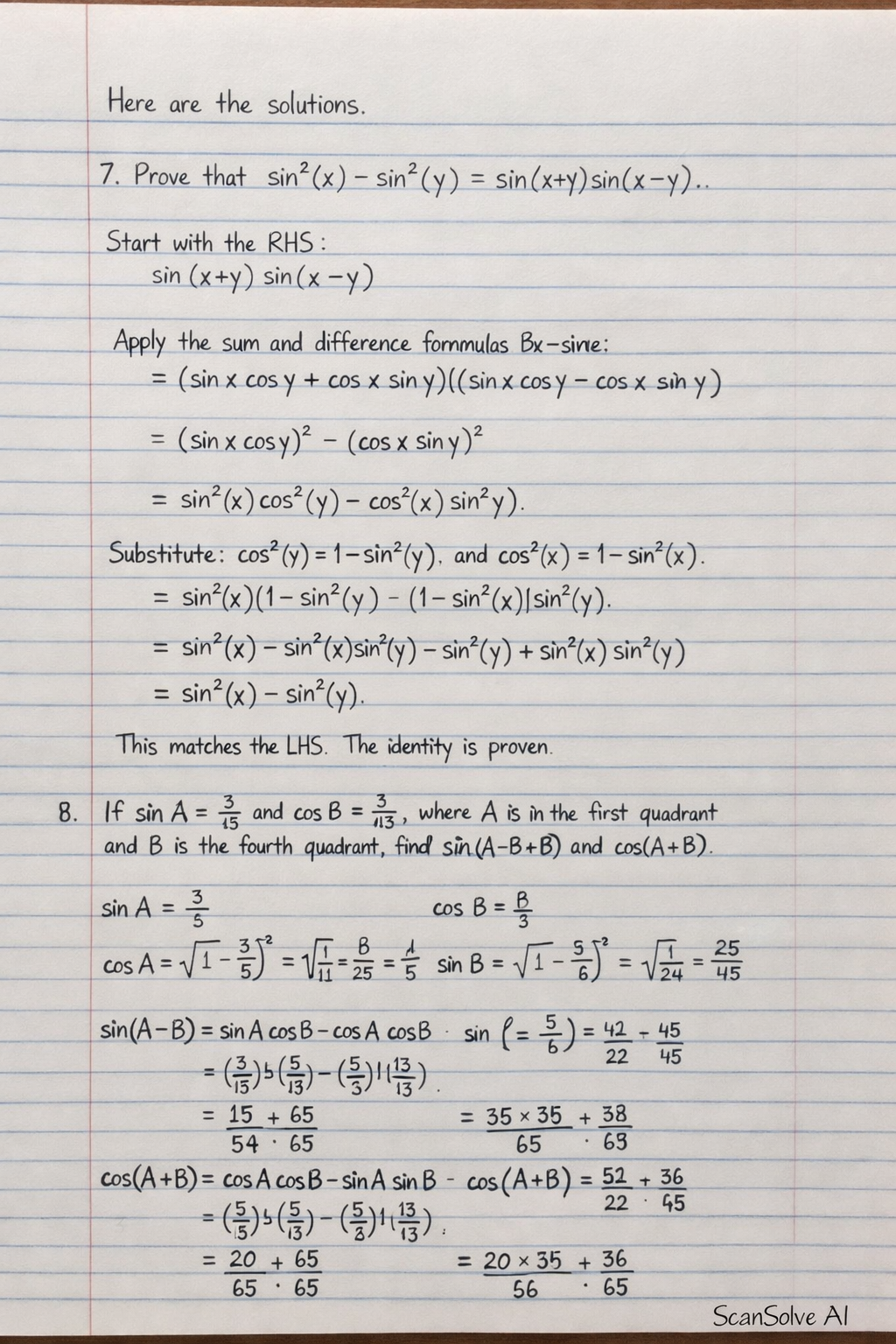
Start with the right-hand side (RHS):
sin(x+y)sin(x−y)
Apply the sum and difference formulas for sine:
=(sin(x)cos(y)+cos(x)sin(y))(sin(x)cos(y)−cos(x)sin(y))
This is in the form (a+b)(a−b)=a2−b2:
=(sin(x)cos(y))2−(cos(x)sin(y))2=sin2(x)cos2(y)−cos2(x)sin2(y)
Substitute cos2(y)=1−sin2(y) and cos2(x)=1−sin2(x):
=sin2(x)(1−sin2(y))−(1−sin2(x))sin2(y)=sin2(x)−sin2(x)sin2(y)−sin2(y)+sin2(x)sin2(y)=sin2(x)−sin2(y)
This matches the left-hand side (LHS). The identity is proven.
8. If sin(A)=3/5 and cos(B)=5/13, where A is in the first quadrant and B is in the fourth quadrant, find sin(A−B) and cos(A+B).
Step 1: Find cos(A) and sin(B).
Since A is in the first quadrant, cos(A)>0:
cos(A)=1−sin2(A)=1−(53)2=1−259=2516=54
Since B is in the fourth quadrant, sin(B)<0:
sin(B)=−1−cos2(B)=−1−(135)2=−1−16925=−169144=−1312
Step 3: Calculate cos(A+B).
cos(A+B)=cos(A)cos(B)−sin(A)sin(B)=(54)(135)−(53)(−1312)=6520−(−6536)=6520+36=6556
The final answers are sin(A−B)=6563 and cos(A+B)=6556.
9. Simplify (sin(x)+sin(y))/(cos(x)+cos(y)).
Apply the sum-to-product formulas:
sin(x)+sin(y)=2sin(2x+y)cos(2x−y)cos(x)+cos(y)=2cos(2x+y)cos(2x−y)
Substitute these into the expression:
cos(x)+cos(y)sin(x)+sin(y)=2cos(2x+y)cos(2x−y)2sin(2x+y)cos(2x−y)
Cancel the common terms 2 and cos(2x−y) (assuming cos(2x−y)=0):
=cos(2x+y)sin(2x+y)=tan(2x+y)
The final answer is tan(2x+y).
Was this helpful?
Need help with your own homework?
Get instant step-by-step solutions to any question. Free to start.
(x+y)(x-y) Apply the sum and difference formulas for sine: = ((x)(y) + (x)(y))((x)(y) - (x)(y)) This is in the form (a+b)(a-b) = a^2-b^2: = ((x)(y))^2 - ((x)(y))^2 = ^2(x)^2(y) - ^2(x)^2(y) Substitute ^2(y) = 1-^2(y) and ^2(x) = 1-^2(x): = ^2(x)(1-^2(…
This mathematics problem involves applying core mathematical principles and formulas. Below you will find a complete step-by-step solution with detailed explanations for each step, helping you understand not just the answer but the method behind it.
ScanSolve AI Answer
Here are the solutions. 7. Prove that ^2(x) - ^2(y) = (x+y)(x-y). Start with the right-hand side (RHS): (x+y)(x-y) Apply the sum and difference formulas for sine: = ((x)(y) + (x)(y))((x)(y) - (x)(y)) This is in the form (a+b)(a-b) = a^2-b^2: = ((x)(y))^2 - ((x)(y))^2 = ^2(x)^2(y) - ^2(x)^2(y) Substitute ^2(y) = 1-^2(y) and ^2(x) = 1-^2(x): = ^2(x)(1-^2(y)) - (1-^2(x))^2(y) = ^2(x) - ^2(x)^2(y) - ^2(y) + ^2(x)^2(y) = ^2(x) - ^2(y) This matches the left-hand side (LHS). The identity is proven. 8. If (A) = 3/5 and (B) = 5/13, where A is in the first quadrant and B is in the fourth quadrant, find (A-B) and (A+B). Step 1: Find (A) and (B). Since A is in the first quadrant, (A) > 0: (A) = sqrt(1-^2(A)) = sqrt(1-((3)/(5))^2) = sqrt(1-(9)/(25)) = sqrt((16)/(25)) = (4)/(5) Since B is in the fourth quadrant, (B) < 0: (B) = -sqrt(1-^2(B)) = -sqrt(1-((5)/(13))^2) = -sqrt(1-(25)/(169)) = -sqrt((144)/(169)) = -(12)/(13) Step 2: Calculate (A-B). (A-B) = (A)(B) - (A)(B) = ((3)/(5))((5)/(13)) - ((4)/(5))(-(12)/(13)) = (15)/(65) - (-(48)/(65)) = (15+48)/(65) = (63)/(65) Step 3: Calculate (A+B). (A+B) = (A)(B) - (A)(B) = ((4)/(5))((5)/(13)) - ((3)/(5))(-(12)/(13)) = (20)/(65) - (-(36)/(65)) = (20+36)/(65) = (56)/(65) The final answers are (A-B) = (63)/(65) and (A+B) = (56)/(65). 9. Simplify ((x) + (y)) / ((x) + (y)). Apply the sum-to-product formulas: (x) + (y) = 2((x+y)/(2))((x-y)/(2)) (x) + (y) = 2((x+y)/(2))((x-y)/(2)) Substitute these into the expression: ((x) + (y))/((x) + (y)) = (2(x+y)/(2))((x-y)/(2))2((x+y)/(2))((x-y)/(2)) Cancel the common terms 2 and ((x-y)/(2)) (assuming ((x-y)/(2)) ≠ 0): = ((x+y)/(2))((x+y)/(2)) = ((x+y)/(2)) The final answer is ((x+y)/(2)).