
We read your photo as:
Mr Ngomane started saving R2400 per month, two years ago so that he can take this money and invest it with a bank in order to put down a deposit when buying a car. He approached a bank that offered him 12.5% interest per annum, compound interest for a period of 2,5 years on the total amount saved.
ScanSolve AI Answer
Step-by-step solution
7 stepsHere are the solutions to the questions:
6.2.1 Determine the monthly interest rate.
Convert the annual interest rate to a decimal.
Divide the annual rate by 12 to get the monthly interest rate.
The monthly interest rate is approximately 0.0104.
6.2.2 Differentiate between interest and interest rate.
Interest is the actual amount of money earned on an investment or paid on a loan. It is typically expressed in currency units (e.g., Rands).
The interest rate is the percentage at which interest is calculated over a specific period. It is expressed as a percentage (e.g., 12.5% per annum).6.2.3 Determine how much he would be able to invest with the bank if he invests the entire amount.
Calculate the total number of months Mr Ngomane saved.
Calculate the total amount saved.
He would be able to invest R57600.
6.2.4 Determine how much he will earn at the end of the investment period.
Identify the principal amount (P), monthly interest rate (i), and total number of compounding periods (n).
Use the compound interest formula to find the future value (A).
He will earn approximately R78912.35 at the end of the investment period.
6.2.5 Determine how much interest he will earn at the end of the period.
Subtract the principal amount from the final amount earned.
He will earn R21312.35 in interest.
Still stuck on this one?
Ask a follow-up, and the answer starts from this question.
More Mathematics Questions
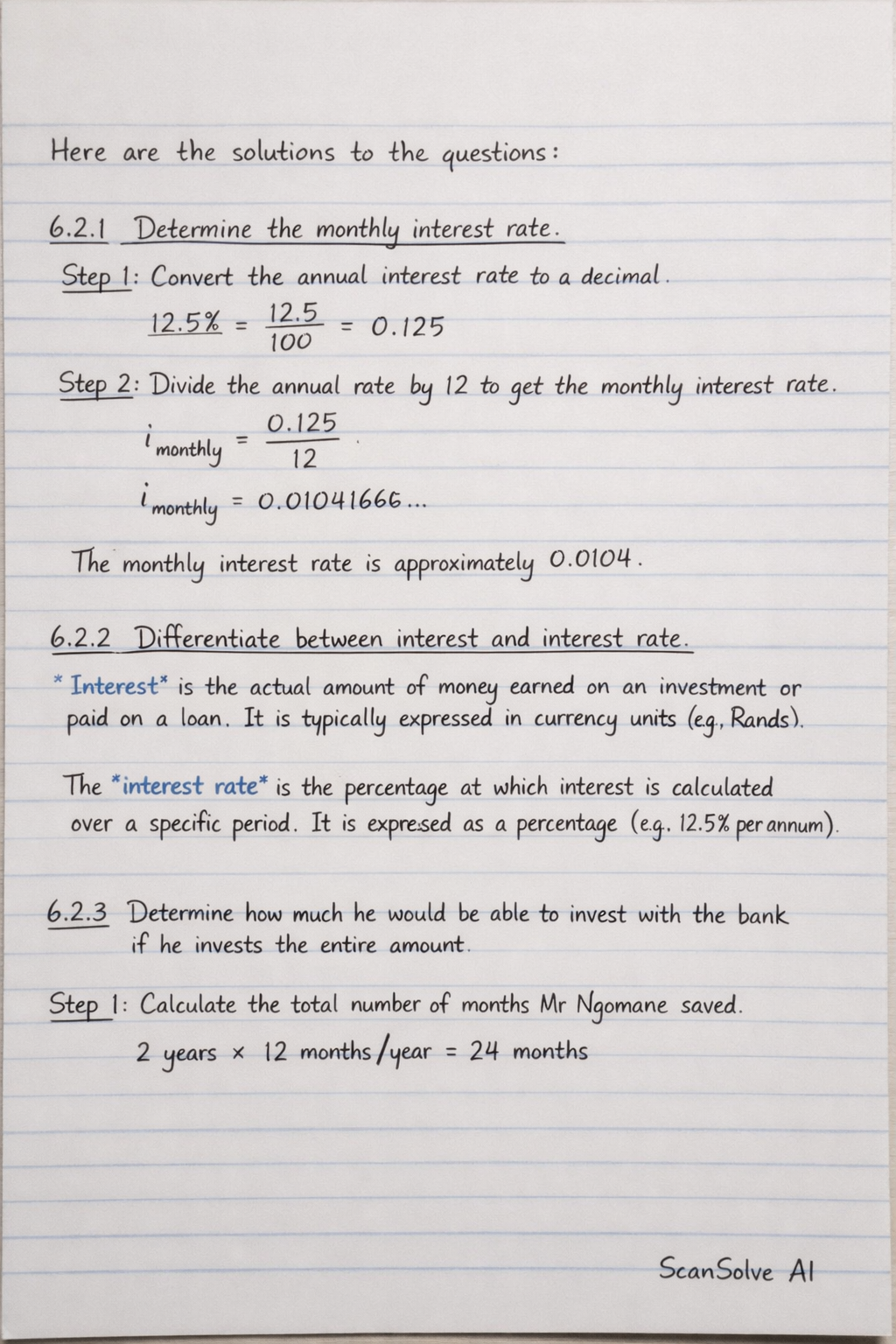
Handwritten Step-by-Step Solution
Get this as a handwritten image on WhatsApp — like a tutor wrote it for you.
Try on WhatsApp