
We read your photo as:
Jake takes out a bank loan of R600 000 to pay for his new car. He repays the loan with monthly instalments of R9 000, starting one month after the granting of the loan. The interest rate is 13% per annum, compounded quarterly.
ScanSolve AI Answer
Step-by-step solution
7 stepsPart 3.1· 2 steps
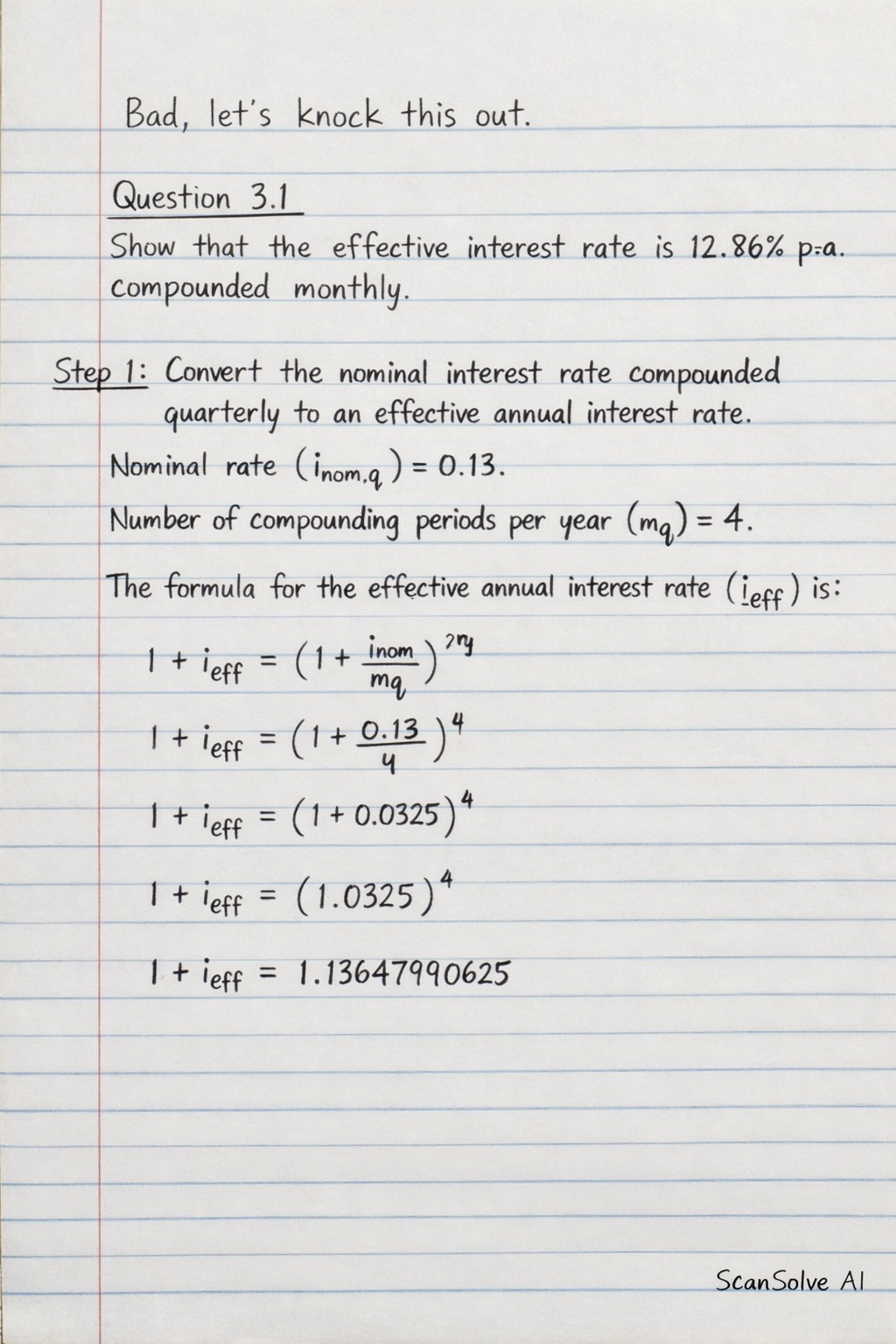
Show that the effective interest rate is 12.86% p.a. compounded monthly.
Convert the nominal interest rate compounded quarterly to an effective annual interest rate.
The given nominal interest rate is 13% p.a. compounded quarterly.
Nominal rate () = 0.13.
Number of compounding periods per year () = 4.
The formula for the effective annual interest rate () is:Convert the effective annual interest rate to an equivalent nominal interest rate compounded monthly.
Let the nominal interest rate compounded monthly be .
Number of compounding periods per year () = 12.
The formula relating effective annual rate to nominal monthly rate is:Take the 12th root of both sides:
Convert to a percentage and round to two decimal places:
Thus, the effective interest rate is .
Part 3.2· 2 steps
How many full monthly repayments would Jake pay?
Identify the loan details and the monthly interest rate.
Loan amount () = R600 000.
Monthly payment () = R9 000.
The nominal interest rate compounded monthly is (from 3.1, using the unrounded value for accuracy).
Monthly interest rate () = .Use the present value annuity formula to solve for the number of payments ().
The formula is:
Substitute the known values:
Divide by 9 000 and multiply by 0.01072:
Rearrange to solve for :
Take the natural logarithm of both sides:
The number of full monthly repayments Jake would pay is .
Part 3.3· 2 steps
What will the final payment be?
Calculate the outstanding balance after 117 full payments.
Number of full payments () = 117.
Loan amount () = R600 000.
Monthly payment () = R9 000.
Monthly interest rate () = 0.01072.
The formula for the outstanding balance () after payments is:Calculate .
Calculate the final payment, which includes interest on the outstanding balance for the last period.
Final payment =
The value of Jake's final payment is .
Part 3.4· 1 step
What did the car cost Jake in total by the time it is paid off?
Calculate the total amount paid.
Total payments = (Number of full payments Monthly payment) + Final payment
Total payments =
Total payments =
Total payments =
The car cost Jake a total of .
Still stuck on this one?
Ask a follow-up, and the answer starts from this question.
More Mathematics Questions
Handwritten Step-by-Step Solution
Get this as a handwritten image on WhatsApp — like a tutor wrote it for you.
Try on WhatsApp