We read your photo as:

If 2A+B = pi/2, then (1+sin B)/(1-sin B) is equal to

Mathematics

ScanSolve AI Answer

Answer

5−14\frac{\sqrt{5}-1}{4}

Step-by-step solution

4 steps

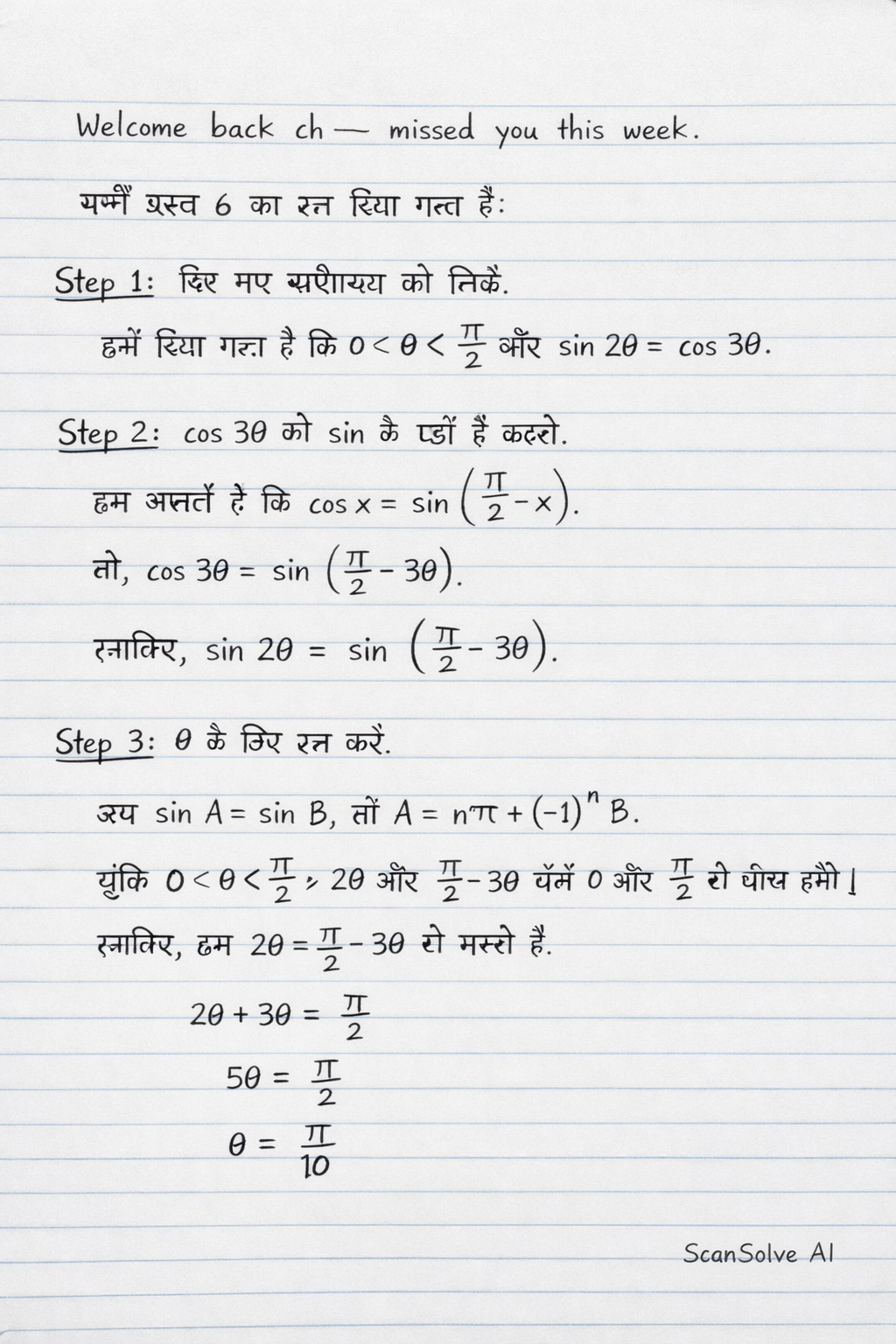
यहाँ प्रश्न 6 का हल दिया गया है:

  1. दिए गए समीकरण को लिखें.

    हमें दिया गया है कि 0<θ<π20 < \theta < \frac{\pi}{2} और sin⁡2θ=cos⁡3θ\sin 2\theta = \cos 3\theta.

  2. cos⁡3θ\cos 3\theta को sin⁡\sin के पदों में बदलें.

    हम जानते हैं कि cos⁡x=sin⁡(π2−x)\cos x = \sin \left(\frac{\pi}{2} - x\right).
    तो, cos⁡3θ=sin⁡(π2−3θ)\cos 3\theta = \sin \left(\frac{\pi}{2} - 3\theta\right).
    समीकरण बन जाता है:

    sin⁡2θ=sin⁡(π2−3θ)\sin 2\theta = \sin \left(\frac{\pi}{2} - 3\theta\right)
  3. θ\theta के लिए हल करें.

    जब sin⁡A=sin⁡B\sin A = \sin B, तो A=nπ+(−1)nBA = n\pi + (-1)^n B.
    चूंकि 0<θ<π20 < \theta < \frac{\pi}{2}, 2θ2\theta और π2−3θ\frac{\pi}{2} - 3\theta दोनों 0 और π\pi के बीच होंगे।
    इसलिए, हम 2θ=π2−3θ2\theta = \frac{\pi}{2} - 3\theta ले सकते हैं।

    2θ+3θ=π22\theta + 3\theta = \frac{\pi}{2} 5θ=π25\theta = \frac{\pi}{2} θ=π10\theta = \frac{\pi}{10}
  4. sin⁡θ\sin \theta का मान ज्ञात करें.

    हमें sin⁡(π10)\sin \left(\frac{\pi}{10}\right) का मान ज्ञात करना है।
    हम जानते हैं कि π10\frac{\pi}{10} रेडियन 18∘18^\circ के बराबर है।
    sin⁡18∘\sin 18^\circ का मान ज्ञात करने के लिए, हम निम्नलिखित विधि का उपयोग कर सकते हैं:
    माना x=18∘x = 18^\circ.
    तो 5x=90∘5x = 90^\circ.
    2x=90∘−3x2x = 90^\circ - 3x.
    sin⁡(2x)=sin⁡(90∘−3x)\sin(2x) = \sin(90^\circ - 3x).
    sin⁡(2x)=cos⁡(3x)\sin(2x) = \cos(3x).
    2sin⁡xcos⁡x=4cos⁡3x−3cos⁡x2\sin x \cos x = 4\cos^3 x - 3\cos x.
    चूंकि cos⁡x≠0\cos x \neq 0 (क्योंकि x=18∘x = 18^\circ), हम cos⁡x\cos x से भाग दे सकते हैं:
    2sin⁡x=4cos⁡2x−32\sin x = 4\cos^2 x - 3.
    2sin⁡x=4(1−sin⁡2x)−32\sin x = 4(1 - \sin^2 x) - 3.
    2sin⁡x=4−4sin⁡2x−32\sin x = 4 - 4\sin^2 x - 3.
    4sin⁡2x+2sin⁡x−1=04\sin^2 x + 2\sin x - 1 = 0.
    यह sin⁡x\sin x में एक द्विघात समीकरण है।
    द्विघात सूत्र का उपयोग करके:

    sin⁡x=−2±22−4(4)(−1)2(4)\sin x = \frac{-2 \pm \sqrt{2^2 - 4(4)(-1)}}{2(4)} sin⁡x=−2±4+168\sin x = \frac{-2 \pm \sqrt{4 + 16}}{8} sin⁡x=−2±208\sin x = \frac{-2 \pm \sqrt{20}}{8} sin⁡x=−2±258\sin x = \frac{-2 \pm 2\sqrt{5}}{8} sin⁡x=−1±54\sin x = \frac{-1 \pm \sqrt{5}}{4}

    चूंकि x=18∘x = 18^\circ पहले चतुर्थांश में है, sin⁡x\sin x धनात्मक होना चाहिए।
    इसलिए, sin⁡18∘=−1+54=5−14\sin 18^\circ = \frac{-1 + \sqrt{5}}{4} = \frac{\sqrt{5} - 1}{4}.

    अतः, sin⁡θ=sin⁡(π10)=5−14\sin \theta = \sin \left(\frac{\pi}{10}\right) = \frac{\sqrt{5} - 1}{4}.

    The final answer is 5−14\frac{\sqrt{5}-1}{4}.

Was this helpful?

Try one yourself

A new problem that tests the same skill.

Still stuck on this one?

Ask a follow-up, and the answer starts from this question.

Got a different question?Ask your own question
Handwritten step-by-step solution preview

Handwritten Step-by-Step Solution

Get this as a handwritten image on WhatsApp — like a tutor wrote it for you.

Try on WhatsApp