
We read your photo as:
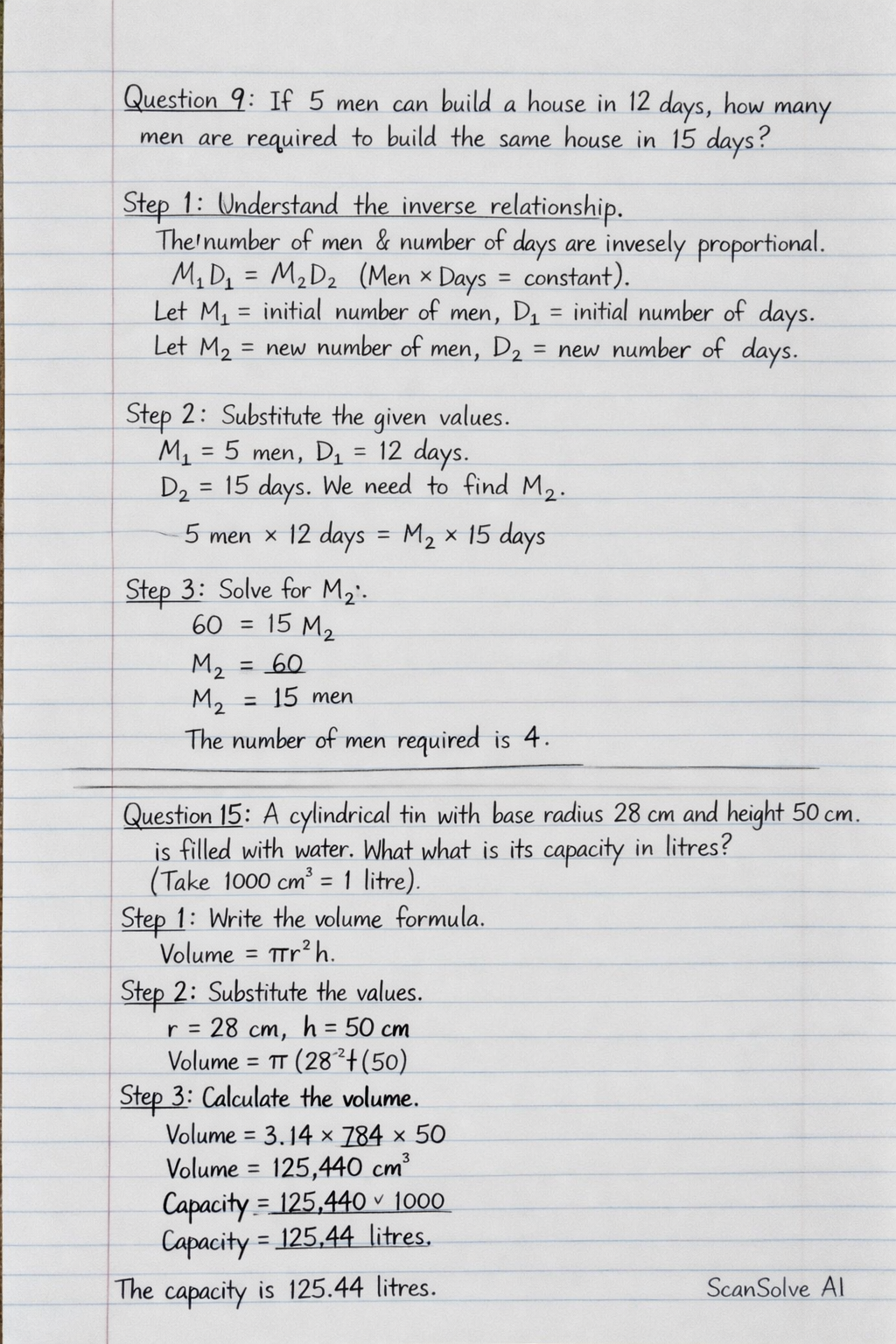
If 5 men can build a house in 12 days, how many men are required to build the same house in 15 days? A cylindrical tin with base radius 28 cm and height 50 cm is filled with water. What is its capacit
ScanSolve AI Answer
Answer
123.2 litres
Step-by-step solution
12 stepshere are the solutions to the problems:
Part 9· 3 steps
If 5 men can build a house in 12 days, how many men are required to build the same house in 15 days?
Understand the inverse relationship.
The number of men and the number of days are inversely proportional. This means that the total work (men days) is constant.
Let be the initial number of men and be the initial number of days.
Let be the new number of men and be the new number of days.
The formula is .Substitute the given values.
men, days.
days. We need to find .Solve for .
The number of men required is 4.
Part 15· 2 steps
A cylindrical tin with base radius 28 cm and height 50 cm is filled with water. What is its capacity in litres? (Take )
Calculate the volume of the cylinder in cubic centimeters.
The formula for the volume of a cylinder is .
Given radius and height . We will use .Convert the volume from cubic centimeters to litres.
Given that .
The correct option is B. 123.2 litres.
Part 16· 3 steps
An open rectangular tank has length 10 m, width 5 m and height 3 m. Find its surface area.
Identify the surfaces to be included in an open rectangular tank.
An open tank has a bottom and four sides, but no top.
The dimensions are: length () = 10 m, width () = 5 m, height () = 3 m.Calculate the area of each surface.
Area of the bottom = .
Area of the two side faces = .
Area of the two front/back faces = .Sum the areas to find the total surface area.
The correct option is A. 140 m.
Part 17· 2 steps
Which of the figures below represents a cube?
Understand the definition of a cube.
A cube is a three-dimensional solid object bounded by six square faces, with three meeting at each vertex. All edges are of equal length.
Examine each figure.
- Figure A is a circle.
- Figure B is a cylinder.
- Figure C is a triangular prism.
- Figure D is a cube. The correct option is D.
Part 18· 2 steps
What is the supplement of ?
Understand supplementary angles.
Two angles are supplementary if their sum is .
Calculate the supplement.
Let the supplementary angle be .
The correct option is B. .
Try one yourself
A new problem that tests the same skill.
Still stuck on this one?
Ask a follow-up, and the answer starts from this question.
More Mathematics Questions
Handwritten Step-by-Step Solution
Get this as a handwritten image on WhatsApp — like a tutor wrote it for you.
Try on WhatsApp