We read your photo as:

If each block costs GH¢ 1.80 and the cost of labour is one-third the cost of a block, find the total cost of laying the blocks.

Mathematics

ScanSolve AI Answer

Step-by-step solution

6 steps

here are the solutions to the questions.

Question (b):
If each block costs GHC 1.80 and the cost of labour is one-third the cost of a block, find the total cost of laying the blocks.

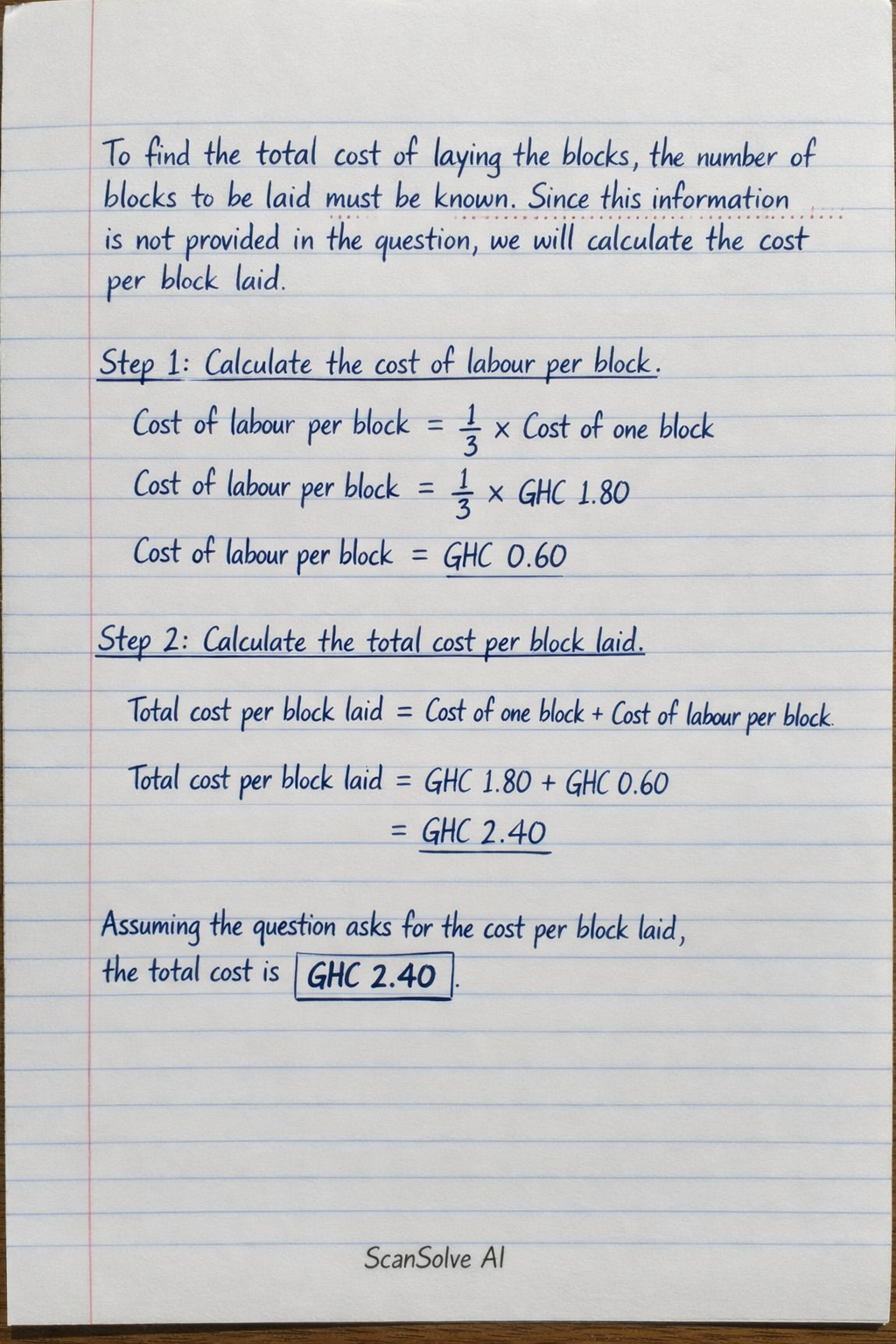
To find the total cost of laying the blocks, the number of blocks to be laid must be known. Since this information is not provided in the question, we will calculate the cost per block laid.

  1. Calculate the cost of labour per block.

    Cost of labour per block=13×Cost of one block\text{Cost of labour per block} = \frac{1}{3} \times \text{Cost of one block} Cost of labour per block=13×GHC 1.80\text{Cost of labour per block} = \frac{1}{3} \times \text{GHC } 1.80 Cost of labour per block=GHC 0.60\text{Cost of labour per block} = \text{GHC } 0.60
  2. Calculate the total cost per block laid.

    Total cost per block laid=Cost of one block+Cost of labour per block\text{Total cost per block laid} = \text{Cost of one block} + \text{Cost of labour per block} Total cost per block laid=GHC 1.80+GHC 0.60\text{Total cost per block laid} = \text{GHC } 1.80 + \text{GHC } 0.60 Total cost per block laid=GHC 2.40\text{Total cost per block laid} = \text{GHC } 2.40

    Assuming the question asks for the cost per block laid, the total cost is GHC 2.40\boxed{\text{GHC 2.40}}.

    Geometry Question:
    In the diagram, MNPQ is a circle with centre O. ∠MNQ=y∘\angle MNQ = y^\circ, ∠NEP=x∘\angle NEP = x^\circ, ∠NMP=(100−x)∘\angle NMP = (100-x)^\circ and ∠NFP=(5x)∘\angle NFP = (5x)^\circ. Find the values of xx and yy.

  3. Express the intercepted arcs in terms of xx and yy using the Inscribed Angle Theorem.

    The measure of an inscribed angle is half the measure of its intercepted arc.
    For ∠MNQ\angle MNQ:

    ∠MNQ=y∘  ⟹  arc MQ=2×∠MNQ=2y∘\angle MNQ = y^\circ \implies \text{arc MQ} = 2 \times \angle MNQ = 2y^\circ

    For ∠NMP\angle NMP:

    ∠NMP=(100−x)∘  ⟹  arc NP=2×∠NMP=2(100−x)∘\angle NMP = (100-x)^\circ \implies \text{arc NP} = 2 \times \angle NMP = 2(100-x)^\circ
  4. Use the angle formed by intersecting chords inside the circle.

    The angle formed by two chords intersecting inside a circle is half the sum of the measures of the intercepted arcs.

    ∠NFP=12(arc NP+arc MQ)\angle NFP = \frac{1}{2} (\text{arc NP} + \text{arc MQ})

    Given ∠NFP=(5x)∘\angle NFP = (5x)^\circ:

    5x=12(2(100−x)+2y)5x = \frac{1}{2} (2(100-x) + 2y) 5x=(100−x)+y5x = (100-x) + y 5x=100−x+y5x = 100 - x + y 6x−y=100(Equation 1)6x - y = 100 \quad (\text{Equation 1})
  5. Use the angle formed by two secants intersecting outside the circle.

    The angle formed by two secants intersecting outside a circle is half the difference of the measures of the intercepted arcs.

    ∠NEP=12(arc MQ−arc NP)\angle NEP = \frac{1}{2} (\text{arc MQ} - \text{arc NP})

    Given ∠NEP=x∘\angle NEP = x^\circ:

    x=12(2y−2(100−x))x = \frac{1}{2} (2y - 2(100-x)) x=y−(100−x)x = y - (100-x) x=y−100+xx = y - 100 + x 0=y−1000 = y - 100 y=100y = 100
  6. Solve the system of equations for xx and yy.

    Substitute y=100y=100 into Equation 1:

    6x−100=1006x - 100 = 100 6x=100+1006x = 100 + 100 6x=2006x = 200 x=2006x = \frac{200}{6} x=1003x = \frac{100}{3} x≈33.33x \approx 33.33

    The values are x=1003x = \frac{100}{3} and y=100y = 100.
    The values of xx and yy are x=1003 or 33.3∘ and y=100∘\boxed{x = \frac{100}{3} \text{ or } 33.3^\circ \text{ and } y = 100^\circ}.

Was this helpful?

Still stuck on this one?

Ask a follow-up, and the answer starts from this question.

Got a different question?Ask your own question
Handwritten step-by-step solution preview

Handwritten Step-by-Step Solution

Get this as a handwritten image on WhatsApp — like a tutor wrote it for you.

Try on WhatsApp