We read your photo as:

Calculate the cost of fencing material, total project cost, and the percentage of labour cost for a project with a perimeter of 78m, fencing cost of R110/m, and fixed labour cost of R2,500.

Mathematics

ScanSolve AI Answer

Step-by-step solution

7 steps

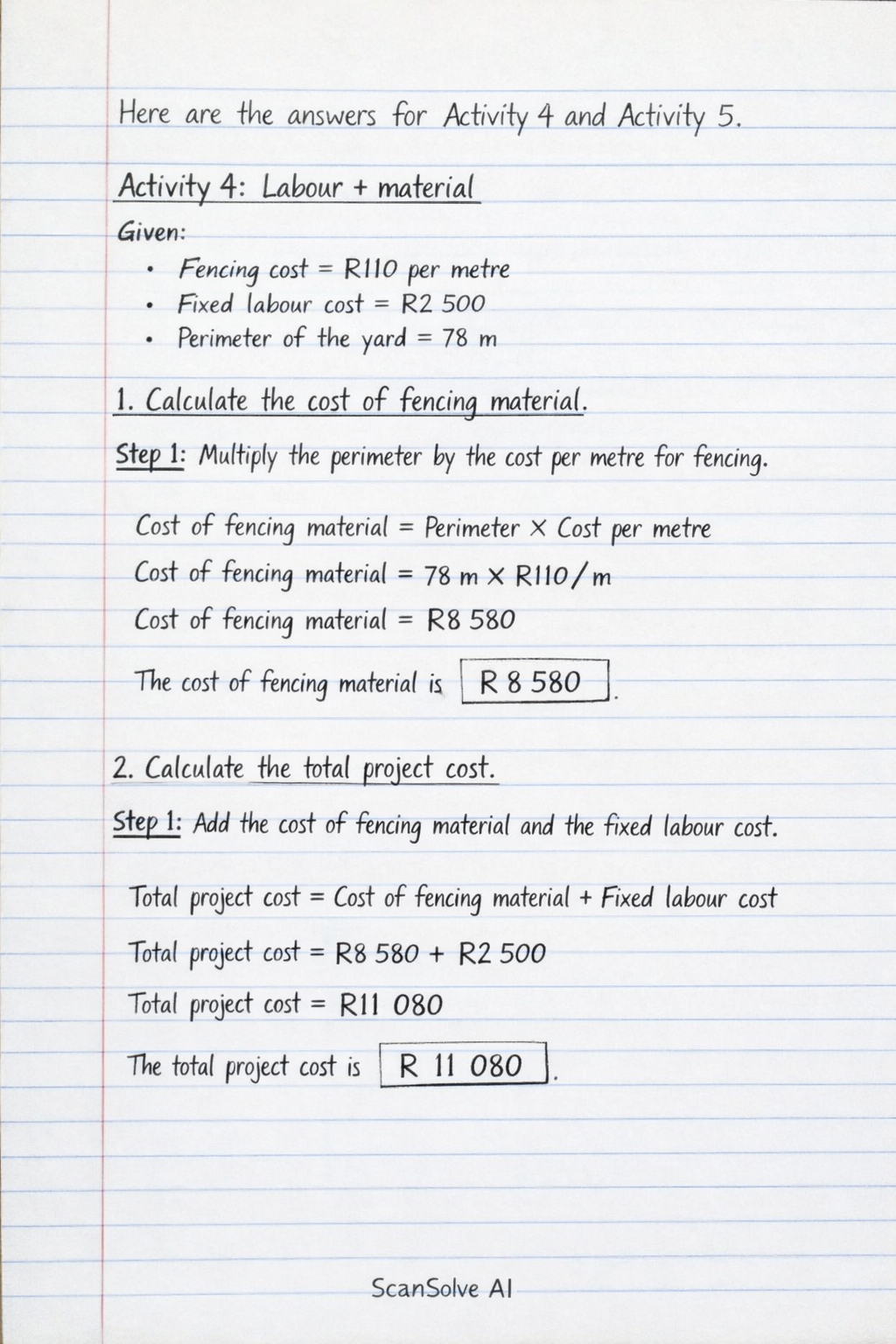
Here are the answers for Activity 4 and Activity 5.

Activity 4: Labour + material
Given:
Fencing cost = R110 per metre
Fixed labour cost = R2 500
Perimeter of the yard = 78 m

1. Calculate the cost of fencing material.

  1. Multiply the perimeter by the cost per metre for fencing.

    Cost of fencing material=Perimeter×Cost per metre\text{Cost of fencing material} = \text{Perimeter} \times \text{Cost per metre} Cost of fencing material=78 m×R110/m\text{Cost of fencing material} = 78 \text{ m} \times \text{R}110/\text{m} Cost of fencing material=R8 580\text{Cost of fencing material} = \text{R}8\,580

    The cost of fencing material is R8 580\boxed{\text{R}8\,580}.

    2. Calculate the total project cost.

  2. Add the cost of fencing material and the fixed labour cost.

    Total project cost=Cost of fencing material+Fixed labour cost\text{Total project cost} = \text{Cost of fencing material} + \text{Fixed labour cost} Total project cost=R8 580+R2 500\text{Total project cost} = \text{R}8\,580 + \text{R}2\,500 Total project cost=R11 080\text{Total project cost} = \text{R}11\,080

    The total project cost is R11 080\boxed{\text{R}11\,080}.

    3. What percentage of the total cost is labour?

  3. Divide the fixed labour cost by the total project cost and multiply by 100%.

    Percentage of labour=Fixed labour costTotal project cost×100%\text{Percentage of labour} = \frac{\text{Fixed labour cost}}{\text{Total project cost}} \times 100\% Percentage of labour=R2 500R11 080×100%\text{Percentage of labour} = \frac{\text{R}2\,500}{\text{R}11\,080} \times 100\% Percentage of labour≈22.56%\text{Percentage of labour} \approx 22.56\%

    The percentage of the total cost that is labour is approximately 22.56%\boxed{22.56\%}.

    Activity 5: Best fencing option
    Given:
    Perimeter of the plot = 64 m

    1. Calculate the total cost for Option A.
    Option A: R135 per metre, labour included.

  4. Multiply the perimeter by the cost per metre.

    Total cost for Option A=Perimeter×Cost per metre\text{Total cost for Option A} = \text{Perimeter} \times \text{Cost per metre} Total cost for Option A=64 m×R135/m\text{Total cost for Option A} = 64 \text{ m} \times \text{R}135/\text{m} Total cost for Option A=R8 640\text{Total cost for Option A} = \text{R}8\,640

    The total cost for Option A is R8 640\boxed{\text{R}8\,640}.

    2. Calculate the total cost for Option B.
    Option B: R110 per metre + R1 800 labour.

  5. Calculate the material cost.

    Material cost=Perimeter×Cost per metre\text{Material cost} = \text{Perimeter} \times \text{Cost per metre} Material cost=64 m×R110/m\text{Material cost} = 64 \text{ m} \times \text{R}110/\text{m} Material cost=R7 040\text{Material cost} = \text{R}7\,040
  6. Add the material cost and the labour cost.

    Total cost for Option B=Material cost+Labour cost\text{Total cost for Option B} = \text{Material cost} + \text{Labour cost} Total cost for Option B=R7 040+R1 800\text{Total cost for Option B} = \text{R}7\,040 + \text{R}1\,800 Total cost for Option B=R8 840\text{Total cost for Option B} = \text{R}8\,840

    The total cost for Option B is R8 840\boxed{\text{R}8\,840}.

    3. Which option is cheaper?
    Compare the total costs: R8 640 (Option A) vs R8 840 (Option B).
    Option A is cheaper.

    4. By how much?

  7. Subtract the cheaper cost from the more expensive cost.

    Difference=Total cost for Option B−Total cost for Option A\text{Difference} = \text{Total cost for Option B} - \text{Total cost for Option A} Difference=R8 840−R8 640\text{Difference} = \text{R}8\,840 - \text{R}8\,640 Difference=R200\text{Difference} = \text{R}200

    Option A is cheaper by R200\boxed{\text{R}200}.

    5. Give one reason (not calculation) why someone may still choose the more expensive option.
    A homeowner might choose the more expensive option if it offers higher quality materials, a better warranty, a more reputable contractor, or a faster completion time.

Was this helpful?

Still stuck on this one?

Ask a follow-up, and the answer starts from this question.

Got a different question?Ask your own question
Handwritten step-by-step solution preview

Handwritten Step-by-Step Solution

Get this as a handwritten image on WhatsApp — like a tutor wrote it for you.

Try on WhatsApp