We read your photo as:

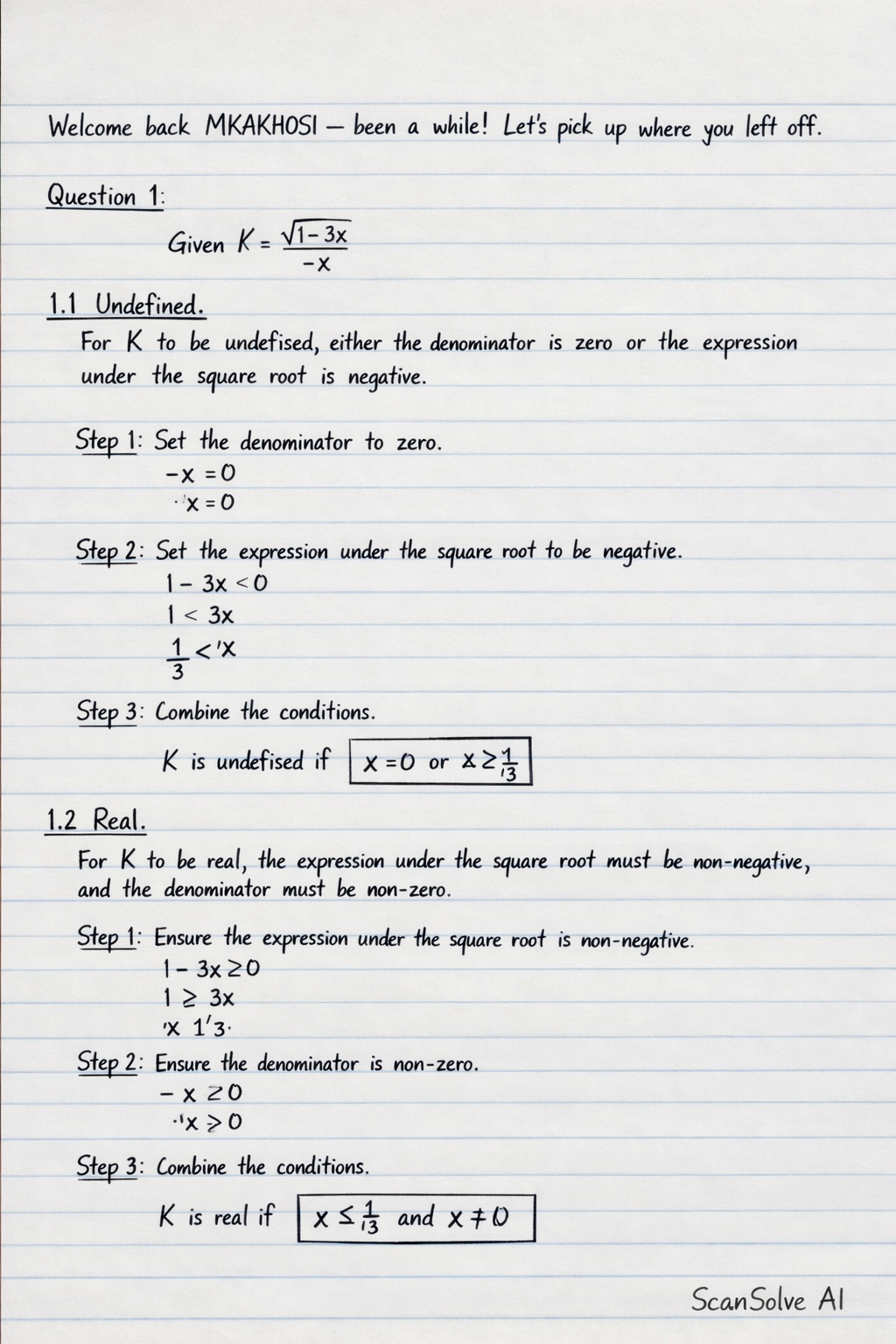
If K = sqrt(1−3x) / -x, find the value(s) of x, such that K is: 1.1 Undefined, 1.2 Real, 1.3 Positive.

Mathematics

ScanSolve AI Answer

Answers

8 parts
1.1

x=0 or x>13x=0 \text{ or } x > \frac{1}{3}

1.2

x≤13,x≠0x \le \frac{1}{3}, x \ne 0

1.3

x<0x < 0

2.1

27x3−827x^3 - 8

2.2

3x33x^3

2.3

b−aab\frac{b-a}{ab}

3.1

5(x+2x)(x2−2+4x2)5\left(x + \frac{2}{x}\right)\left(x^2 - 2 + \frac{4}{x^2}\right)

3.2

y=3 or x=6 or x=−6y=3 \text{ or } x=6 \text{ or } x=-6

Step-by-step solution

28 steps

Part 1

Given K=1−3x−xK = \frac{\sqrt{1-3x}}{-x}.

Part 1.1

x=0 or x>13x=0 \text{ or } x > \frac{1}{3}

Undefined.

For KK to be undefined, either the denominator is zero or the expression under the square root is negative.

  1. Set the denominator to zero.

    −x=0-x = 0 x=0x = 0
  2. Set the expression under the square root to be negative.

    1−3x<01-3x < 0 1<3x1 < 3x 13<x\frac{1}{3} < x
  3. Combine the conditions.

    KK is undefined if x=0x=0 or x>13x > \frac{1}{3}.

    x=0 or x>13\boxed{x=0 \text{ or } x > \frac{1}{3}}

Part 1.2

x≤13,x≠0x \le \frac{1}{3}, x \ne 0

Real.

For KK to be real, the expression under the square root must be non-negative, and the denominator must be non-zero.

  1. Ensure the expression under the square root is non-negative.

    1−3x≥01-3x \ge 0 1≥3x1 \ge 3x x≤13x \le \frac{1}{3}
  2. Ensure the denominator is non-zero.

    −x≠0-x \ne 0 x≠0x \ne 0
  3. Combine the conditions.

    KK is real if x≤13x \le \frac{1}{3} and x≠0x \ne 0.

    x≤13,x≠0\boxed{x \le \frac{1}{3}, x \ne 0}

Part 1.3

x<0x < 0

Positive.

For KK to be positive, K>0K > 0. This means 1−3x−x>0\frac{\sqrt{1-3x}}{-x} > 0.
The numerator 1−3x\sqrt{1-3x} must be real and positive, and the denominator −x-x must also be positive.

  1. Ensure the numerator is positive.

    For 1−3x\sqrt{1-3x} to be positive, 1−3x>01-3x > 0.

    1>3x1 > 3x x<13x < \frac{1}{3}
  2. Ensure the denominator is positive.

    −x>0-x > 0 x<0x < 0
  3. Combine the conditions.

    Both conditions x<13x < \frac{1}{3} and x<0x < 0 must be met. The stricter condition is x<0x < 0.

    x<0\boxed{x < 0}

Part 2

Part 2.1

27x3−827x^3 - 8

Simplify (3x−2)(9x2+6x+4)(3x-2)(9x^2+6x+4)

  1. Recognize the pattern as the difference of cubes formula, (a−b)(a2+ab+b2)=a3−b3(a-b)(a^2+ab+b^2) = a^3-b^3.

    Here, a=3xa=3x and b=2b=2.

    (3x−2)((3x)2+(3x)(2)+22)(3x-2)((3x)^2 + (3x)(2) + 2^2)
  2. Apply the formula.

    (3x)3−23(3x)^3 - 2^3
  3. Calculate the powers.

    27x3−827x^3 - 8 27x3−8\boxed{27x^3 - 8}

Part 2.2

3x33x^3

Simplify 2x−2÷x−5+(x−1)−32x^{-2} \div x^{-5} + (x^{-1})^{-3}

  1. Simplify the division term using the exponent rule am÷an=am−na^m \div a^n = a^{m-n}.

    2x−2÷x−5=2x−2−(−5)=2x−2+5=2x32x^{-2} \div x^{-5} = 2x^{-2 - (-5)} = 2x^{-2+5} = 2x^3
  2. Simplify the second term using the exponent rule (am)n=amn(a^m)^n = a^{mn}.

    (x−1)−3=x(−1)×(−3)=x3(x^{-1})^{-3} = x^{(-1) \times (-3)} = x^3
  3. Add the simplified terms.

    2x3+x3=3x32x^3 + x^3 = 3x^3 3x3\boxed{3x^3}

Part 2.3

b−aab\frac{b-a}{ab}

Simplify (a−2−b−2)÷(a−1+b−1)(a^{-2}-b^{-2}) \div (a^{-1}+b^{-1})

  1. Rewrite terms with negative exponents as fractions.

    a−2−b−2=1a2−1b2=b2−a2a2b2a^{-2}-b^{-2} = \frac{1}{a^2} - \frac{1}{b^2} = \frac{b^2-a^2}{a^2b^2} a−1+b−1=1a+1b=b+aaba^{-1}+b^{-1} = \frac{1}{a} + \frac{1}{b} = \frac{b+a}{ab}
  2. Perform the division by multiplying by the reciprocal of the divisor.

    b2−a2a2b2÷b+aab=b2−a2a2b2×abb+a\frac{b^2-a^2}{a^2b^2} \div \frac{b+a}{ab} = \frac{b^2-a^2}{a^2b^2} \times \frac{ab}{b+a}
  3. Factor the difference of squares in the numerator, b2−a2=(b−a)(b+a)b^2-a^2 = (b-a)(b+a).

    (b−a)(b+a)a2b2×abb+a\frac{(b-a)(b+a)}{a^2b^2} \times \frac{ab}{b+a}
  4. Cancel common factors (b+a)(b+a) and abab.

    (b−a)ab\frac{(b-a)}{ab} b−aab\boxed{\frac{b-a}{ab}}

Part 3

Part 3.1

5(x+2x)(x2−2+4x2)5\left(x + \frac{2}{x}\right)\left(x^2 - 2 + \frac{4}{x^2}\right)

Factorise the following expression fully: 5x3+40x35x^3 + \frac{40}{x^3}

  1. Factor out the common factor of 5.

    5(x3+8x3)5\left(x^3 + \frac{8}{x^3}\right)
  2. Recognize the expression inside the parenthesis as a sum of cubes, A3+B3=(A+B)(A2−AB+B2)A^3+B^3 = (A+B)(A^2-AB+B^2), where A=xA=x and B=2xB=\frac{2}{x}.

    5(x3+(2x)3)5\left(x^3 + \left(\frac{2}{x}\right)^3\right)
  3. Apply the sum of cubes formula.

    5(x+2x)(x2−x(2x)+(2x)2)5\left(x + \frac{2}{x}\right)\left(x^2 - x\left(\frac{2}{x}\right) + \left(\frac{2}{x}\right)^2\right)
  4. Simplify the terms inside the second parenthesis.

    5(x+2x)(x2−2+4x2)5\left(x + \frac{2}{x}\right)\left(x^2 - 2 + \frac{4}{x^2}\right) 5(x+2x)(x2−2+4x2)\boxed{5\left(x + \frac{2}{x}\right)\left(x^2 - 2 + \frac{4}{x^2}\right)}

Part 3.2

y=3 or x=6 or x=−6y=3 \text{ or } x=6 \text{ or } x=-6

Solve simultaneously for xx and yy if: x2(y−3)+36(3−y)=0x^2(y-3)+36(3-y)=0

  1. Rewrite the term 36(3−y)36(3-y) to have a common factor with x2(y−3)x^2(y-3).

    Note that (3−y)=−(y−3)(3-y) = -(y-3).

    x2(y−3)−36(y−3)=0x^2(y-3) - 36(y-3) = 0
  2. Factor out the common term (y−3)(y-3).

    (y−3)(x2−36)=0(y-3)(x^2-36) = 0
  3. Set each factor equal to zero to find the possible values for xx and yy.

    y−3=0orx2−36=0y-3 = 0 \quad \text{or} \quad x^2-36 = 0
  4. Solve for yy.

    y=3y = 3
  5. Solve for xx.

    x2=36x^2 = 36 x=±36x = \pm\sqrt{36} x=±6x = \pm 6

    The solutions are y=3y=3 (for any real xx) or x=6x=6 (for any real yy) or x=−6x=-6 (for any real yy).
    More precisely, the equation holds if y=3y=3 (and xx can be any real number) OR if x=6x=6 or x=−6x=-6 (and yy can be any real number).

    y=3 or x=6 or x=−6\boxed{y=3 \text{ or } x=6 \text{ or } x=-6}
Was this helpful?

Try one yourself

A new problem that tests the same skill.

Still stuck on this one?

Ask a follow-up, and the answer starts from this question.

Got a different question?Ask your own question
Handwritten step-by-step solution preview

Handwritten Step-by-Step Solution

Get this as a handwritten image on WhatsApp — like a tutor wrote it for you.

Try on WhatsApp