
We read your photo as:
If (^n C2)/(^n P3) = (1)/(10), find the value of n.
ScanSolve AI Answer
Answers
2 partsStep-by-step solution
12 stepsHere are the solutions for questions 2, 3, and 4.
Part 2
Part a7
If , find the value of .
Write out the formulas for combinations and permutations.
Apply the formulas to and .
Substitute these expressions into the given equation.
Simplify the equation.
Assuming and (which must be true for the terms to be defined, as for ), we can cancel from the numerator and denominator.
Solve for .
The value of is:
Part b
Evaluate .
Use the logarithm properties and .
Combine the terms.
The evaluated expression is:
Part 3· 5 steps
The product of the 3rd and 7th terms of an arithmetic progression is 105. The $18$th term divided by the $5$th term is 5. The first term is positive. Find: a) second term b) Sum of the first 20 terms.
Define the terms of an arithmetic progression.
Let the first term be and the common difference be . The -th term is .
Set up equations based on the given information.
- Product of 3rd and 7th terms is 105:
- 18th term divided by 5th term is 5:
Solve equation (2) for in terms of or in terms of .
Substitute the expression for into equation (1).
Solve for .
Since the first term is positive, .
Step
Try one yourself
A new problem that tests the same skill.
Still stuck on this one?
Ask a follow-up, and the answer starts from this question.
More Mathematics Questions
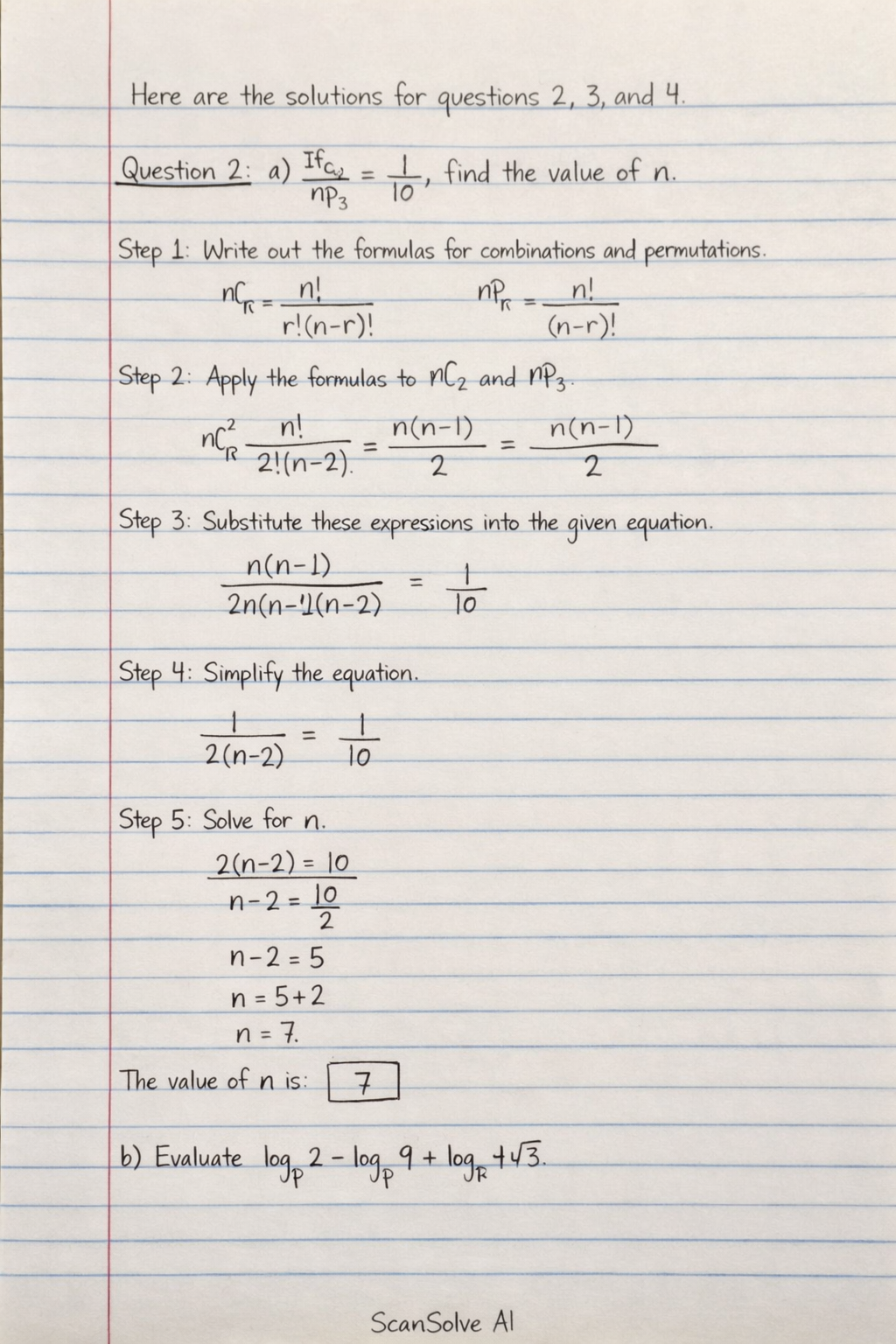
Handwritten Step-by-Step Solution
Get this as a handwritten image on WhatsApp — like a tutor wrote it for you.
Try on WhatsApp