

This mathematics problem involves applying core mathematical principles and formulas. Below you will find a complete step-by-step solution with detailed explanations for each step, helping you understand not just the answer but the method behind it.
ScanSolve AI Answer
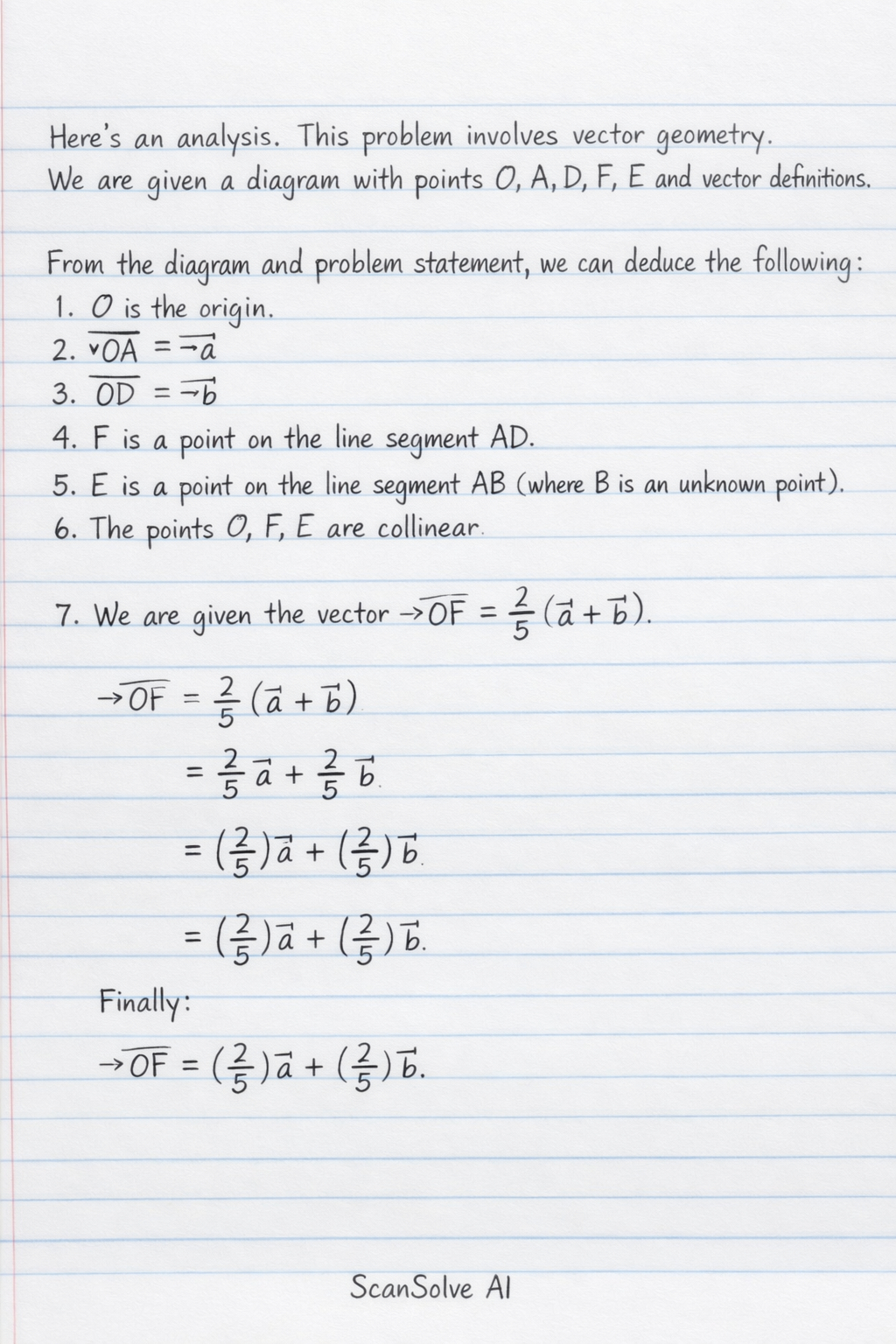
This problem involves vector geometry. We are given a diagram with points O, A, D, F, E and vector definitions. From the diagram and problem statement, we can deduce the following: 1. O is the origin. 2. OA = a 3. OD = b 4. F is a point on the line segment AD. 5. E is a point on the line segment AB (where B is an unknown point). 6. The points O, F, E are collinear. 7. We are given the vector OF = (2)/(5)(a + b). Step 1: Express OF in terms of a and b using the fact that F is on AD. If F is on the line segment AD, then OF can be expressed as a linear combination of OA and OD using the section formula: OF = (1-t)OA + tOD OF = (1-t)a + tb We are given OF = (2)/(5)(a + b) = (2)/(5)a + (2)/(5)b. Comparing the coefficients of a and b (assuming a and b are not parallel, which they are not as they form a triangle OAD): 1-t = (2)/(5) t = 1 - (2)/(5) = (3)/(5) t = (2)/(5) This presents a contradiction, as t cannot be both (3)/(5) and (2)/(5). This implies that the point F, as defined by the given vector equation, is not on the line AD, despite what the diagram suggests. This is a common issue in vector problems where the diagram might be illustrative rather than strictly accurate to all given conditions. We must prioritize the algebraic conditions. Therefore, we will proceed with the given OF = (2)/(5)(a + b) and the collinearity of O, F, E, and E being on AB. Step 2: Express OE using the collinearity of O, F, E. Since O, F, E are collinear, OE must be a scalar multiple of OF. Let OE = k OF for some scalar k. OE = k ( (2)/(5)(a + b) ) = (2k)/(5)a + (2k)/(5)b Step 3: Express OE using the fact that E is on AB. The diagram shows a line segment from A, through E, to a point that is also labeled E. This is likely a typo, and the point at the end of the line segment from A, through E, should be B. So E is on the line segment AB. We can write OE using the section formula for E on AB: OE = (1-s)OA + sOB OE = (1-s)a + sOB We need to determine OB. The diagram shows D on the line segment OB. This means O, D, B are collinear. So, OB must be a scalar multiple of OD. Let OB = m OD = mb for some scalar m. OE = (1-s)a + smb Step 4: Equate the two expressions for OE and solve for k, s, m. (2k)/(5)a + (2k)/(5)b = (1-s)a + smb Equating the coefficients of a and b (since a and b are linearly independent): (2k)/(5) = 1-s (Equation 1) (2k)/(5) = sm (Equation 2) From Equation 1 and Equation 2, we have: 1-s = sm 1 = s + sm 1 = s(1+m) (Equation 3) We have three unknowns (k, s, m) and only two independent equations. This indicates that there might be an implicit condition from the diagram that we haven't used, or the problem is designed to be solved by a specific method (e.g., Menelaus' Theorem in vector form). Let's reconsider the contradiction from Step 1. If the diagram is correct about F being on AD, then the given OF is incorrect. If the given OF is correct, then F is not on AD. Given the explicit vector equation, we must assume the equation is correct. The diagram's placement of F on AD is therefore misleading. Let's assume the standard interpretation of such a diagram where O, F, E are collinear, and E is on AB, and D is on OB. The problem is to express DE. DE = OE - OD = OE - b We need to find OE. Let's use the property that if O, F, E are collinear, and E is on AB, and D is on OB, then we can use ratios. From OF = (2)/(5)(a + b), we know that F is a point. Since O, F, E are collinear, OE = OF = (2)/(5)(a + b). Since E is on AB, OE = (1-s)a + sOB. Since D is on OB, OB = mOD = mb. So, OE = (1-s)a + smb. Equating coefficients: (2)/(5) = 1-s (2)/(5) = sm This implies 1-s = sm 1 = s(1+m). This still leaves us with two unknowns s and m. There must be a missing piece of information or a different interpretation of the diagram. What if the diagram implies that F is the intersection of OE and AD? If F is on AD, then OF = (1-t)a + tb. If OF = (2)/(5)a + (2)/(5)b, then 1-t = (2)/(5) and t = (2)/(5). This is a contradiction (t=(3)/(5) and t=(2)/(5)). This means F, as defined by the equation, cannot be on AD. Let's assume the diagram is a general representation of a triangle OAB, with D on OB, and E on AB, and F on OE. The problem asks for DE. DE = OE - OD = OE - b. We have OE = k OF = k (2)/(5)(a + b). So, DE = k (2)/(5)(a + b) - b. We need to find k. Consider the line AB. E is on AB. OE = (1-s)OA + sOB = (1-s)a + sOB. The diagram shows D on OB. Let OB = mOD = mb. So OE = (1-s)a + smb. Equating coefficients from OE = (2k)/(5)a + (2k)/(5)b: (2k)/(5) = 1-s (2k)/(5) = sm This implies 1-s = sm. This is still not enough to find k. Let's re-examine the image for any subtle clues. The point labeled 'E' on the right is the end of the line segment starting from A. This means the line is AB, and E is on AB. The line segment from O passes through F and then to E. The line segment from A passes through F and then to D. This means F is the intersection of OE and AD. This is the standard interpretation. If F is the intersection of OE and AD, then: 1. F is on AD: OF = (1-t)OA + tOD = (1-t)a + tb. 2. F is on OE: OF = OE. We are given OF = (2)/(5)(a + b). This means (1-t)a + tb = (2)/(5)a + (2)/(5)b. This implies 1-t = (2)/(5) and t = (2)/(5). This is the contradiction t = (3)/(5) and t = (2)/(5). This contradiction means that the problem statement is inconsistent with the diagram if F is the intersection of AD and OE. Given the explicit vector equation OF = (2)/(5)(a + b), we must assume this is correct. The diagram's implication that F is on AD must be incorrect. Let's assume the problem means: 1. OA = a 2. OD = b 3. OF = (2)/(5)(a + b) 4. E is a point on the line AB (where B is some point such that O, D, B are collinear). 5. O, F, E are collinear. We need to find DE = OE - OD = OE - b. Since O, F, E are collinear, OE = k OF = k (2)/(5)(a + b). Since E is on AB, OE = (1-s)a + sOB. Since O, D, B are collinear, OB = mOD = mb. So OE = (1-s)a + smb. Equating coefficients: (2k)/(5) = 1-s (2k)/(5) = sm This implies 1-s = sm s(1+m) = 1. This still leaves us with too many unknowns. There is a possibility that the question implies that the point D is actually B. If OA = a and OB = b (i.e., D is B), then: OF = (2)/(5)(a + b). E is on AB. O, F, E are collinear. If D is B, then we need to express BE in terms of a and b. BE = OE - OB = OE - b. Since E is on AB, OE = (1-s)a + sb. Since O, F, E are collinear, OE = k OF = k (2)/(5)(a + b). Equating coefficients: 1-s = (2k)/(5) s = (2k)/(5) So 1-s = s 1 = 2s s = (1)/(2). Then (2k)/(5) = (1)/(2) k = (5)/(4). So OE = (1)/(2)a + (1)/(2)b. Then DE = OE - b = ((1)/(2)a + (1)/(2)b) - b = (1)/(2)a - (1)/(2)b = (1)/(2)(a - b). This interpretation makes the problem solvable. It assumes D is B. Let's verify this interpretation with the diagram. The label 'b' is next to D. If D is B, then OB = b. This is a common convention. So, let's assume: OA = a OB = b (where B is the point labeled D in the diagram). F is a point such that OF = (2)/(5)(a + b). E is a point on the line segment AB. O, F, E are collinear. Step 1: Express OE using the collinearity of O, F, E. Since O, F, E are collinear, OE = k OF for some scalar k. OE = k ( (2)/(5)(a + b) ) = (2k)/(5)a + (2k)/(5)b Step 2: Express OE using the fact that E is on AB. Since E is on the line segment AB, we can write OE using the section formula: OE = (1-s)OA + sOB OE = (1-s)a + sb Step 3: Equate the two expressions for OE and solve for k and s. (2k)/(5)a + (2k)/(5)b = (1-s)a + sb Equating coefficients of a and b: (2k)/(5) = 1-s (Equation 1) (2k)/(5) = s (Equation 2) Substitute Equation 2 into Equation 1: s = 1-s 2s = 1 s = (1)/(2) Now substitute s = (1)/(2) back into Equation 2 to find k: (2k)/(5) = (1)/(2) 2k = (5)/(2) k = (5)/(4) Step 4: Find OE. Substitute k = (5)/(4) back into the expression for OE from Step 1: OE = (2)/(5) ( (5)/(4) ) (a + b) OE = (1)/(2)(a + b) = (1)/(2)a + (1)/(2)b Step 5: Express DE in terms of a and b. We need to find DE. Remember that we assumed D is the point B, so OD = b. DE = OE - OD DE = ( (1)/(2)a + (1)/(2)b ) - b ✂️ _That answer was long and got cut off. Reply continue and I'll finish it._