
We read your photo as:
Determine if the following lines are parallel, intersecting, or skew: L: (x+8)/2 = (y−10)/3 = (z−6)/1 and M: (x-1)/-1 = (y−1)/2 = (z−1)/4
ScanSolve AI Answer
Answer
Step-by-step solution
4 stepsTo determine the relationship between the two lines, we first extract their direction vectors and a point on each line.
The symmetric equations of the lines are given as:
Line L:
Line M:
Identify direction vectors and points.
For line L, the direction vector is and a point on the line is .
For line M, the direction vector is and a point on the line is .Check if the lines are parallel.
Lines are parallel if their direction vectors are scalar multiples of each other.
We check if for some scalar .From the x-components: .
From the y-components: .
Since the values of are not consistent (), the direction vectors are not parallel. Therefore, the lines are not parallel.Check if the lines intersect.
To check for intersection, we write the parametric equations for each line and set the corresponding coordinates equal.
Parametric equations for L:
Parametric equations for M:
Set the coordinates equal:
From equation (3), express in terms of :
Substitute this expression for into equation (1):
Now substitute back into the expression for :
Finally, check if these values of and satisfy equation (2):
This statement is false, as . Since the values of and do not satisfy all three equations, the lines do not intersect.Determine the relationship.
Since the lines are not parallel and do not intersect, they are skew.
We can also check if they are perpendicular by calculating the dot product of their direction vectors:
.
Since the dot product is not zero, the lines are not perpendicular.The relationship between lines L and M is that they are skew lines.
The final answer is
Try one yourself
A new problem that tests the same skill.
Still stuck on this one?
Ask a follow-up, and the answer starts from this question.
More Mathematics Questions
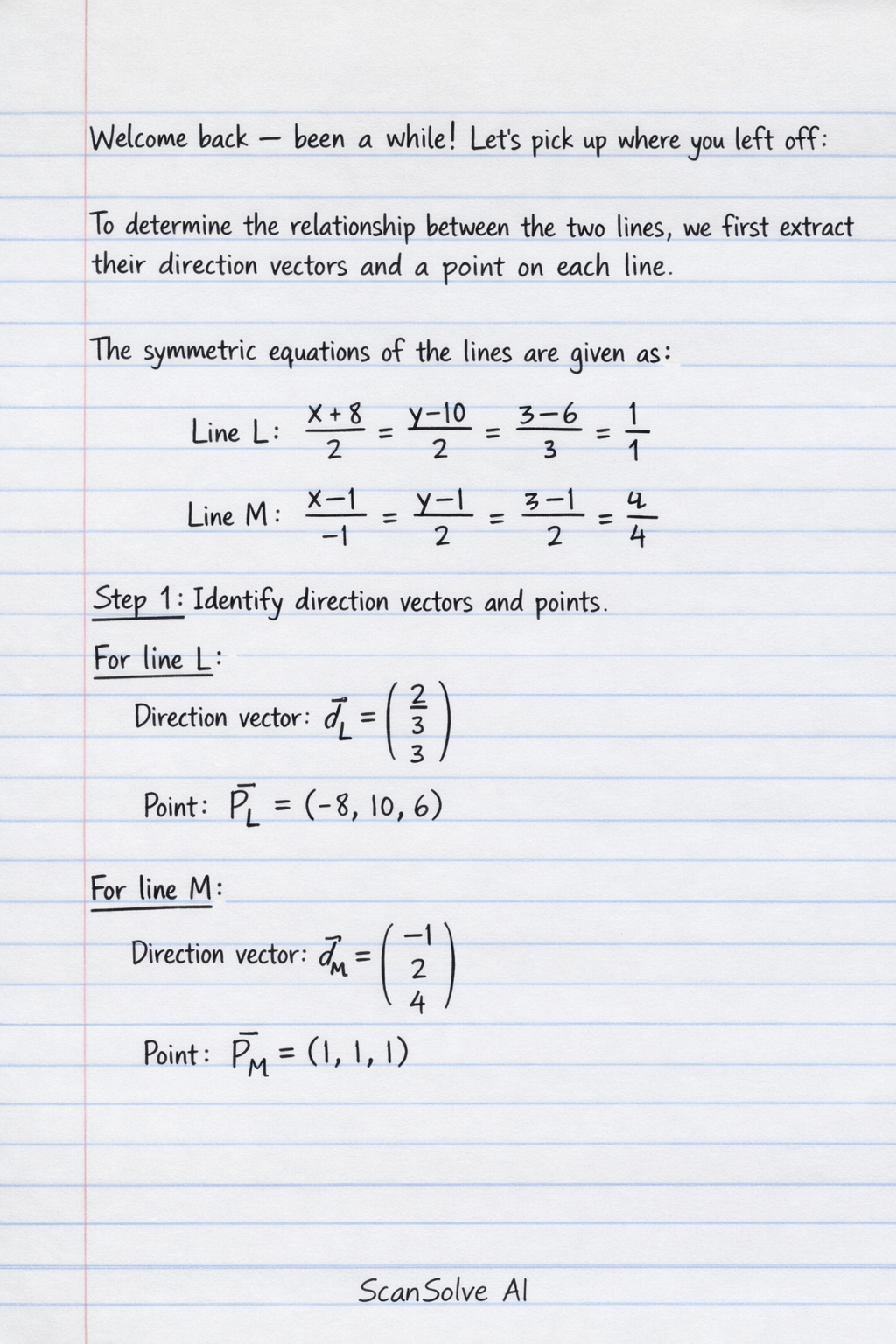
Handwritten Step-by-Step Solution
Get this as a handwritten image on WhatsApp — like a tutor wrote it for you.
Try on WhatsApp