
We read your photo as:
Determine if the following numbers are prime or composite: 40, 87, 83, 2, 46, 80, 89, 53, 50, 76, 82, and 94. Show the prime factorization for composite numbers.
Mathematics
ScanSolve AI Answer
This answer stops before the end.
It was cut off when it was first written. Ask ScanSolve this question again for the full working.
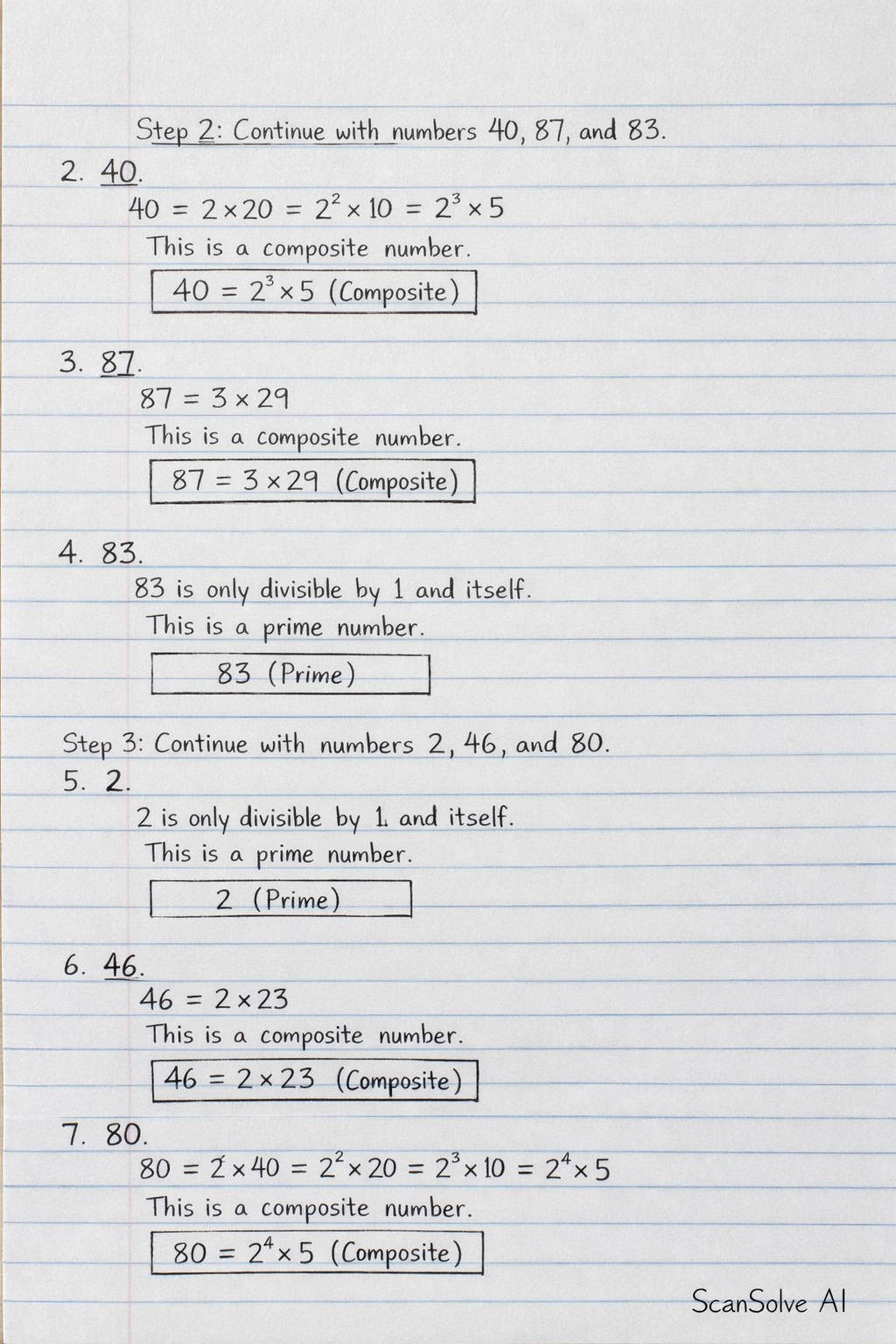
Step 2: Continue with numbers 40, 87, and 83.
- 40 This is a composite number.
- 87 This is a composite number.
- 83 83 is only divisible by 1 and itself. This is a prime number.
Step 3: Continue with numbers 2, 46, and 80.
- 2 2 is only divisible by 1 and itself. This is a prime number.
- 46 This is a composite number.
- 80 This is a composite number.
Step 4: Continue with numbers 89, 53, and 50.
- 89 89 is only divisible by 1 and itself. This is a prime number.
- 53 53 is only divisible by 1 and itself. This is a prime number.
- 50 This is a composite number.
Step 5: Continue with numbers 76, 82, and 94.
- 76 This is a composite number.
- 82 This is a composite number.
- 94 This is a composite number.
Step 6: Continue with numbers 67, 32, and 47.
- 67 67 is only divisible by 1 and itself. This is a prime number.
- 32 This is a composite number.
- 47 47 is only divisible by 1 and itself. This is a prime number.
Step 7: Continue with numbers 3 and 9.
- 3 3 is only divisible by 1 and itself. This is a prime number.
- 9 This is a composite number.
Was this helpful?
Still stuck on this one?
Ask a follow-up, and the answer starts from this question.
Got a different question?Ask your own question
More Mathematics Questions
QFind the prime factorization for the following numbers: 50, 80, 144, 95, and 125.QFor each number, we will find its prime factorization and determine if it is a prime or composite…QClassify the following numbers as prime or composite: 201, 211, 55, 112, 73. Then, find the product…QFind the prime factors for the following numbers: a) 27 b) 40 c) 50 d) 75 e) 90QBreak down the following numbers by their prime factors: 6, 72, 108, 30, 60, 150.
Handwritten Step-by-Step Solution
Get this as a handwritten image on WhatsApp — like a tutor wrote it for you.
Try on WhatsApp