
We read your photo as:
Determine if the following pairs of triangles are congruent. Explain your reasoning, citing the appropriate congruence rule.
ScanSolve AI Answer
Step-by-step solution
9 stepsPart a· 3 steps
Convert units to be consistent.
Compare the triangles.
Both triangles are right-angled.
The hypotenuse of the first triangle is , and the hypotenuse of the second triangle is .
One side of the first triangle is , and one side of the second triangle is .Determine congruency.
The triangles are congruent because they are right-angled, have equal hypotenuses, and one pair of corresponding sides are equal. This satisfies the RHS (Right angle - Hypotenuse - Side) rule.
The triangles are congruent by the RHS rule.
Part b· 3 steps
Convert units to be consistent.
Compare the triangles.
For the first triangle, two angles are and , and the included side is ().
For the second triangle, two angles are and , and the included side is .Determine congruency.
Since two angles and the included side are equal in both triangles, they are congruent by the ASA (Angle - Side - Angle) rule.
The triangles are congruent by the ASA rule.
Part c· 3 steps
Convert units to be consistent.
Compare the triangles.
The sides of the first triangle are , , and .
The sides of the second triangle are , , and .Determine congruency.
All three corresponding sides of the triangles are equal. This satisfies the SSS (Side - Side - Side) rule.
The triangles are congruent by the SSS rule.
Still stuck on this one?
Ask a follow-up, and the answer starts from this question.
More Mathematics Questions
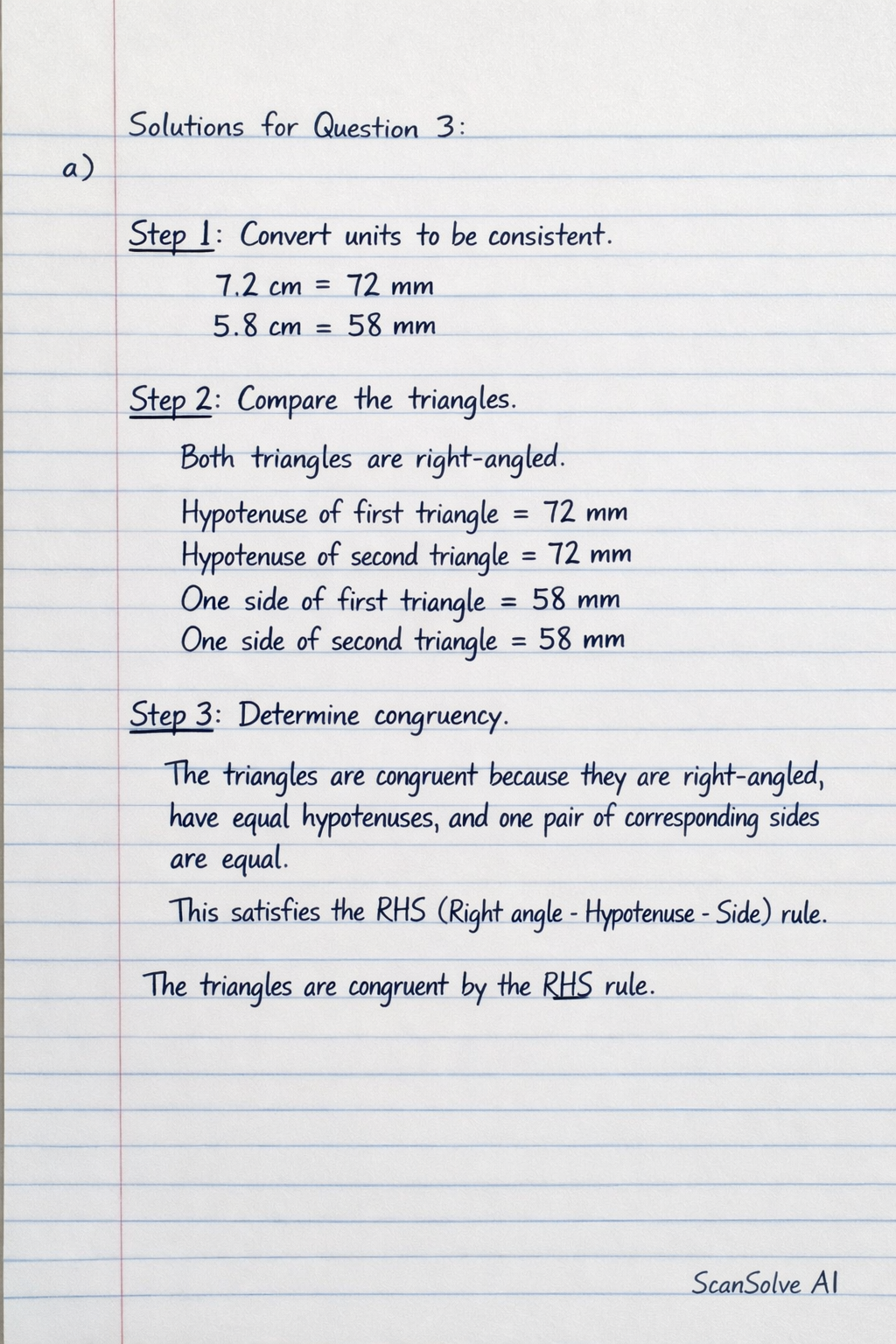
Handwritten Step-by-Step Solution
Get this as a handwritten image on WhatsApp — like a tutor wrote it for you.
Try on WhatsApp