
We read your photo as:
If the mine winch drum diameter is 6 m, calculate how far the cage will drop for each single rotation of the drum.
ScanSolve AI Answer
Step-by-step solution
6 stepsHere are the solutions to the questions:
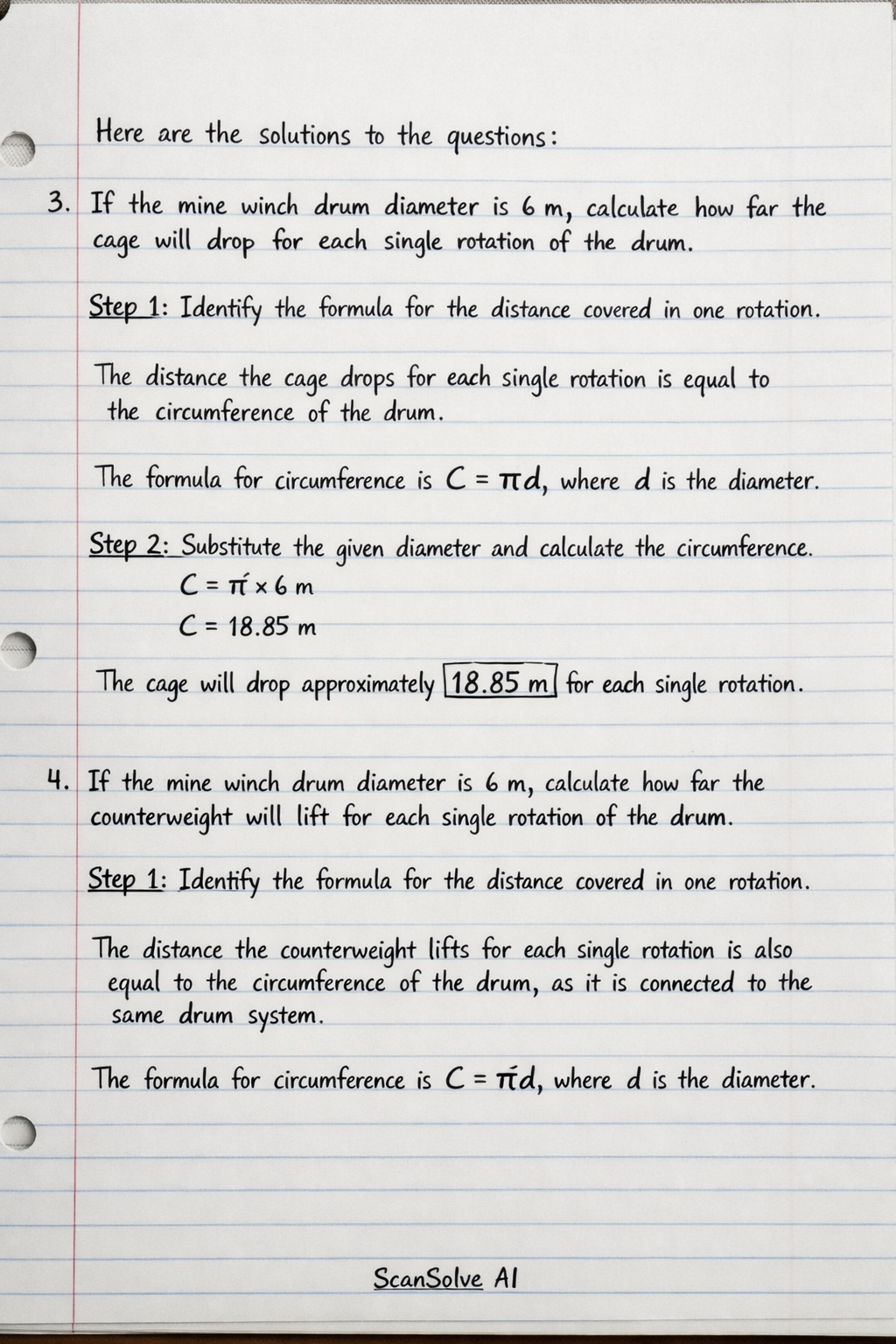
3. If the mine winch drum diameter is 6 m, calculate how far the cage will drop for each single rotation of the drum.
Identify the formula for the distance covered in one rotation.
The distance the cage drops for each single rotation is equal to the circumference of the drum.
The formula for circumference is , where is the diameter.Substitute the given diameter and calculate the circumference.
The cage will drop approximately for each single rotation.
4. If the mine winch drum diameter is 6 m, calculate how far the counterweight will lift for each single rotation of the drum.
Identify the formula for the distance covered in one rotation.
The distance the counterweight lifts for each single rotation is also equal to the circumference of the drum, as it is connected to the same drum system.
The formula for circumference is , where is the diameter.Substitute the given diameter and calculate the circumference.
The counterweight will lift approximately for each single rotation.
5. Calculate how many turns of cable you will need on the drum for your cage and skip to move up and down by 500 m.
Determine the distance covered per turn.
From questions 3 and 4, the distance covered per turn (circumference) is .
Calculate the number of turns required.
The number of turns is the total distance divided by the distance per turn.
You will need approximately of cable.
6. Which of the two systems in Figure 4 do you think will need the largest motor? Explain your answer.
The system on the left (without a counterweight) will need the largest motor. This is because it must lift the full weight of the cage and its contents without any assistance. The system on the right, with a counterweight, balances a significant portion of the load, thereby reducing the net force the motor needs to apply and requiring less power.
7. Which system will be safer? Explain your answer.
The system on the right (with a counterweight) will be safer. The counterweight reduces the effective load on the motor and braking system, which minimizes stress and wear on these critical components. This decreases the risk of mechanical failure and allows for smoother, more controlled operation during both lifting and lowering.
Still stuck on this one?
Ask a follow-up, and the answer starts from this question.
More Mathematics Questions
Handwritten Step-by-Step Solution
Get this as a handwritten image on WhatsApp — like a tutor wrote it for you.
Try on WhatsApp