

This physics problem tests your understanding of fundamental physical laws and their applications. The step-by-step solution below breaks down the problem using relevant equations and physical reasoning.
ScanSolve AI Answer
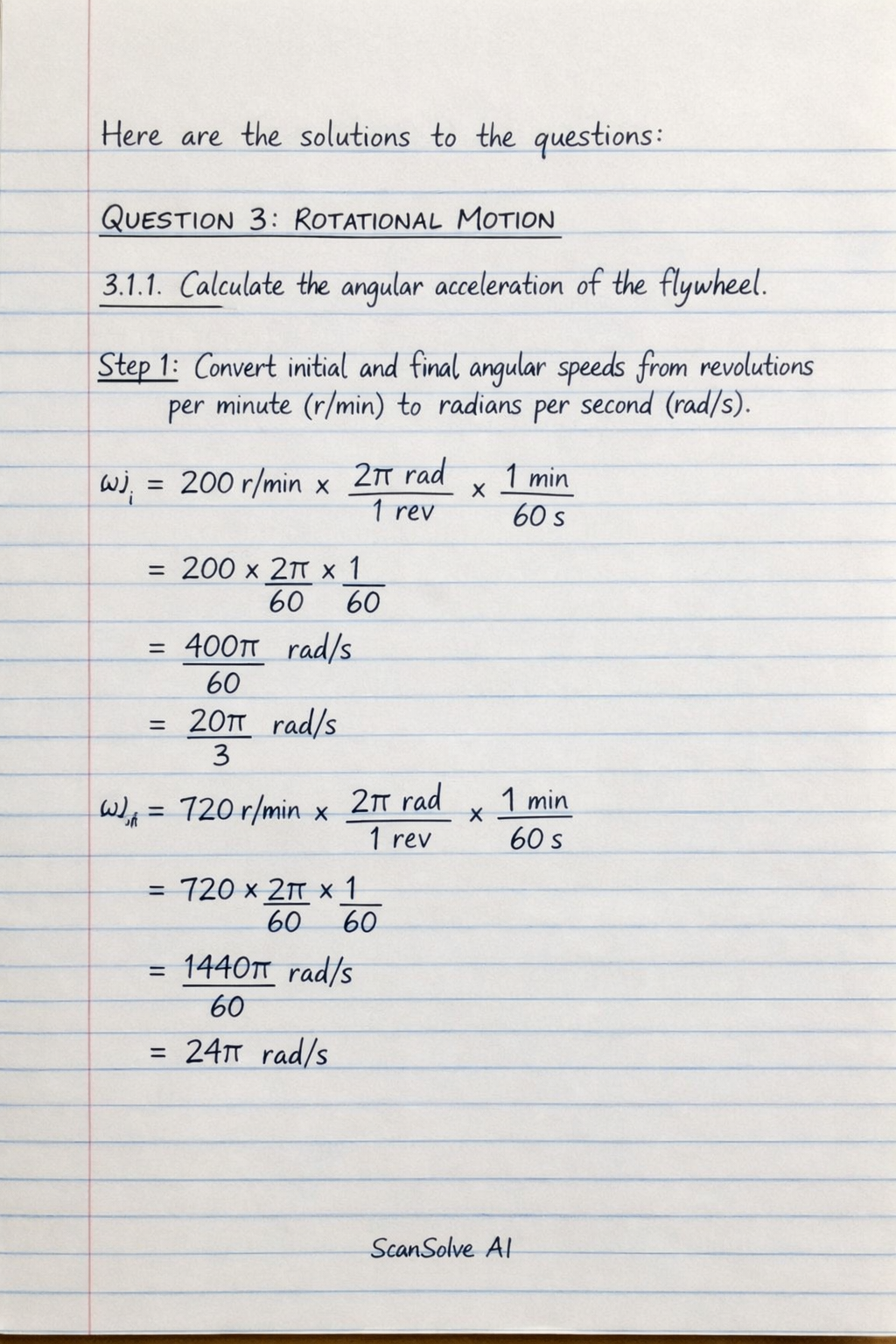
Here are the solutions to the questions: QUESTION 3: ROTATIONAL MOTION 3.1.1 Calculate the angular acceleration of the flywheel. Step 1: Convert initial and final angular speeds from revolutions per minute (r/min) to radians per second (rad/s). _i = 200 r/min × 2 rad1 rev × 1 min60 s = (400)/(60) rad/s = (20)/(3) rad/s _f = 720 r/min × 2 rad1 rev × 1 min60 s = (1440)/(60) rad/s = 24 rad/s Step 2: Calculate the angular acceleration using the formula = (_f - _i)/(t). = 24 rad/s - (20)/(3) rad/s8 s = (72 - 20)/(3)8 rad/s^2 = (52)/(24) rad/s^2 = (13)/(6) rad/s^2 ≈ 6.81 rad/s^2 The angular acceleration is (13)/(6) rad/s^2 or 6.81 rad/s^2. 3.1.2 Determine the number of revolutions made during the 8 s. Step 1: Calculate the angular displacement using the formula = ((_i + _f))/(2) t. = ((20)/(3) rad/s + 24 rad/s)2 × 8 s = ((20 + 72)/(3))2 × 8 rad = (92)/(6) × 8 rad = (46)/(3) × 8 rad = (368)/(3) rad Step 2: Convert the angular displacement from radians to revolutions. Number of revolutions = ()/(2 rad/rev) = (368)/(3) rad2 rad/rev = (368)/(6) rev = (184)/(3) rev Number of revolutions ≈ 61.33 rev The number of revolutions made is (184)/(3) revolutions or 61.33 revolutions. 3.2.1 Calculate the torque required on the drum to lift the load. Step 1: Calculate the radius of the drum and the force required to lift the load. Diameter D = 380 mm = 0.380 m Radius r = (D)/(2) = 0.380 m2 = 0.190 m Mass m = 1250 kg Force (weight) F = mg = 1250 kg × 9.8 m/s^2 = 12250 N Step 2: Calculate the torque using the formula = Fr. = 12250 N × 0.190 m = 2327.5 N·m The torque required is 2327.5 N·m. 3.2.2 If the drum rotates at 24 r/min, calculate the power developed. Step 1: Convert the angular speed from r/min to rad/s. = 24 r/min × 2 rad1 rev × 1 min60 s = (48)/(60) rad/s = (4)/(5) rad/s Step 2: Calculate the power developed P using the formula P = . P = 2327.5 N·m × (4)/(5) rad/s P = 1862 W ≈ 5850.7 W The power developed is 1862 W or 5850.7 W. QUESTION 4: DYNAMICS 4.1.1 Calculate the kinetic energy of the bakkie. Step 1: Convert the speed from kilometers per hour (km/h) to meters per second (m/s). v = 90 km/h × 1000 m1 km × 1 h3600 s = 25 m/s Step 2: Calculate the kinetic energy KE using the formula KE = (1)/(2)mv^2. KE = (1)/(2) × 1800 kg × (25 m/s)^2 KE = 900 kg × 625 m^2/s^2 = 562500 J The kinetic energy is 562500 J. 4.1.2 If the bakkie is brought to rest in 40 m, calculate the average braking force. Step 1: Use the work-energy theorem, W = KE. The initial kinetic energy KE_i = 562500 J (from 4.1.1). The final kinetic energy KE_f = 0 J (since the bakkie comes to rest). W = KE_f - KE_i = 0 - 562500 J = -562500 J Step 2: Calculate the average braking force F_b using W = F_b d . The braking force acts opposite to the direction of motion, so = 180^ and (180^) = -1. -562500 J = F_b × 40 m × (-1) F_b = 562500 J40 m = 14062.5 N The average braking force is 14062.5 N. 4.2.1 Calculate the tension in the rope. Step 1: Identify the forces acting on the crate and apply Newton's second law. Mass m = 50 kg Acceleration a = 1.2 m/s^2 (upwards) Gravitational acceleration g = 9.8 m/s^2 The forces are tension T (upwards) and weight mg (downwards). F_y = ma_y T - mg = ma T = m(g+a) Step 2: Substitute the values and calculate the tension. T = 50 kg × (9.8 m/s^2 + 1.2 m/s^2) T = 50 kg × 11.0 m/s^2 = 550 N The tension in the rope is 550 N. 4.2.2 Calculate the work done in lifting the crate. Step 1: Use the formula for work done by a constant force, W = Fd. The force doing the work is the tension T = 550 N (from 4.2.1). The distance d = 30 m. The force and displacement are in the same direction, so = 0^ and (0^) = 1. W = Td Step 2: Substitute the values and calculate the work done. W = 550 N × 30 m = 16500 J The work done in lifting the crate is 16500 J. 4.3.1 Calculate the maximum static frictional force acting on the box. Step 1: Calculate the normal force N acting on the box. Mass m = 25 kg Angle of inclination = 25^ Normal force N = mg N = 25 kg × 9.8 m/s^2 × (25^) N = 245 N × 0.9063 ≈ 222.04 N Step 2: Calculate the maximum static frictional force f_s,max using the formula f_s,max = _s N. Coefficient of static friction _s = 0.35 f_s,max = 0.35 × 222.04 N ≈ 77.71 N The maximum static frictional force is 77.71 N. 4.3.2 Show that the box is indeed about to slide down the plane. Step 1: Calculate the component of the gravitational force parallel to the incline, which tends to pull the box down. F_parallel = mg F_parallel = 25 kg × 9.8 m/s^2 × (25^) F_parallel = 245 N × 0.4226 ≈ 103.54 N Step 2: Compare the parallel component of gravity with the maximum static frictional force. From 4.3.1, the maximum static frictional force f_s,max = 77.71 N. The component of gravity pulling the box down the incline is F_parallel = 103.54 N. Since F_parallel (103.54 N) > f_s,max (77.71 N), the force pulling the box down the incline is greater than the maximum static friction that can oppose it. This means the box will overcome static friction and slide down the plane, confirming that it is indeed in a state where it will slide. Send me the next one 📸