
We read your photo as:
If the perimeter of the rectangle is 24cm, show that y = 9 − x, If the area of the rectangle is 27cm², show that x² − 6x = 0, Use your results in (i) and (ii) to find the width of the rectangle.
ScanSolve AI Answer
Answer
Step-by-step solution
11 stepsHere's the solution to the rectangle problem:
Part i· 3 steps
Write the formula for the perimeter of a rectangle.
The perimeter of a rectangle with length and width is given by .
Given cm and cm.
Given cm.Substitute the given values into the perimeter formula.
Simplify the equation to show .
Divide both sides by 2:
Subtract and 3 from both sides:
This shows the required relationship.
Part ii· 4 steps
Write the formula for the area of a rectangle.
The area of a rectangle with length and width is given by .
Given cm and cm.
Given cm.Substitute the given values into the area formula.
Substitute (from part i) into the area equation.
Expand and simplify the equation to show .
Subtract 27 from both sides:
Multiply by -1:
This shows the required relationship.
Part iii
Solve the quadratic equation from part ii for .
Factor out :
This gives two possible values for :
Use the equation from part i to find the corresponding values of .
If :
If :
Determine the dimensions for each possible value of .
Case 1: If
Length cm.
Width cm.
In this case, the "length" (3 cm) is shorter than the "width" (9 cm), which contradicts the usual convention that length is greater than or equal to width.Case 2: If
Length cm.
Width cm.
In this case, the "length" (9 cm) is greater than the "width" (3 cm), which is consistent with the usual convention.Select the valid solution and state the width.
Based on the convention that the length of a rectangle is typically greater than or equal to its width, Case 2 is the valid solution.
Therefore, the width of the rectangle is 3 cm.The width of the rectangle is .
Try one yourself
A new problem that tests the same skill.
Still stuck on this one?
Ask a follow-up, and the answer starts from this question.
More Mathematics Questions
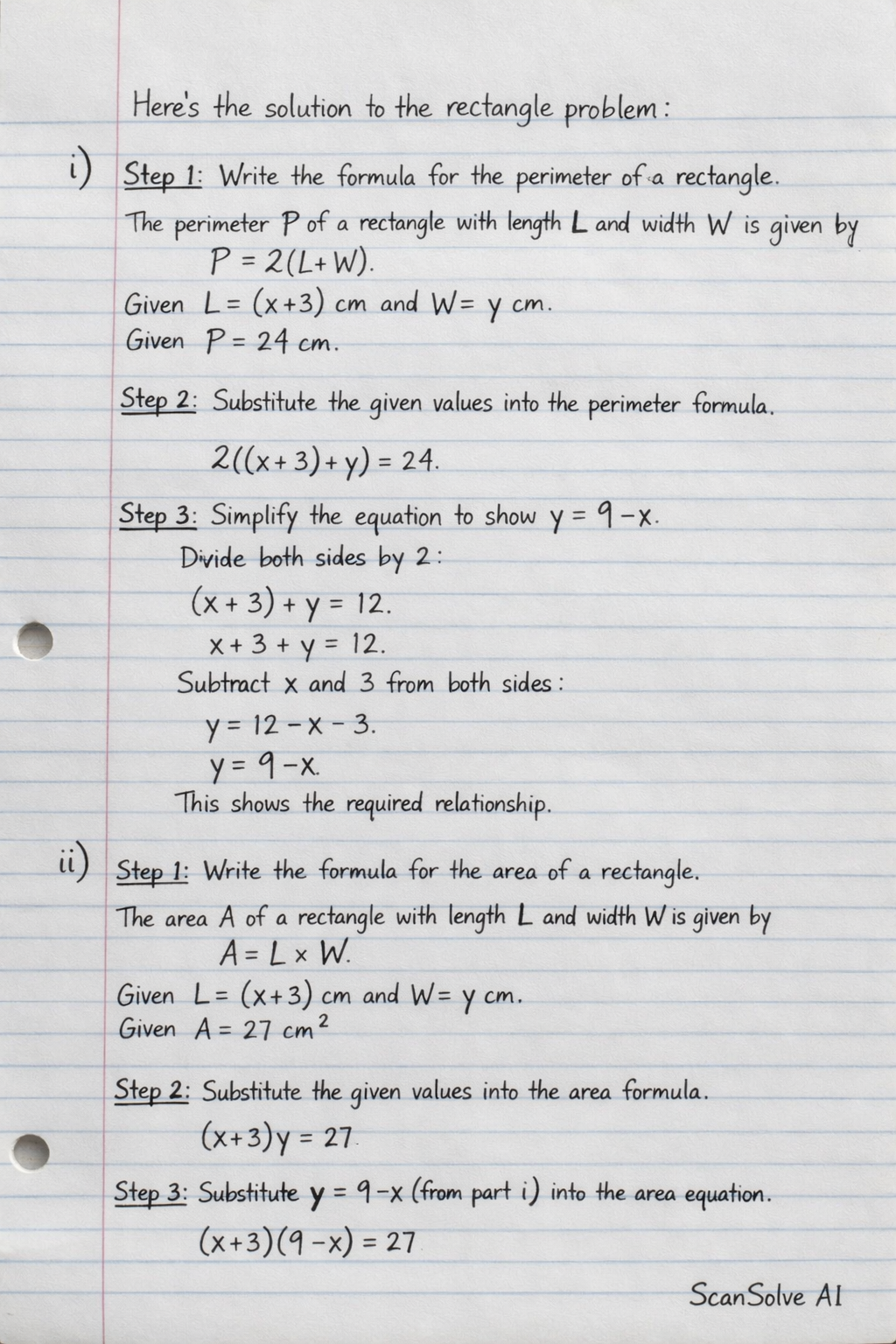
Handwritten Step-by-Step Solution
Get this as a handwritten image on WhatsApp — like a tutor wrote it for you.
Try on WhatsApp