
We read your photo as:
Verify if x=3 and y=1 satisfy the equation (x-j2y) - (y+1/jx) = 2+j.
Mathematics
ScanSolve AI Answer
Step-by-step solution
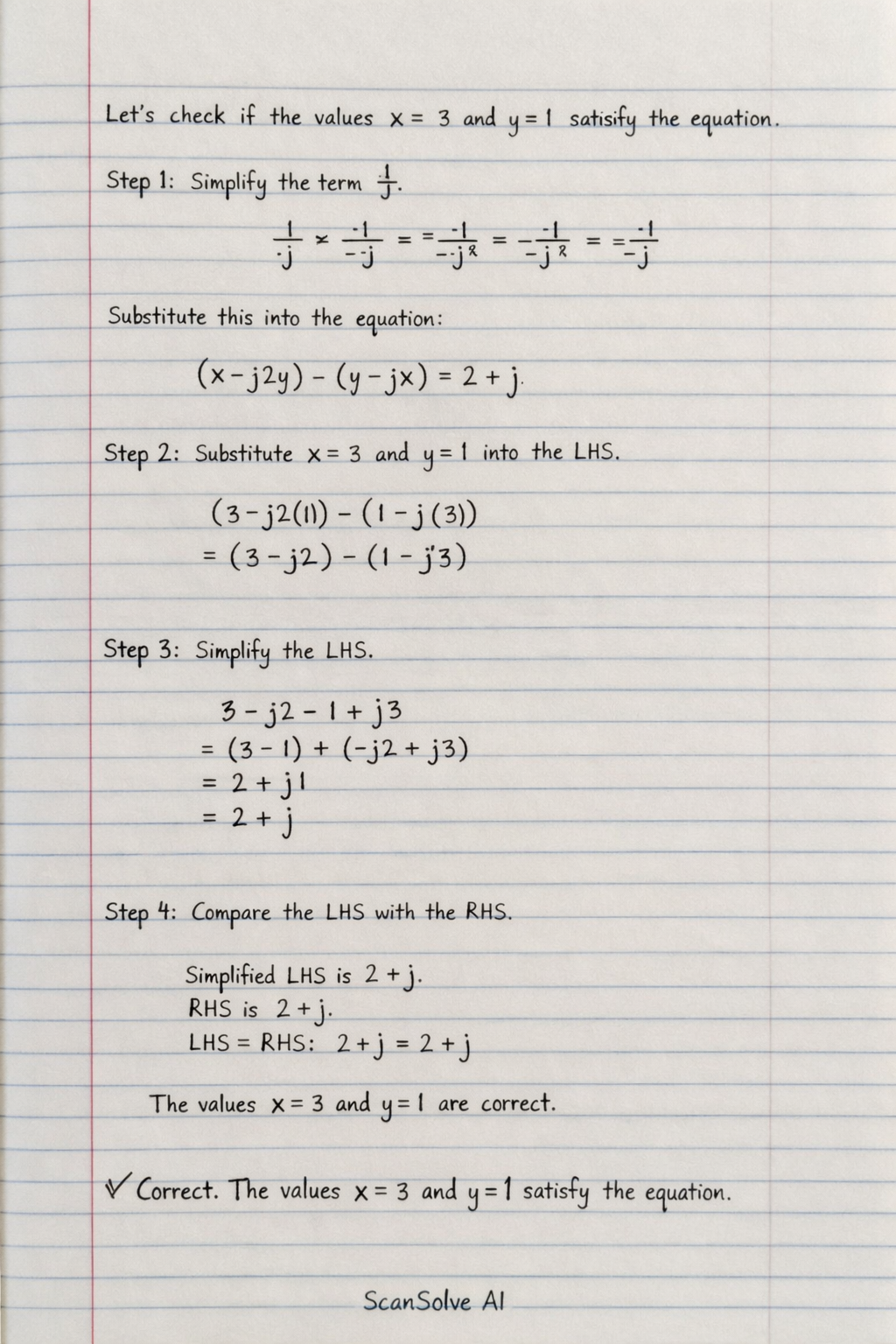
4 stepsLet's check if the given values for and satisfy the equation.
The given equation is:
The proposed values are and .
Simplify the term .
Now substitute this into the equation:
Substitute the proposed values and into the left-hand side (LHS) of the equation.
Simplify the LHS by performing the subtraction.
Group the real and imaginary parts:
Compare the simplified LHS with the right-hand side (RHS).
The simplified LHS is .
The RHS of the original equation is .
Since LHS = RHS (), the given values are correct.✅ Correct. The values and satisfy the equation.
Was this helpful?
Still stuck on this one?
Ask a follow-up, and the answer starts from this question.
Got a different question?Ask your own question
More Mathematics Questions
QSolve for x and y in the equation: jx(x+3y) = (3x+j4)(1+jy)QIf x and y are real, solve the equation: (jx)/(1+jy) = (3x+j4)/(x+3y)QSolve for x: 1.1.1 x(x−3)=0 1.1.2 2x2+1=4x 1.1.3 x2-2x−3>0 1.1.4 22x−2^x+2-32=0 1.1.5…QVerify if the couples (3; −2) and (0; 1) are solutions to the system (S) = x + 2y = 2 x − y = −1QSolve the equation (jx)/(1+jy) = (3x+j4)/(x+3y) and express z = (a+jb)/(c+jd) in the form X+jY.
Handwritten Step-by-Step Solution
Get this as a handwritten image on WhatsApp — like a tutor wrote it for you.
Try on WhatsApp