We read your photo as:

If y = sinh(ksin⁻¹x), show that (1-x²)y'' - xy' - k²y = 0

Mathematics

ScanSolve AI Answer

Step-by-step solution

7 steps
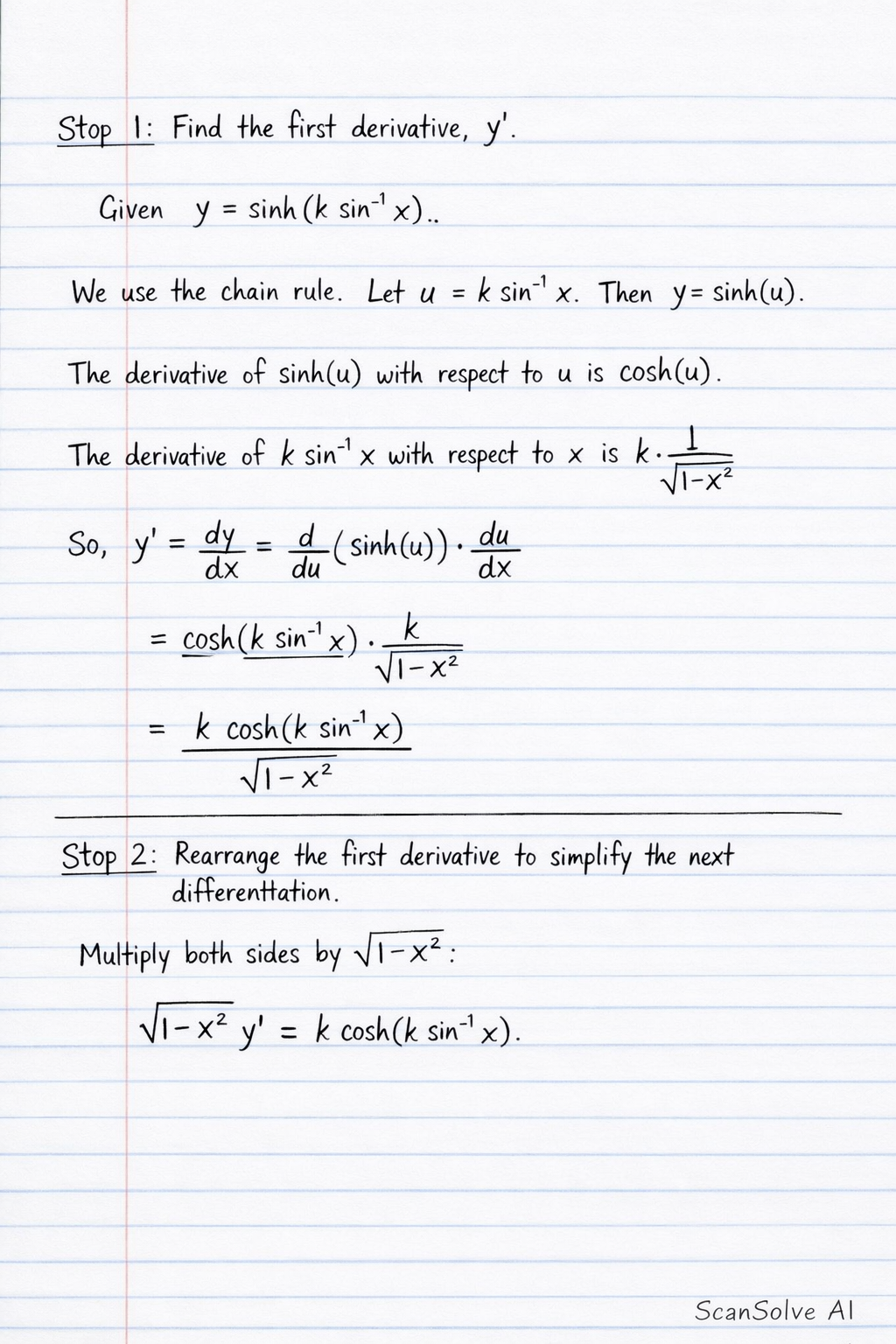
  1. Find the first derivative, y′y'.

    Given y=sinh⁡(ksin⁡−1x)y = \sinh(k \sin^{-1} x).
    We use the chain rule. Let u=ksin⁡−1xu = k \sin^{-1} x. Then y=sinh⁡(u)y = \sinh(u).
    The derivative of sinh⁡(u)\sinh(u) with respect to uu is cosh⁡(u)\cosh(u).
    The derivative of ksin⁡−1xk \sin^{-1} x with respect to xx is k⋅11−x2k \cdot \frac{1}{\sqrt{1-x^2}}.
    So, y′=dydx=ddu(sinh⁡(u))⋅dudx=cosh⁡(ksin⁡−1x)⋅k1−x2y' = \frac{dy}{dx} = \frac{d}{du}(\sinh(u)) \cdot \frac{du}{dx} = \cosh(k \sin^{-1} x) \cdot \frac{k}{\sqrt{1-x^2}}.

    y′=kcosh⁡(ksin⁡−1x)1−x2y' = \frac{k \cosh(k \sin^{-1} x)}{\sqrt{1-x^2}}
  2. Rearrange the first derivative to simplify the next differentiation.

    Multiply both sides by 1−x2\sqrt{1-x^2}:

    1−x2y′=kcosh⁡(ksin⁡−1x)\sqrt{1-x^2} y' = k \cosh(k \sin^{-1} x)
  3. Differentiate both sides of the rearranged equation with respect to xx.

    On the left side, use the product rule: ddx(uv)=u′v+uv′\frac{d}{dx}(uv) = u'v + uv'.
    Let u=1−x2u = \sqrt{1-x^2} and v=y′v = y'.
    dudx=12(1−x2)−1/2(−2x)=−x1−x2\frac{du}{dx} = \frac{1}{2}(1-x^2)^{-1/2}(-2x) = \frac{-x}{\sqrt{1-x^2}}.
    dvdx=y′′\frac{dv}{dx} = y''.
    So, the left side becomes:

    −x1−x2y′+1−x2y′′\frac{-x}{\sqrt{1-x^2}} y' + \sqrt{1-x^2} y''

    On the right side, use the chain rule:
    ddx(kcosh⁡(ksin⁡−1x))=k⋅sinh⁡(ksin⁡−1x)⋅ddx(ksin⁡−1x)\frac{d}{dx}(k \cosh(k \sin^{-1} x)) = k \cdot \sinh(k \sin^{-1} x) \cdot \frac{d}{dx}(k \sin^{-1} x)

    =k⋅sinh⁡(ksin⁡−1x)⋅k1−x2=k2sinh⁡(ksin⁡−1x)1−x2= k \cdot \sinh(k \sin^{-1} x) \cdot \frac{k}{\sqrt{1-x^2}} = \frac{k^2 \sinh(k \sin^{-1} x)}{\sqrt{1-x^2}}
  4. Equate the differentiated left and right sides.

    −xy′1−x2+1−x2y′′=k2sinh⁡(ksin⁡−1x)1−x2\frac{-x y'}{\sqrt{1-x^2}} + \sqrt{1-x^2} y'' = \frac{k^2 \sinh(k \sin^{-1} x)}{\sqrt{1-x^2}}
  5. Substitute yy back into the equation.

    Recall that y=sinh⁡(ksin⁡−1x)y = \sinh(k \sin^{-1} x). Substitute this into the equation:

    −xy′1−x2+1−x2y′′=k2y1−x2\frac{-x y'}{\sqrt{1-x^2}} + \sqrt{1-x^2} y'' = \frac{k^2 y}{\sqrt{1-x^2}}
  6. Multiply the entire equation by 1−x2\sqrt{1-x^2} to clear the denominators.

    −xy′+(1−x2)y′′=k2y-x y' + (1-x^2) y'' = k^2 y
  7. Rearrange the terms to match the desired form.

    (1−x2)y′′−xy′−k2y=0(1-x^2) y'' - x y' - k^2 y = 0

    This proves the given differential equation.

Was this helpful?

Still stuck on this one?

Ask a follow-up, and the answer starts from this question.

Got a different question?Ask your own question
Handwritten step-by-step solution preview

Handwritten Step-by-Step Solution

Get this as a handwritten image on WhatsApp — like a tutor wrote it for you.

Try on WhatsApp