We read your photo as:

Find the image of the line 2y = x under the transformation with matrix operator (0 -1 / -1 0). Find the inverse of the matrix A, where A = (1 −1 1 / 2 1 -3 / 1 1 1). Hence solve the equations x − y + z = 7, 2x + y - 3z = -6, x + y + z = 4.

Mathematics

ScanSolve AI Answer

Answers

3 parts
i

y=2xy = 2x

1

(0,40,20,2−0,500,50,1−0,20,3)\begin{pmatrix} 0,4 & 0,2 & 0,2 \\ -0,5 & 0 & 0,5 \\ 0,1 & -0,2 & 0,3 \end{pmatrix}

2
2,4
-1,5
3,1

Step-by-step solution

10 steps

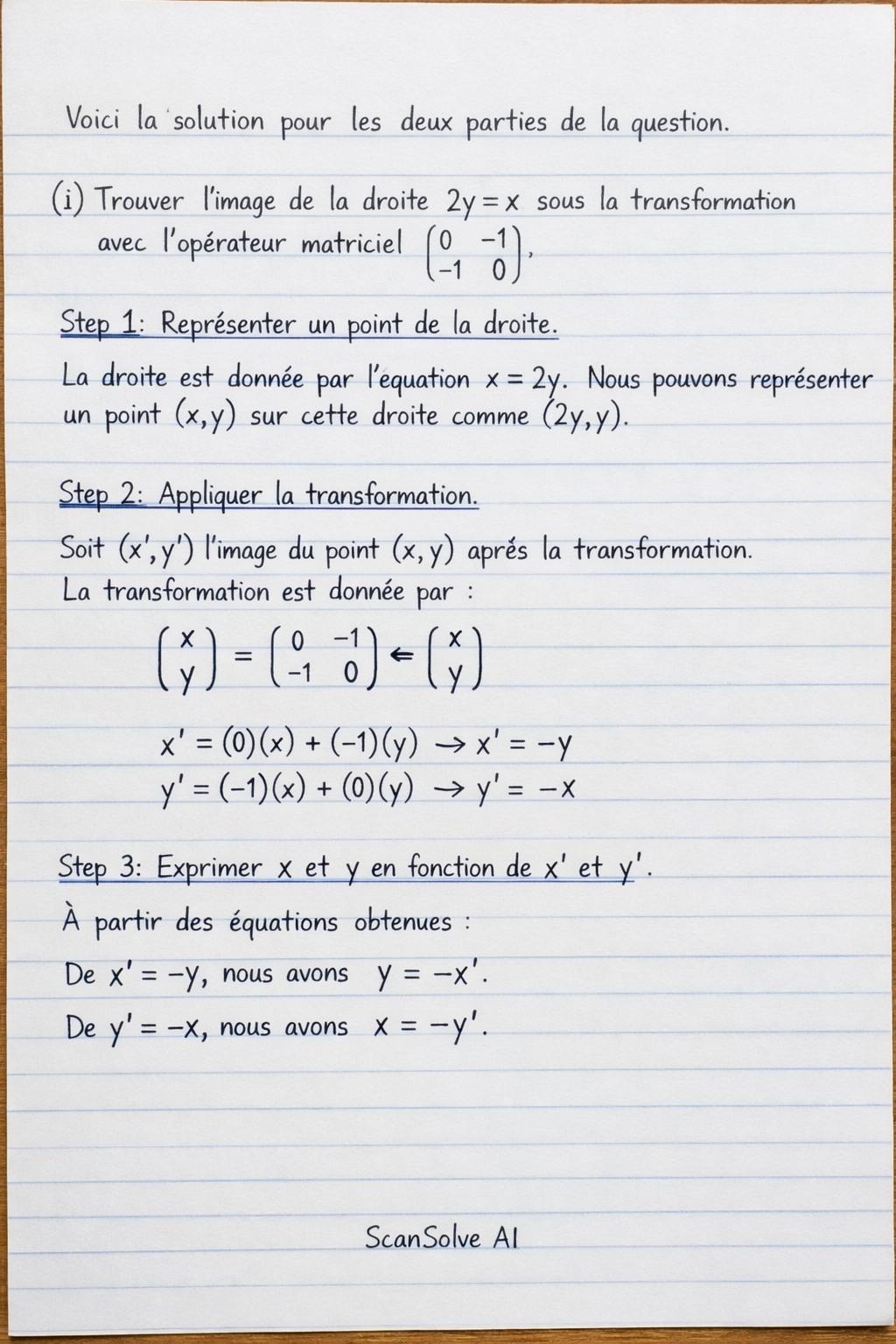
Voici la solution pour les deux parties de la question.

Part i· 4 steps

Trouver l'image de la droite 2y=x2y = x sous la transformation avec l'opérateur matriciel (0−1−10)\begin{pmatrix} 0 & -1 \\ -1 & 0 \end{pmatrix}

  1. Représenter un point de la droite.

    La droite est donnée par l'équation x=2yx = 2y. Nous pouvons représenter un point (x,y)(x, y) sur cette droite comme (2y,y)(2y, y).

  2. Appliquer la transformation.

    Soit (x′,y′)(x', y') l'image du point (x,y)(x, y) après la transformation. La transformation est donnée par :

    (x′y′)=(0−1−10)(xy)\begin{pmatrix} x' \\ y' \end{pmatrix} = \begin{pmatrix} 0 & -1 \\ -1 & 0 \end{pmatrix} \begin{pmatrix} x \\ y \end{pmatrix}

    Effectuons la multiplication matricielle :

    x′=(0)(x)+(−1)(y)  ⟹  x′=−yx' = (0)(x) + (-1)(y) \implies x' = -y y′=(−1)(x)+(0)(y)  ⟹  y′=−xy' = (-1)(x) + (0)(y) \implies y' = -x
  3. Exprimer xx et yy en fonction de x′x' et y′y'.

    À partir des équations obtenues :
    De x′=−yx' = -y, nous avons y=−x′y = -x'.
    De y′=−xy' = -x, nous avons x=−y′x = -y'.

  4. Substituer dans l'équation de la droite originale.

    L'équation de la droite originale est x=2yx = 2y. Nous substituons les expressions de xx et yy en termes de x′x' et y′y' :

    −y′=2(−x′)-y' = 2(-x') −y′=−2x′-y' = -2x'

    Multiplions les deux côtés par −1-1 :

    y′=2x′y' = 2x'

    L'image de la droite 2y=x2y = x sous la transformation donnée est y=2x\boxed{y = 2x}.

Part ii

Trouver l'inverse de la matrice AA, où A=(1−1121−3111)A = \begin{pmatrix} 1 & -1 & 1 \\ 2 & 1 & -3 \\ 1 & 1 & 1 \end{pmatrix}. Ensuite, résoudre les équations.

Part 1

(0,40,20,2−0,500,50,1−0,20,3)\begin{pmatrix} 0,4 & 0,2 & 0,2 \\ -0,5 & 0 & 0,5 \\ 0,1 & -0,2 & 0,3 \end{pmatrix}

Trouver l'inverse de la matrice AA

  1. Calculer le déterminant de AA.

    Le déterminant de la matrice AA est calculé comme suit :

    det(A)=1⋅∣1−311∣−(−1)⋅∣2−311∣+1⋅∣2111∣det(A) = 1 \cdot \begin{vmatrix} 1 & -3 \\ 1 & 1 \end{vmatrix} - (-1) \cdot \begin{vmatrix} 2 & -3 \\ 1 & 1 \end{vmatrix} + 1 \cdot \begin{vmatrix} 2 & 1 \\ 1 & 1 \end{vmatrix} det(A)=1((1)(1)−(−3)(1))+1((2)(1)−(−3)(1))+1((2)(1)−(1)(1))det(A) = 1((1)(1) - (-3)(1)) + 1((2)(1) - (-3)(1)) + 1((2)(1) - (1)(1)) det(A)=1(1+3)+1(2+3)+1(2−1)det(A) = 1(1 + 3) + 1(2 + 3) + 1(2 - 1) det(A)=1(4)+1(5)+1(1)det(A) = 1(4) + 1(5) + 1(1) det(A)=4+5+1det(A) = 4 + 5 + 1 det(A)=10det(A) = 10
  2. Calculer la matrice des cofacteurs CC.

    Les cofacteurs CijC_{ij} sont calculés comme (−1)i+jMij(-1)^{i+j} M_{ij}, où MijM_{ij} est le déterminant de la sous-matrice obtenue en supprimant la ii-ième ligne et la jj-ième colonne.

    C11=+∣1−311∣=1−(−3)=4C_{11} = +\begin{vmatrix} 1 & -3 \\ 1 & 1 \end{vmatrix} = 1 - (-3) = 4 C12=−∣2−311∣=−(2−(−3))=−5C_{12} = -\begin{vmatrix} 2 & -3 \\ 1 & 1 \end{vmatrix} = -(2 - (-3)) = -5 C13=+∣2111∣=2−1=1C_{13} = +\begin{vmatrix} 2 & 1 \\ 1 & 1 \end{vmatrix} = 2 - 1 = 1 C21=−∣−1111∣=−(−1−1)=2C_{21} = -\begin{vmatrix} -1 & 1 \\ 1 & 1 \end{vmatrix} = -(-1 - 1) = 2 C22=+∣1111∣=1−1=0C_{22} = +\begin{vmatrix} 1 & 1 \\ 1 & 1 \end{vmatrix} = 1 - 1 = 0 C23=−∣1−111∣=−(1−(−1))=−2C_{23} = -\begin{vmatrix} 1 & -1 \\ 1 & 1 \end{vmatrix} = -(1 - (-1)) = -2 C31=+∣−111−3∣=3−1=2C_{31} = +\begin{vmatrix} -1 & 1 \\ 1 & -3 \end{vmatrix} = 3 - 1 = 2 C32=−∣112−3∣=−(−3−2)=5C_{32} = -\begin{vmatrix} 1 & 1 \\ 2 & -3 \end{vmatrix} = -(-3 - 2) = 5 C33=+∣1−121∣=1−(−2)=3C_{33} = +\begin{vmatrix} 1 & -1 \\ 2 & 1 \end{vmatrix} = 1 - (-2) = 3

    La matrice des cofacteurs est :

    C=(4−5120−2253)C = \begin{pmatrix} 4 & -5 & 1 \\ 2 & 0 & -2 \\ 2 & 5 & 3 \end{pmatrix}
  3. Calculer la matrice adjointe (ou adjugée) adj(A)adj(A).

    La matrice adjointe est la transposée de la matrice des cofacteurs :

    adj(A)=CT=(422−5051−23)adj(A) = C^T = \begin{pmatrix} 4 & 2 & 2 \\ -5 & 0 & 5 \\ 1 & -2 & 3 \end{pmatrix}
  4. Calculer l'inverse de la matrice AA.

    L'inverse de AA est A−1=1det(A)adj(A)A^{-1} = \frac{1}{det(A)} adj(A).

    A−1=110(422−5051−23)A^{-1} = \frac{1}{10} \begin{pmatrix} 4 & 2 & 2 \\ -5 & 0 & 5 \\ 1 & -2 & 3 \end{pmatrix} A−1=(0,40,20,2−0,500,50,1−0,20,3)A^{-1} = \boxed{\begin{pmatrix} 0,4 & 0,2 & 0,2 \\ -0,5 & 0 & 0,5 \\ 0,1 & -0,2 & 0,3 \end{pmatrix}}

Part 22,4

Résoudre le système d'équations

  1. Écrire le système d'équations sous forme matricielle.

    Le système d'équations est :
    x−y+z=7x - y + z = 7
    2x+y−3z=−62x + y - 3z = -6
    x+y+z=4x + y + z = 4
    Ceci peut être écrit comme AX=BAX = B, où :

    A=(1−1121−3111),X=(xyz),B=(7−64)A = \begin{pmatrix} 1 & -1 & 1 \\ 2 & 1 & -3 \\ 1 & 1 & 1 \end{pmatrix}, \quad X = \begin{pmatrix} x \\ y \\ z \end{pmatrix}, \quad B = \begin{pmatrix} 7 \\ -6 \\ 4 \end{pmatrix}

    Nous avons déjà trouvé l'inverse de AA. La solution est donnée par X=A−1BX = A^{-1}B.

  2. Multiplier A−1A^{-1} par BB.

    X=(xyz)=110(422−5051−23)(7−64)X = \begin{pmatrix} x \\ y \\ z \end{pmatrix} = \frac{1}{10} \begin{pmatrix} 4 & 2 & 2 \\ -5 & 0 & 5 \\ 1 & -2 & 3 \end{pmatrix} \begin{pmatrix} 7 \\ -6 \\ 4 \end{pmatrix}

    Effectuons la multiplication matricielle :

    x=110((4)(7)+(2)(−6)+(2)(4))=110(28−12+8)=110(24)=2,4x = \frac{1}{10} ((4)(7) + (2)(-6) + (2)(4)) = \frac{1}{10} (28 - 12 + 8) = \frac{1}{10} (24) = 2,4 y=110((−5)(7)+(0)(−6)+(5)(4))=110(−35+0+20)=110(−15)=−1,5y = \frac{1}{10} ((-5)(7) + (0)(-6) + (5)(4)) = \frac{1}{10} (-35 + 0 + 20) = \frac{1}{10} (-15) = -1,5 z=110((1)(7)+(−2)(−6)+(3)(4))=110(7+12+12)=110(31)=3,1z = \frac{1}{10} ((1)(7) + (-2)(-6) + (3)(4)) = \frac{1}{10} (7 + 12 + 12) = \frac{1}{10} (31) = 3,1

    La solution du système d'équations est :
    x=2,4x = \boxed{2,4}
    y=−1,5y = \boxed{-1,5}
    z=3,1z = \boxed{3,1}

Was this helpful?

Still stuck on this one?

Ask a follow-up, and the answer starts from this question.

Got a different question?Ask your own question
Handwritten step-by-step solution preview

Handwritten Step-by-Step Solution

Get this as a handwritten image on WhatsApp — like a tutor wrote it for you.

Try on WhatsApp